
You wake up. You remember a dream. You smell coffee brewing. You check your phone.
These are events. They happen one after another—successively. Sometimes, they happen at the exact same moment—simultaneously. But how do you know one thing happened before another? You might think, “Well, I just watched it happen.” But Kant has a radical proposition: you don’t learn what time is by watching things move. Experience itself wouldn’t exist without an internal sense of time already running in the background.
Example: The CPU Internal Rhythm
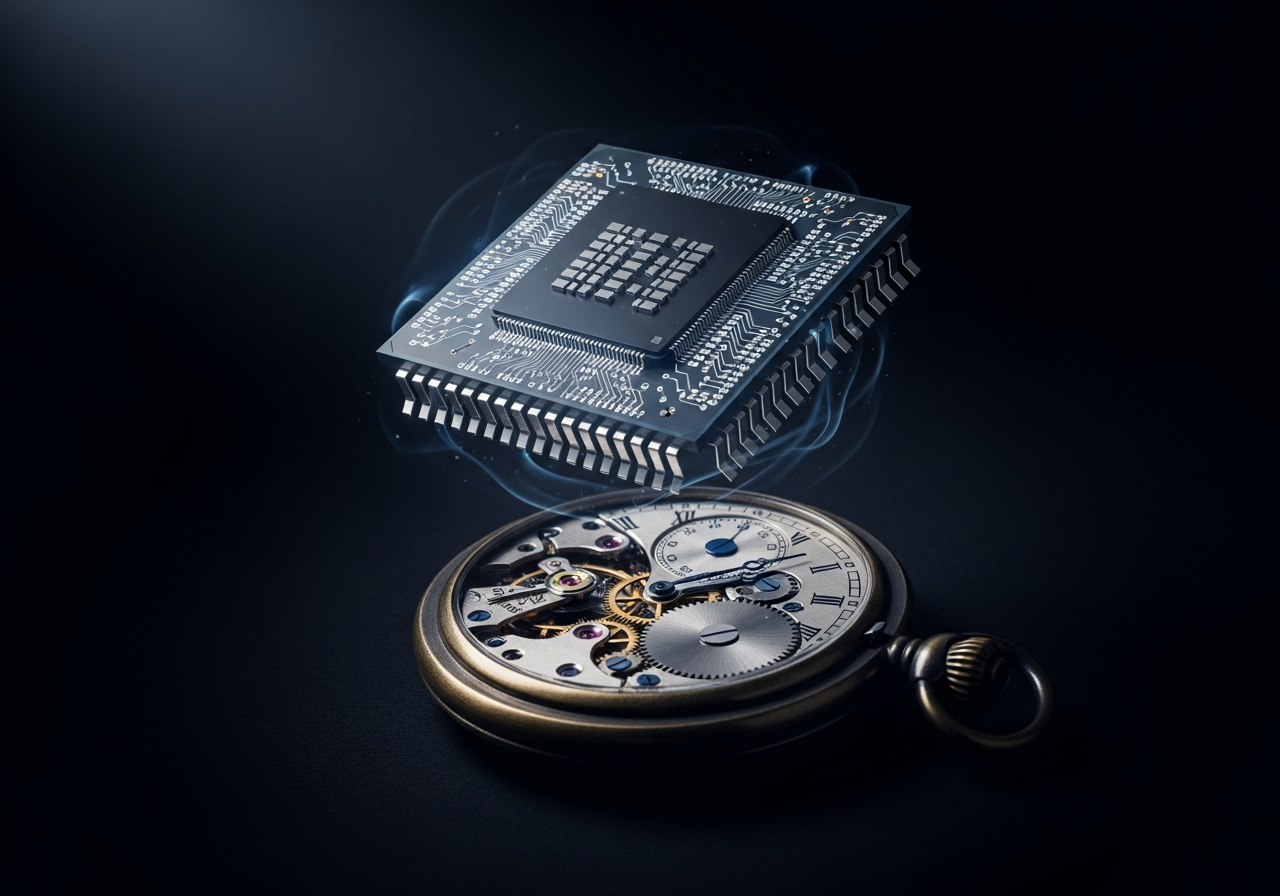
Imagine a computer processor receiving packets of data from a keyboard, mouse, and camera. The computer doesn’t look at a clock on the wall to know when to handle the data. The “tick-tock” is built right into the CPU—it’s the clock cycle.
Without that internal clock cycle, the data packets would be a static, chaotic pile of meaningless bits. The processor can’t experience “first this packet, then that packet” unless it already has an internal rhythm to slot them into. Time is your mind’s clock cycle.
Kant argues that Time is an a priori intuition. It isn’t a concept we pull out of the world; it is the fundamental “Inner Sense” that makes any thought or sensation possible.
“Time is not an empirical concept that has been derived from any experience… Only on the presupposition of time can we represent to ourselves a number of things as existing simultaneously or successively.”
If Kant is right, then Time is not something external we are passing through. It is the very structure of our subjectivity.
Having established Space as the pure form of outer sense, Kant now turns inward. How do we experience our own thoughts, feelings, and the succession of events?
| Term | Plain English | Kant's Core Definition |
|---|---|---|
| Time (Die Zeit) |
The processing clock of the mind. The necessary condition for experiencing "before," "after," or "at the same time." | An a priori intuition lying at the basis of all succession and simultaneity. |
| Inner Sense (Innere Sinn) |
The mind's capacity to observe its own internal states (thoughts, feelings). | The property of our mind by which we intuit ourselves and our inner state. |
/* Pure CSS override for markers! */
.diagram-container .mermaid *[id^="arrowhead"] path,
.diagram-container .mermaid marker path {
fill: #cccccc !important;
stroke: #cccccc !important;
}
/* Force transparent background on connecting arrow labels */
.diagram-container .mermaid .edgeLabel,
.diagram-container .mermaid .edgeLabel rect {
background-color: transparent !important;
fill: transparent !important;
}
/* Shift text labels hover above arrow lines to avoid intersections */
.diagram-container .mermaid .edgeLabel text {
transform: translateY(-20px);
}
%%{init: {
  "theme": "base",
  "themeVariables": {
    "fontFamily": "'IBM Plex Serif', 'IBM Plex Sans', serif",
    "textColor": "#e2e8f0",
    "lineColor": "#cccccc",
    "edgeLabelBackground": "transparent"
  }
}}%%
graph LR
    A[Perception of Succession/Simultaneity] -->|Requires framework| B[Time as an Underlying Basis]
    B -->|Therefore| C[Time is A Priori]
    D[Experience of Moving Objects] -.->|Empiricist Claim| E[Time is Empirical]
    C --|Rebuts| E
Time is not an empirical concept that has been derived from any experience... Only on the presupposition of time can we represent to ourselves a number of things as existing simultaneously or successively.
Time Transcendental Exp (§5) →
B 46 | A 30 1. Time is not an empirical concept that has been derived from any experience. For neither coexistence nor succession would ever come into our perception, if the representation of time did not lie a priori at the basis. Only on the presupposition of time can we represent to ourselves a number of things as existing at one and the same time (simultaneously) or at different times (successively).
Premise 1: We perceive succession (things happening one after another) and simultaneity (things happening at once) in experience.
Premise 2: We cannot perceive succession or simultaneity unless a framework for them (Time) already exists.
Conclusion: Therefore, Time is the a priori basis of experience, not derived from empirical observations.
Zeit (§5) →
| A30 |
AA IV 29
Zweiter Abschnitt. Von der Zeit.
§ 4. Metaphysische Erörterung des Begriffs der Zeit.
1. Die Zeit ist kein empirischer Begriff, der irgend von einer Erfahrung abgezogen worden wäre. Denn das Zugleichsein oder Aufeinanderfolgen würde selbst nicht in die Wahrnehmung kommen, wenn die Vorstellung der Zeit nicht a priori zum Grunde läge. Nur unter deren Voraussetzung kann man sich vorstellen: daß einiges zu einer und derselben Zeit (zugleich) oder in verschiedenen Zeiten (nacheinander) sei. |
Zeit (§5) →
| B46 |
AA III 57
Zweiter Abschnitt. Von der Zeit.
§ 4. Metaphysische Erörterung des Begriffs der Zeit.
1. Die Zeit ist kein empirischer Begriff, der irgend von einer Erfahrung abgezogen worden wäre. Denn das Zugleichsein oder Aufeinanderfolgen würde selbst nicht in die Wahrnehmung kommen, wenn die Vorstellung der Zeit nicht a priori zum Grunde läge. Nur unter deren Voraussetzung kann man sich vorstellen: daß einiges zu einer und derselben Zeit (zugleich) oder in verschiedenen Zeiten (nacheinander) sei. |
Leave a Reply
You must be logged in to post a comment.