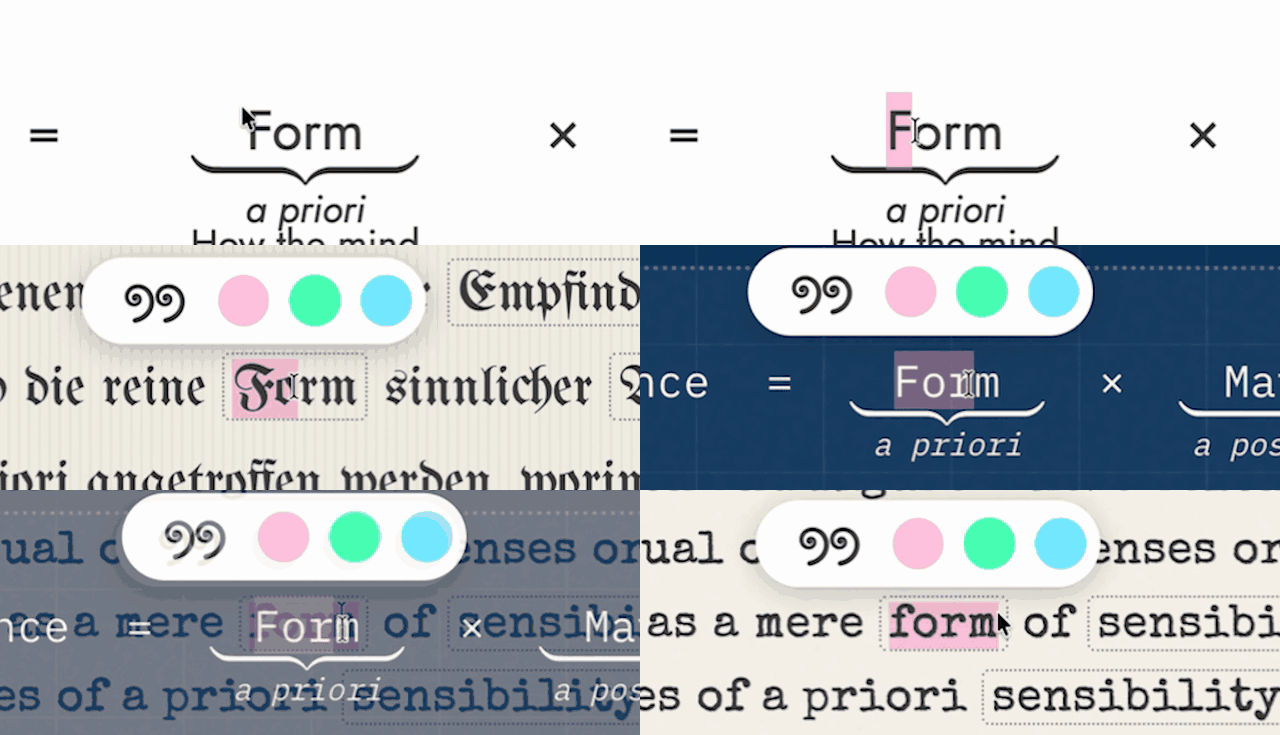
Welcome. This domain serves as my personal homepage, featuring details on my research. However, its primary role is an interactive experiment in reading difficult philosophy.
This project began with a failure of understanding.
I spent a year trying to read Kant’s Critique of Pure Reason like an ordinary book: steadily, patiently, page by page. I made almost no real progress.
Language was an obstacle—my German is limited—but the deeper problem was structural. You cannot read this text passively. You can move through the sentences without ever truly grasping the architecture of the argument or the necessity of its conclusions.
With texts like this, reading is not understanding. To follow the movement of thought, you need repetition and a way to rigorously test whether the argument is actually clear.
I took the usual secondary route: introductions, commentaries, and guides. They helped, but only up to a point. Whenever I returned to Kant himself, progress remained painfully slow.
This site is my answer to that problem.
Why this site exists
Serious reading is active, selective, and iterative. It is closer to learning physics than to consuming prose. A philosophical concept remains abstract until you test it, rephrase it, question it, and examine it from multiple angles.
Understanding is built through friction: back-and-forth correction, reformulation, and application. Without that work, deep intuition never forms. This blog is an experiment in a better way to read difficult philosophy.
Reading as practice
The goal is not passive consumption, but disciplined engagement through slow reading, structured return, and conceptual testing.
AI as instrument
The AI layer is not an oracle. It is a reading instrument grounded in the primary text, scholarship, and tools for logical analysis.
How the site is structured
The method is layered, so difficult material can be approached from several complementary angles rather than from a single summary.
The original text
The source remains central rather than being displaced by explanation.
Structural blueprints
Arguments and concepts are mapped so their internal relations become easier to follow.
Block-level analysis
Difficult passages are broken down into smaller units without losing their logic.
Interactive dialogue
Any sentence, passage, or concept can become the beginning of a focused inquiry.
What this project is trying to do
- Make difficult philosophy more navigable without making it superficial.
- Make it more discussable without flattening it into slogans.
- Create conditions for real understanding through structure, dialogue, and repeated clarification.
I am not offering summaries in place of reading. I am trying to build a better way to read: a system for entering difficult texts through structure, dialogue, and iterative clarification.