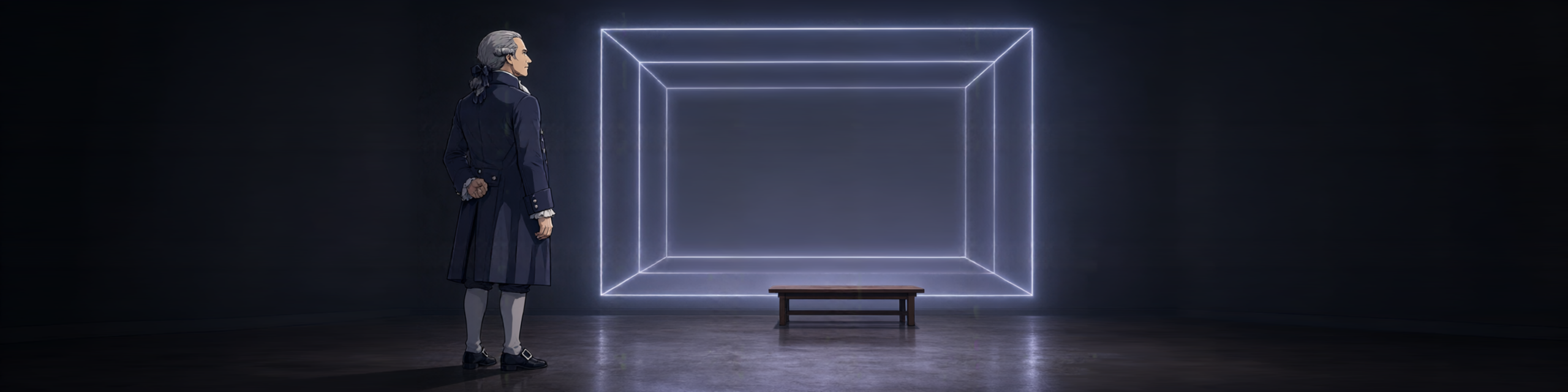
Look around the room. Everything you can see is somewhere — over there, behind that, a little to the left. Now try a small experiment. Empty the room. Empty the building, the city, the sky. Take away every object in the universe.
Can you make the space go too?
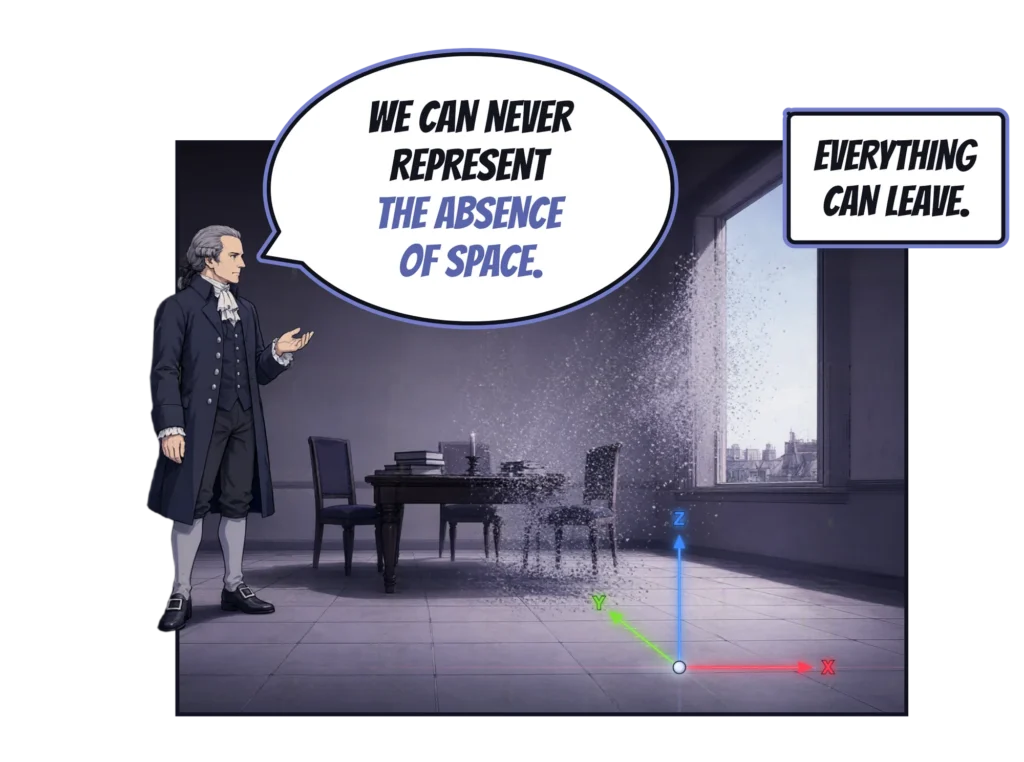
Most people find they can’t. You can imagine space with nothing in it. You cannot imagine there not being any. Kant puts it in one line: “We can never represent to ourselves the absence of space, though we can quite well think it as empty of objects.”
Last time we left Kant mid-promise. He had stripped experience down to its parts and said there were two pure forms holding the whole thing up. Here is the first of them. In 1781 there were two respectable answers to the question what is space? One camp said it was a real thing, a vast container that would still be there if every star went out. The other, following Leibniz, said it was nothing over and above the relations between things — this to the left of that, that further off than this. Kant thought both were wrong, and that the little failure of imagination you just had is the place to start. He doesn’t treat it as a quirk of your mind. He treats it as evidence about what space actually is.
Here is the conclusion he draws, stated flatly before we have earned it: space is not something you find in the world. It is something you bring to it. The rest of this piece is the argument.
Here is the move that does the work, and it is easier than it looks.
Think about the word chair. There are millions of chairs, and the word covers all of them. Each one is an instance that falls under the word. That is what a general idea does: it sits above its examples and collects them.
Now think about space. When you talk about “the space in this room” and “the space in the next room,” you are not naming two instances of a general thing. You are pointing at two regions inside one single space — carved out of it, like two shapes cut from the same sheet. There is only ever one.
Example: The Word and the Sheet
A word is a container of examples: chairs fall under “chair,” and you can always add another one.
A sheet of paper is a container of parts: every shape you cut is taken out of the one sheet, and the sheet came first.
Kant’s claim is that space behaves like the sheet, not like the word. And nothing that behaves like the sheet can be a general idea we learned by noticing things. It has to be something we bring.
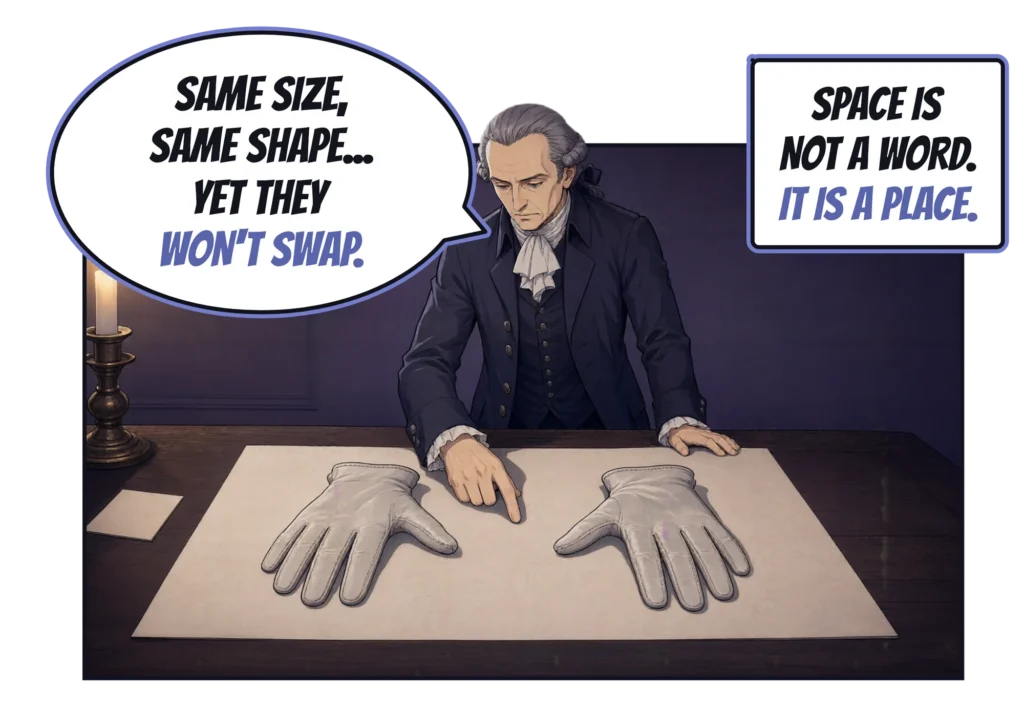
Kant had a sharper test, and you can try it with what you are wearing. Take a pair of gloves. Measure the left one: every length, every angle, every curve. Now measure the right one. The numbers come out the same, and you could write a description of one that fits the other word for word. And still the left glove will not go on the right hand. Kant used exactly this example two years after the Critique, in the Prolegomena, and drew the lesson that no concept, however detailed, can capture the difference. It shows up only when you put the two gloves in space, as parts of one whole: left and right make sense only within it.
The same lesson holds for two identical boxes. Kant notes that the idea of a cubic foot is “throughout one and the same” however often you think it, and yet two cubic feet are two, “by the mere difference of their locations”. The difference is not in the idea. It is in the space.
That is the whole of §2, in four arguments. Two of them show that space comes before experience rather than out of it: you cannot even see something as “over there” unless you already have a there. Two show that it is a single given whole rather than a general idea. Put together: space is not a concept you acquired. It is the standing condition under which anything can show up as being anywhere at all.
In 1787, six years after the first edition, Kant gave this chapter a new section. He was clear that he had not changed his mind: in the new preface he says he found “nothing to alter” in the propositions or their proofs, only in the “mode of exposition”. The geometry point had been squeezed into a few lines of the first edition. Now it got a section of its own, and the argument runs from something nobody disputes.
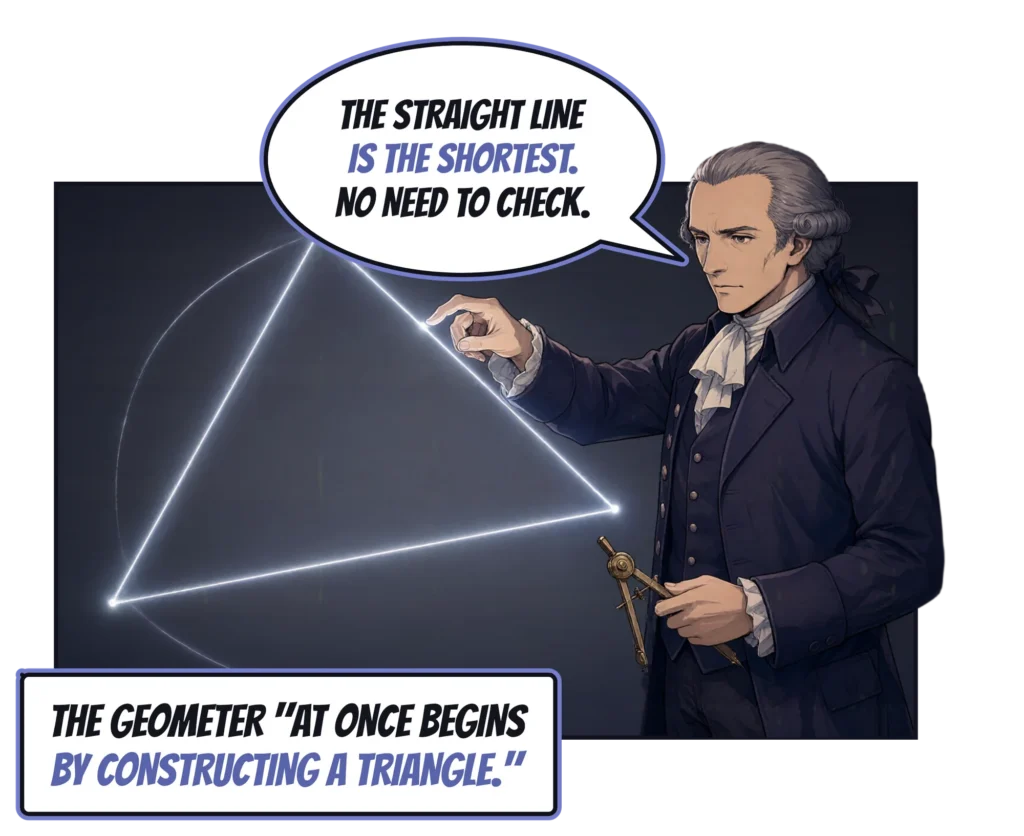
Geometry works. Not usually, not so far. Kant’s own example, from the Introduction, is that a straight line is the shortest path between two points. There is no corner of the universe where a counterexample might be waiting. You did not check. You could not have checked. You know it anyway.
Kant asks the obvious question that almost nobody asks: how?
It cannot come from experience. Experience can only ever say what the first edition said it would: “so far as hitherto observed, no space has been found which has more than three dimensions.” That is a report, not a law, and geometry is not a report. And it cannot come from unpacking the definition of a straight line either, because, as Kant puts it, “my concept of straight contains nothing of quantity”. Nothing about shortest is in there. A philosopher can stare at the concept of a triangle forever and get nothing new out of it. A geometer, Kant says, “at once begins by constructing a triangle”. You have to draw the thing, even if only in your head.
So there is something you have access to, before you look at anything, that is structured enough to prove theorems about. Kant’s answer is that you are not consulting the world. You are consulting the form your own outer sense has — and it has that form before any object arrives in it.
“This intuition must be found in us prior to any perception of an object, and must therefore be pure, not empirical, intuition.”
And it is why the drawing in your head binds the world outside it. Every object you will ever meet has to show up in that same space, so what holds of the triangle you constructed holds of every triangle you will find. Kant was confident enough to call his conclusion — that space is a form of our own intuition — “not merely possible or probable, but indubitably certain”. It is a strange and rather beautiful conclusion: the reliability of geometry is evidence about you.
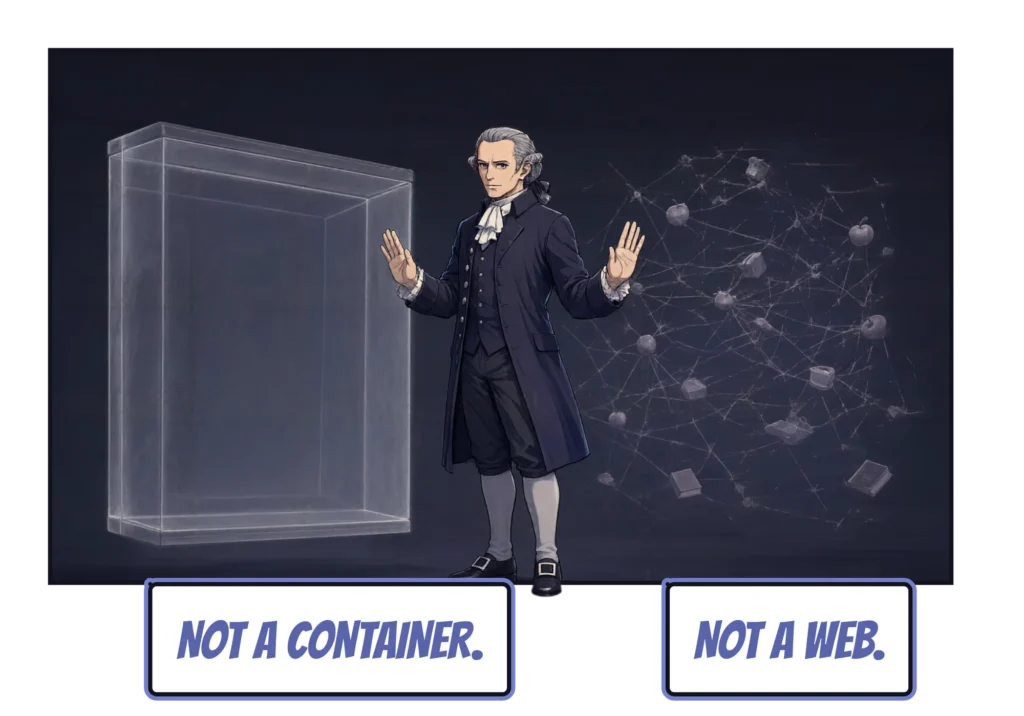
Now go back to the two answers Kant inherited. Space is a giant container. Or space is a web of relations between things. They look like opposites, and Kant disposes of both with one sentence: no feature of a thing, “whether absolute or relative”, can be known before the thing itself is there.
Think about what that rules out. If space were a property of the world, or the pattern of relations between the things in it, you would have to meet the world first and find space out afterwards, the way you find out that a stone is heavy. But we have just seen that you have space before you meet anything. You can’t even see the stone as over there without it. And something you have before you meet the world cannot be a report about the world.
Kant also says what each rival costs. The container view leaves you believing in “two eternal and infinite self-subsistent non-entities”, space and time, enormous somethings that contain everything real and are nothing real themselves. The relations view makes geometry a summary of what has been observed so far, so it has to give up the certainty of geometry, which is the one thing about space we are surest of. His own view keeps the certainty and needs neither of the invented somethings.
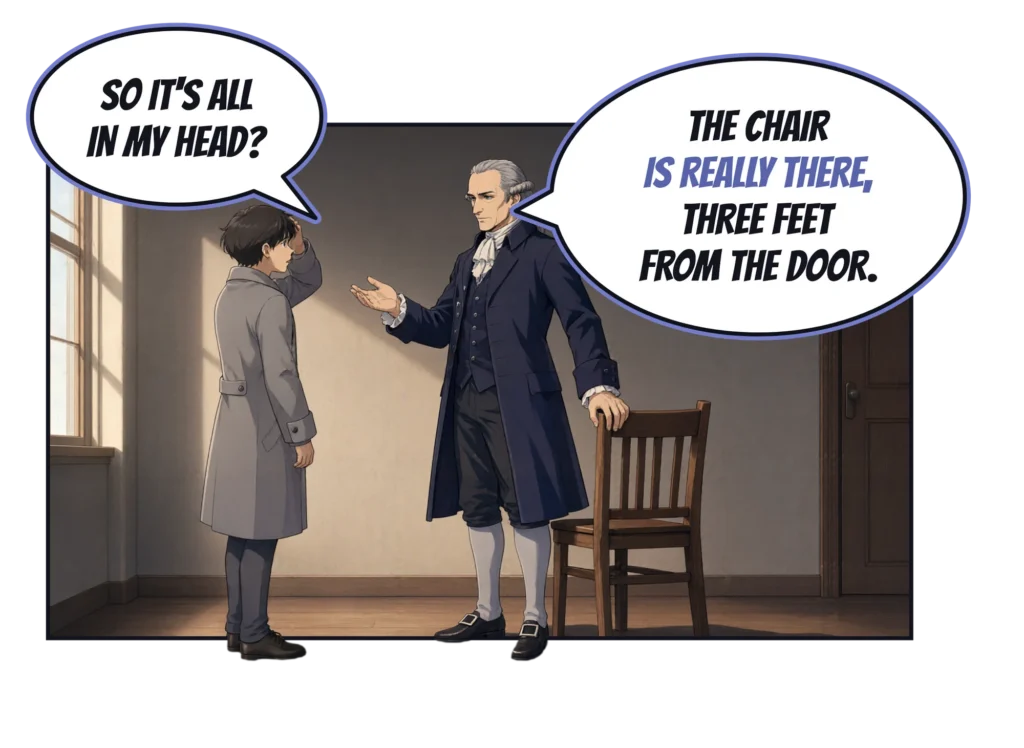
This is the point where every reader since 1781 has pushed back, and Kant knew it. If space is something we bring rather than something we find, isn’t the world we see just a projection? A hallucination with good frame rates?
No — and the reason matters more than the conclusion.
Kant was careful to put two claims side by side, and dropping either one gets him wrong. Space is empirically real: it holds, without exception, of every object that can ever be given to your senses. Nothing you will ever encounter escapes it. And space is transcendentally ideal: ask what is left of it once you subtract the condition of any possible experience, and the answer is nothing at all. It is, he says, “solely from the human standpoint that we can speak of space” — and he is honest enough to add that he cannot know whether other kinds of minds are bound by the same form.
Then he turns the worry around. “It would be my own fault,” he writes, “if out of that which I ought to reckon as appearance, I made mere illusion.” The view that slides into illusion is the other one. If space is a real thing that would still exist with everything removed from it, then the things in it start to look like shadows of something stranger, and Kant says that, faced with that, “we cannot blame the good Berkeley for degrading bodies to mere illusion.” Treat space as a form you bring and the problem goes away. The chair is really there, really in space, and really three feet from the door.
He even tells you which comparison to avoid. People reach for tastes and colours — well, a wine tastes different to different people, a rose looks different to different eyes, so space is like that. It is not. Those really are private sensations, they vary from person to person, and you can prove precisely nothing in advance about them. Space is the opposite case. It came from us, and that is exactly why it holds of everything, for everyone, without a single exception.
Which turns the worry inside out. Space being yours is not what makes the world less real to you. It is what makes the world legible to you at all — and it is the reason a proof you did in your head at school is binding on a galaxy you will never visit.
Next: the second of the two forms. Not the one you see things in, but the one you live in — time.
Section I of the Transcendental Aesthetic in full: the four arguments that space is an a priori intuition, the geometry argument Kant gave its own section in 1787, and the two conclusions that turn all of it into a claim about what space is. Where the 1781 and 1787 editions differ, both are mapped, and where Kant comes back to an argument later in the Critique, the later passage is quoted beside it.
Post one left off on a promise: there are two pure forms of sensible intuition, and Kant is about to examine them. This is the first — space.
He opens not with an answer but with a question, and it is worth reading slowly, because the whole section is built to answer it:
“What, then, are space and time? Are they real existences? Are they only determinations or relations of things, yet such as would belong to things even if they were not intuited? Or are space and time such that they belong only to the form of intuition, and therefore to the subjective constitution of our mind?”
These are not three abstract possibilities. Each had serious holders in 1781, and Kant names the first two himself a few pages later, in §7 (A39–40/B56–57), when he looks back at what the section has done to them:
| Space is… | Who held it | Kant’s verdict, in his words |
|---|---|---|
| a real existence — a self-standing container | “mathematical students of nature” (the Newtonian side) | They “have to admit two eternal and infinite self-subsistent non-entities”, there “only in order to contain in themselves all that is real” |
| a relation between things, which would hold even if nobody intuited them | “metaphysical students of nature” — Leibniz, whom Kant later says “intellectualised these forms of sensibility” (A275/B331) | Since for them space is “abstracted from experience”, they are “obliged to deny that a priori mathematical doctrines have any validity in respect of real things” |
| the form of our intuition | Kant | “On our theory of the true character of these two original forms of sensibility, both difficulties are removed.” |
Keep this table in view. Every argument below is aimed at one of the first two rows, and the two Conclusions at the end are Kant crossing them out.
His method for settling it is an exposition. In 1787 he defines the word before he uses it; the 1781 text simply says “wollen wir zuerst den Raum betrachten” — let us first consider space — with no definition and no section numbers.
| Term | Plain English | Kant’s own words |
|---|---|---|
| Exposition (Erörterung, expositio) |
Laying out what is already in a concept | “The clear, though not necessarily exhaustive, representation of that which belongs to a concept” (B38) |
| Metaphysical exposition (metaphysische Erörterung) |
Showing what kind of representation it is | “When it contains that which exhibits the concept as given a priori” (B38) |
| Transcendental exposition (transscendentale Erörterung) |
Showing what it makes possible | “The explanation of a concept, as a principle from which the possibility of other a priori synthetic knowledge can be understood” (B40) |
| Outer sense (äußerer Sinn) |
The capacity by which things show up as outside you | “By means of outer sense, a property of our mind, we represent to ourselves objects as outside us, and all without exception in space” (A22/B37) |
| Intuition vs concept (Anschauung / Begriff) |
A thing met directly, vs a common mark shared by many things | Intuition is “immediate representation” of objects (B41). A concept is “contained in an infinite number of different possible representations (as their common character)” (B40) |
| Synthetic vs analytic | Adds to a concept, vs unpacks it | Analytic: the predicate is “(covertly) contained” in the subject concept. Synthetic: it lies “outside the concept”, though connected with it (Introduction IV, A6–7/B10–11) |
| A priori, and how you can tell | Known independently of experience | “Necessity and strict universality are thus sure criteria of a priori knowledge” (Introduction II, B4) |
| Apodeictic (apodiktisch) |
Cannot be otherwise | “Bound up with the consciousness of their necessity” (B41) |
The two expositions ask different questions about the same concept, and that is the shape of the whole section: §2 asks what is this representation?, §3 asks what does having it let us do?
Two of the arguments establish that space is a priori; two that it is an intuition and not a concept. That is the entire division of labour.
| # | Claim | The move | Establishes |
|---|---|---|---|
| 1 | Space is not an empirical concept drawn from outer experience | To refer a sensation to something outside me, or to place two things “not only different but as in different places”, I must already have space. So space cannot be abstracted from that experience — “this outer experience is itself possible at all only through that representation”. | a priori |
| 2 | Space is a necessary a priori representation underlying all outer intuition | “We can never represent to ourselves the absence of space, though we can quite well think it as empty of objects.” Emptiness is thinkable; absence is not. So space is the condition of appearances, “and not as a determination dependent upon them”. | a priori |
| 3 | Space is not a general concept of relations but a pure intuition | There is only one space. What we call “spaces” are limitations of it — parts thought only in it, never building blocks it is assembled from. | intuition |
| 4 | Space is represented as an infinite given magnitude | A concept holds infinitely many representations under itself; no concept holds infinitely many within itself. Space does exactly that: “all the parts of space coexist ad infinitum”. | intuition |
Argument 4 is the one to sit with. The test is a structural one about containment, and it is what makes the conclusion unavoidable:
The four arguments are compressed to a paragraph each. Kant comes back to most of them later, and the later passages often show more clearly what the short version meant:
| Argument | Where | What the later passage adds |
|---|---|---|
| 1 — not abstracted | §7, A40/B57 | The relational view is named for what argument 1 denies: space as “relations abstracted from experience, and in this isolation confusedly represented”. |
| 2 — empty, never absent | Antinomy, note to A429/B457 | Thinking space empty is not perceiving an empty thing: “Space is merely the form of outer intuition (formal intuition). It is not a real object which can be outwardly intuited.” A relation of the world to infinite empty space is “the predicate of a mere thought-entity”. |
| 3 — one space, parts within | Amphiboly, A272/B328 | “The concept of a cubic foot of space, wherever and however often I think it, is in itself throughout one and the same. But two cubic feet are nevertheless distinguished in space by the mere difference of their locations (numero diversa)” — and those locations “do not, however, belong to the concept but entirely to sensibility”. |
| 3 — one space, parts within | Prolegomena §13 (1783), AA IV 285–86 | The left and right hand: equal and alike in every describable respect, yet a glove for one will not fit the other. The difference cannot be made intelligible “durch keinen einzigen Begriff”, only through the relation to the whole of space: “der Theil ist nur durchs Ganze möglich” — the part is possible only through the whole. |
| 3 — the triangle coda | Discipline of Pure Reason, A716–17/B744–45 | The philosopher “can analyse and clarify the concept of a straight line or of an angle… but he can never arrive at any properties not already contained in these concepts”. The geometer “at once begins by constructing a triangle”. |
The Prolegomena lines are quoted in Kant’s German from the Akademie edition, Prolegomena §13, AA IV 286; the gloss after the dash is our translation. The Critique passages are Kemp Smith (1929).
The A edition of 1781 runs five numbered arguments here; B in 1787 runs four. Kant’s own account of the revision, in the B Preface (Bxxxvii–xxxviii), is worth having before the table:
“In the propositions themselves and their proofs … I have found nothing to alter. … As to the mode of exposition, on the other hand, much still remains to be done; and in this edition I have sought to make improvements which should help in removing, first, the misunderstanding in regard to the Aesthetic, especially concerning the concept of time.”
So, by his own account, what moved was the exposition, not the doctrine — and the table bears that out, with one exception in argument 5 that is more than a rewording:
| A (1781) | B (1787) |
|---|---|
| Opening: “let us first consider space” — no definition, no § | §2 defines exposition and calls this one metaphysical |
| 1) not an empirical concept | 1) the same |
| 2) a necessary a priori representation | 2) the same |
| 3) on this necessity rests “the apodeictic certainty of all geometrical propositions”. Were space learned from experience, it would not be necessary “that there should be only one straight line between two points”; we could only say “that, so far as hitherto observed, no space has been found which has more than three dimensions” | — taken out of §2 and rebuilt as the new §3 |
| 4) not a discursive concept but a pure intuition, with the triangle coda | 3) the same, coda included |
| 5) an infinite given magnitude — argued from the progression of intuition: a general concept of space, “found alike in a foot and in an ell”, determines nothing about magnitude, and “if there were no limitlessness in the progression of intuition, no concept of relations could yield a principle of their infinitude” | 4) the same claim, but a different argument: the under/within test above, and an infinity that is given at once (“all the parts of space coexist”) rather than reached by going on |
| Closing remark: the taste of a wine and colours as “modifications of the sense of sight” | Rewritten: space is the only subjective representation of something outer that could be called “[at once] objective [and] a priori”, because only from it can synthetic a priori propositions be derived — and B now cites the new §3 for that |
Why rewrite argument 5? Kant does not say. One reading, plausible but interpretation, not text, draws on the note to the First Antinomy (A432/B460): there “the true transcendental concept of infinitude” is “that the successive synthesis of units required for the enumeration of a quantum can never be completed”, whereas the manifold of a world infinite in extension “is given as co-existing”. An infinity reached by an endless progression is exactly that never-completed series, so B moves the infinity of space into the simultaneous coexistence of its parts.
The metaphysical exposition told us what space is. The transcendental exposition asks what having it buys us, and Kant’s answer is the existence of geometry.
A transcendental exposition has two conditions, and Kant states them before he starts: “(1) that such knowledge does really flow from the given concept, (2) that this knowledge is possible only on the assumption of a given mode of explaining the concept.” The first paragraph of §3 meets the first condition; the last paragraph, with its “only explanation”, meets the second.
§3 also leans on two pages from the Introduction, cited in brackets in the text, and it is worth seeing what they say:
| §3 cites | What it establishes | Kant’s example |
|---|---|---|
| Introduction V (B14–17) | Geometry is synthetic: its propositions go beyond their concepts | “That the straight line between two points is the shortest, is a synthetic proposition. For my concept of straight contains nothing of quantity, but only of quality.” (B16) |
| Introduction II (B3–6) | Geometry is a priori: necessity cannot come from experience | Experience gives only “comparative universality, through induction” — “so far as we have hitherto observed, there is no exception to this or that rule”. (B3–4) |
Notice that the A edition’s argument 3 had already used exactly that inductive formula — “so far as hitherto observed, no space has been found which has more than three dimensions” — as a picture of what geometry would be reduced to if space were learned. §3 keeps the point and drops the picture. Geometry states things about space that are synthetic and yet hold a priori, and Kant runs that fact backwards into a condition on what space must be:
%%{init: {
  "theme": "base",
  "themeCSS": ".marker { fill:#ccc !important; stroke:#ccc !important; } .edge-thickness-normal { stroke:#ccc !important; }",
  "themeVariables": {
    "fontFamily": "'IBM Plex Serif','IBM Plex Sans',serif",
    "textColor": "#e2e8f0",
    "lineColor": "#cccccc",
    "edgeLabelBackground": "transparent"
  }
}}%%
flowchart TD
  G["Geometry is a real science
 it determines space synthetically"] --> S["Its propositions are synthetic
 they go beyond the concept"]
  G --> N["Its propositions are apodeictic
 e.g. space has three dimensions"]
  S -->|"no synthetic proposition
 comes from a mere concept"| I["So the representation of space
 must be an INTUITION"]
  N -->|"necessity cannot be
 read off experience"| P["So that intuition must be
 A PRIORI, found in us
 before any object"]
  I --> F["An intuition prior to all objects
 can only have its seat in the subject"]
  P --> F
  F --> C["Space is the FORM OF OUTER SENSE"]
Notice the direction of travel. Kant is not proving geometry from his theory of space; he is taking geometry as a settled fact and asking what space would have to be for that fact to be possible. As he puts it, only this explanation makes geometry intelligible — and any rival account “can by this criterion be distinguished from it with the greatest certainty”.
At the end of the Aesthetic (General Observations, A46–49/B63–66) Kant runs the same argument again, this time as an elimination — he says it will “set what has been said in §3 in a clearer light”. A synthetic, necessary proposition about space has to come from somewhere, and there are only four candidate sources:
| from concepts | from intuition | |
|---|---|---|
| a posteriori | only empirical propositions — no necessity | only empirical propositions — no necessity |
| a priori | “from mere concepts only analytic knowledge, not synthetic knowledge, is to be obtained” | the only source left — “You must therefore give yourself an object a priori in intuition” |
His test case is “Two straight lines cannot enclose a space”: try to get it out of the concepts of straight line and two, and “all your labour is vain”. And he states the result in stronger terms than §3 does: it is “not merely possible or probable, but indubitably certain” that space and time are merely subjective conditions of our intuition.
The same argument also explains why geometry applies to the physical world, which Kant works out in the Axioms of Intuition (A165/B206): because empirical intuition is possible only through the pure intuition of space, “what geometry asserts of pure intuition is therefore undeniably valid of empirical intuition”.
P1. Space is intuited a priori — that is, before and independently of any object.
P2. “No determinations, whether absolute or relative, can be intuited prior to the existence of the things to which they belong.”
∴ Space represents no property of things in themselves, and no relation among them.
The hinge is P2, and it is doing real work. Anything you can have before you meet an object cannot have come from that object. So if space is genuinely a priori, it is not something the world handed us.
Go back to the table at the top. P2 says whether absolute or relative, and those two words cross out both rival rows at once: an absolute determination (space as a property or container of things) and a relative one (space as the relations between things) are equally things you could only learn from the things. P1 is what §2 established. Geometry, notably, is not a premise here: (a) is stated in both editions, including 1781, where there is no §3.
P1. Space is nothing but the form of all appearances of outer sense — the subjective condition under which outer intuition is possible for us at all.
P2. The subject’s receptivity, its capacity to be affected by objects, must precede every intuition of those objects.
∴ The form of all appearances can be given in the mind prior to all actual perceptions — a priori.
The consequence is drawn at once: “It is, therefore, solely from the human standpoint that we can speak of space, of extended things, etc.” Two qualifications follow. First, Kant does not claim to know that every mind must intuit spatially — “we cannot judge in regard to the intuitions of other thinking beings, whether they are bound by the same conditions as those which limit our intuition”. Second, and this is the move learners usually miss, the restriction does not weaken the claim. It makes it unconditional:
“All things are side by side in space” — valid only under a limitation.
“All things, as outer appearances, are side by side in space” — “the rule is valid universally and without limitation.”
Once the condition is written into the subject of the judgment, it has no exceptions left.
Kant now states the two halves together, and they only make sense as a pair:
| Claim | What it rules out | |
|---|---|---|
| Empirical reality | Space is objectively valid for everything that can ever be given to our outer senses | That space is a dream, an illusion, or a private distortion |
| Transcendental ideality | Space is nothing at all once we drop the condition of possible experience | That space is a container the world sits in whether or not anyone is looking |
“We assert, then, the empirical reality of space, as regards all possible outer experience; and yet at the same time we assert its transcendental ideality — in other words, that it is nothing at all, immediately we withdraw the above condition, namely, its limitation to possible experience, and so look upon it as something that underlies things in themselves.”
The obvious objection is that this makes bodies illusions. Kant answers it in a passage added in 1787 (General Observations, B69–71), and the answer is a reversal:
“It would be my own fault, if out of that which I ought to reckon as appearance, I made mere illusion. That does not follow as a consequence of our principle of the ideality of all our sensible intuitions — quite the contrary.”
It is the view that space belongs to things in themselves that ends in illusion. Make space and time real, and you need “two infinite things, which are not substances, nor anything actually inhering in substances” that would go on existing “even although all existing things be removed” — and faced with that absurdity, Kant says, “we cannot blame the good Berkeley for degrading bodies to mere illusion.” The Refutation of Idealism (B274) makes the same point in one sentence: “Dogmatic idealism is unavoidable, if space be interpreted as a property that must belong to things in themselves… The ground on which this idealism rests has already been undermined by us in the Transcendental Aesthetic.”
Kant heads off the most tempting illustration: this is not the point that colours and tastes are subjective. Those are mere sensations, “changes in the subject, changes which may, indeed, be different for different men”, and they yield no a priori knowledge of anything. Space is the opposite case — subjective in origin, and for that very reason universally and necessarily valid for every object we can encounter. The two editions make the point differently. A uses the taste of a wine. B gives a criterion instead: there is “no other subjective representation from which we can derive a priori synthetic propositions, as we can from intuition in space (§3)”, so colours, sounds and heat “have no ideality” at all. The final paragraph, with the rose that looks different “to every observer”, is the same in both.
The limit drawn here is the one the whole Aesthetic closes on (B73): judgments based on pure intuition “can never extend beyond objects of the senses; they are valid only for objects of possible experience.”
Vermittelst des äußeren Sinnes (einer Eigenschaft unsres Gemüths)stellen wir uns Gegenstände als außer uns und diese insgesammt imRaume vor. Darin ist ihre Gestalt, Größe und Verhältniß gegen einanderbestimmt oder bestimmbar. Der innere Sinn, vermittelst dessen dasGemüth sich selbst oder seinen inneren Zustand anschauet, giebt zwar keineAnschauung von der Seele selbst als einem Object, allein es ist doch einebestimmte Form, unter der die Anschauung ihres innern Zustandes alleinmöglich ist, so daß alles, was zu den innern Bestimmungen gehört, inVerhältnissen der Zeit vorgestellt wird. Äußerlich kann die Zeit nicht angeschautwerden, so wenig wie der Raum als etwas in uns. Was sindnun Raum und Zeit? Sind es wirkliche Wesen? Sind es zwar nur Bestimmungenoder auch Verhältnisse der Dinge, aber doch solche, welcheihnen auch an sich zukommen würden, wenn sie auch nicht angeschautwürden; oder sind sie solche, die nur an der Form der Anschauung alleinhaften und mithin an der subjectiven Beschaffenheit unseres Gemüths,ohne welche die Prädicate gar keinem Dinge beigelegt werden können?Um uns hierüber zu belehren, wollen wir zuerst den Raum betrachten.
1) der Raum ist kein empirischer Begriff, der von äußeren Erfahrungenabgezogen worden. Denn damit gewisse Empfindungen auf etwasaußer mir bezogen werden (d. i. auf etwas in einem andern Orte desRaumes, als darin ich mich befinde), imgleichen damit ich sie als außereinander, mithin nicht blos verschieden, sondern als in verschiedenen Ortenvorstellen könne, dazu muß die Vorstellung des Raumes schon zum Grundeliegen. Demnach kann die Vorstellung des Raumes nicht aus den Verhältnissender äußern Erscheinung durch Erfahrung erborgt sein, sonderndiese äußere Erfahrung ist selbst nur durch gedachte Vorstellung allererstmöglich.
2) Der Raum ist eine nothwendige Vorstellung a priori, die allenäußeren Anschauungen zum Grunde liegt. Man kann sich niemals eineVorstellung davon machen, daß kein Raum sei, ob man sich gleich ganzwohl denken kann, daß keine Gegenstände darin angetroffen werden. Erwird also als die Bedingung der Möglichkeit der Erscheinungen und nichtals eine von ihnen abhängende Bestimmung angesehen und ist eine Vorstellunga priori, die nothwendiger weise äußeren Erscheinungen zumGrunde liegt.
3) Auf diese Nothwendigkeit a priori gründet sich die apodiktischeGewißheit aller geometrischen Grundsätze und die Möglichkeit ihrer Constructionena priori. Wäre nämlich diese Vorstellung des Raums eina posteriori erworbener Begriff, der aus der allgemeinen äußeren Erfahrunggeschöpft wäre, so würden die ersten Grundsätze der mathematischenBestimmung nichts als Wahrnehmungen sein. Sie hätten also alle Zufälligkeitder Wahrnehmung, und es wäre eben nicht nothwendig, daßzwischen zwei Punkten nur eine gerade Linie sei, sondern die Erfahrungwürde es so jederzeit lehren. Was von der Erfahrung entlehnt ist, hatauch nur comparative Allgemeinheit, nämlich durch Induction. Manwürde also nur sagen können: so viel zur Zeit noch bemerkt worden, istkein Raum gefunden worden, der mehr als drei Abmessungen hätte.
4) Der Raum ist kein discursiver oder, wie man sagt, allgemeinerBegriff von Verhältnissen der Dinge überhaupt, sondern eine reine Anschauung.Denn erstlich kann man sich nur einen einigen Raum vorstellen,und wenn man von vielen Räumen redet, so versteht man darunternur Theile eines und desselben alleinigen Raumes. Diese Theile könnenauch nicht vor dem einigen, allbefassenden Raume gleichsam als dessen Bestandtheile(daraus seine Zusammensetzung möglich sei) vorhergehen, sondernnur in ihm gedacht werden. Er ist wesentlich einig, das Mannigfaltigein ihm, mithin auch der allgemeine Begriff von Räumen überhauptberuht lediglich auf Einschränkungen. Hieraus folgt, daß in Ansehungseiner eine Anschauung a priori (die nicht empirisch ist) allen Begriffenvon demselben zum Grunde liege. So werden auch alle geometrischeGrundsätze, z. E. daß in einem Triangel zwei Seiten zusammen größersind als die dritte, niemals aus allgemeinen Begriffen von Linie undTriangel, sondern aus der Anschauung und zwar a priori mit apodiktischerGewißheit abgeleitet.
5) Der Raum wird als eine unendliche Größe gegeben vorgestellt.Ein allgemeiner Begriff vom Raum (der sowohl einem Fuße, als einerElle gemein ist) kann in Ansehung der Größe nichts bestimmen. Wärees nicht die Grenzenlosigkeit im Fortgange der Anschauung, so würde keinBegriff von Verhältnissen ein Principium der Unendlichkeit derselben beisich führen.
a) Der Raum stellt gar keine Eigenschaft irgend einiger Dinge ansich, oder sie in ihrem Verhältniß auf einander vor, d. i. keine Bestimmungderselben, die an Gegenständen selbst haftete, und welche bliebe, wennman auch von allen subjectiven Bedingungen der Anschauung abstrahirte.Denn weder absolute, noch relative Bestimmungen können vor dem Daseinder Dinge, welchen sie zukommen, mithin nicht a priori angeschaut werden.
b) Der Raum ist nichts anders, als nur die Form aller Erscheinungenäußerer Sinne, d. i. die subjective Bedingung der Sinnlichkeit,unter der allein uns äußere Anschauung möglich ist. Weil nun die Receptivitätdes Subjects, von Gegenständen afficirt zu werden, nothwendigerWeise vor allen Anschauungen dieser Objecte vorhergeht, so läßt sich verstehen,wie die Form aller Erscheinungen vor allen wirklichen Wahrnehmungen,mithin a priori im Gemüthe gegeben sein könne, und wie sie alseine reine Anschauung, in der alle Gegenstände bestimmt werden müssen,Principien der Verhältnisse derselben vor aller Erfahrung enthalten könne.Wir können demnach nur aus dem Standpunkte eines Menschenvom Raum, von ausgedehnten Wesen etc. reden. Gehen wir von der subjectivenBedingung ab, unter welcher wir allein äußere Anschauung bekommenkönnen, so wie wir nämlich von den Gegenständen afficiert werdenmögen, so bedeutet die Vorstellung vom Raume gar nichts. Dieses Prädicatwird den Dingen nur in so fern beigelegt, als sie uns erscheinen, d. i.Gegenstände der Sinnlichkeit sind. Die beständige Form dieser Receptivität,welche wir Sinnlichkeit nennen, ist eine nothwendige Bedingungaller Verhältnisse, darin Gegenstände als außer uns angeschauet werden,und wenn man von diesen Gegenständen abstrahirt, eine reine Anschauung,welche den Namen Raum führt. Weil wir die besonderen Bedingungender Sinnlichkeit nicht zu Bedingungen der Möglichkeit der Sachen, sondernnur ihrer Erscheinungen machen können, so können wir wohl sagen,daß der Raum alle Dinge befasse, die uns äußerlich erscheinen mögen,aber nicht alle Dinge an sich selbst, sie mögen nun angeschaut werden odernicht, oder auch von welchem Subject man wolle. Denn wir können vonden Anschauungen anderer denkenden Wesen gar nicht urtheilen, ob siean die nämlichen Bedingungen gebunden seien, welche unsere Anschauungeinschränken und für uns allgemein gültig sind. Wenn wir die Einschränkungeines Urtheils zum Begriff des Subjects hinzufügen, so giltdas Urtheil alsdann unbedingt. Der Satz: Alle Dinge sind neben einanderim Raum, gilt nur unter der Einschränkung, wenn diese Dinge alsGegenstände unserer sinnlichen Anschauung genommen werden. Füge ichhier die Bedingung zum Begriffe und sage: Alle Dinge als äußere Erscheinungensind neben einander im Raum, so gilt diese Regel allgemeinund ohne Einschränkung. Unsere Erörterungen lehren demnach die Realität(d. i. die objective Gültigkeit) des Raumes in Ansehung alles dessen,was äußerlich als Gegenstand uns vorkommen kann, aber zugleich dieIdealität des Raums in Ansehung der Dinge, wenn sie durch die Vernunftan sich selbst erwogen werden, d. i. ohne Rücksicht auf die Beschaffenheitunserer Sinnlichkeit zu nehmen. Wir behaupten also die empirischeRealität des Raumes (in Ansehung aller möglichen äußeren Erfahrung),obzwar zugleich die transscendentale Idealität desselben, d. i. daßer Nichts sei, so bald wir die Bedingung der Möglichkeit aller Erfahrungweglassen und ihn als etwas, was den Dingen an sich selbst zum Grundeliegt, annehmen.Es giebt aber auch außer dem Raum keine andere subjective undauf etwas äußeres bezogene Vorstellung, die a priori objectiv heißenkönnte; daher diese subjective Bedingung aller äußeren Erscheinungen mitkeiner andern kann verglichen werden. Der Wohlgeschmack eines Weinesgehört nicht zu den objectiven Bestimmungen des Weines, mithin eines Objectssogar als Erscheinung betrachtet, sondern zu der besondern Beschaffenheitdes Sinnes an dem Subjecte, was ihn genießt. Die Farben sind nichtBeschaffenheiten der Körper, deren Anschauung sie anhängen, sondernauch nur Modificationen des Sinnes des Gesichts, welches vom Lichte aufgewisse Weise afficirt wird. Dagegen gehört der Raum, als Bedingungäußerer Objecte, nothwendiger Weise zur Erscheinung oder Anschauungderselben. Geschmack und Farben sind gar nicht nothwendige Bedingungen,unter welchen die Gegenstände allein für uns Objecte der Sinne werdenkönnen. Sie sind nur als zufällig beigefügte Wirkungen der besondernOrganisation mit der Erscheinung verbunden. Daher sind sie auch keineVorstellungen a priori, sondern auf Empfindung, der Wohlgeschmack abersogar auf Gefühl (der Lust und Unlust) als einer Wirkung der Empfindunggegründet. Auch kann niemand a priori weder eine Vorstellung einerFarbe, noch irgend eines Geschmacks haben: der Raum aber betrifft nurdie reine Form der Anschauung, schließt also gar keine Empfindung(nichts Empirisches) in sich, und alle Arten und Bestimmungen desRaumes können und müssen sogar a priori vorgestellt werden können,wenn Begriffe der Gestalten sowohl, als Verhältnisse entstehen sollen.Durch denselben ist es allein möglich, daß Dinge für uns äußere Gegenständesind.Die Absicht dieser Anmerkung geht nur dahin, zu verhüten: daß mandie behauptete Idealität des Raumes nicht durch bei weitem unzulänglicheBeispiele zu erläutern sich einfallen lasse, da nämlich etwa Farben,Geschmack etc. mit Recht nicht als Beschaffenheiten der Dinge, sondernblos als Veränderungen unseres Subjects, die sogar bei verschiedenenMenschen verschieden sein können, betrachtet werden. Denn in diesemFalle gilt das, was ursprünglich selbst nur Erscheinung ist, z. B. eineRose, im empirischen Verstande für ein Ding an sich selbst, welches dochjedem Auge in Ansehung der Farbe anders erscheinen kann. Dagegen istder transscendentale Begriff der Erscheinungen im Raume eine kritischeErinnerung, daß überhaupt nichts, was im Raume angeschaut wird, eineSache an sich, noch daß der Raum eine Form der Dinge sei, die ihnenetwa an sich selbst eigen wäre, sondern daß uns die Gegenstände an sichgar nicht bekannt sind, und was wir äußere Gegenstände nennen, nichtsanders als bloße Vorstellungen unserer Sinnlichkeit sind, deren Form derRaum ist, deren wahres Correlatum aber, d. i. das Ding an sich selbst,dadurch gar nicht erkannt wird noch erkannt werden kann, nach welchemaber auch in der Erfahrung niemals gefragt wird.
Vermittelst des äußeren Sinnes (einer Eigenschaft unsres Gemüths)stellen wir uns Gegenstände als außer uns und diese insgesammt imRaume vor. Darin ist ihre Gestalt, Größe und Verhältniß gegen einanderbestimmt oder bestimmbar. Der innere Sinn, vermittelst dessendas Gemüth sich selbst oder seinen inneren Zustand anschauet, giebt zwarkeine Anschauung von der Seele selbst als einem Object; allein es ist docheine bestimmte Form, unter der die Anschauung ihres inneren Zustandesallein möglich ist, so daß alles, was zu den inneren Bestimmungen gehört,in Verhältnissen der Zeit vorgestellt wird. Äußerlich kann die Zeit nichtangeschaut werden, so wenig wie der Raum als etwas in uns. Was sindnun Raum und Zeit? Sind es wirkliche Wesen? Sind es zwar nur Bestimmungenoder auch Verhältnisse der Dinge, aber doch solche, welcheihnen auch an sich zukommen würden, wenn sie auch nicht angeschautwürden, oder sind sie solche, die nur an der Form der Anschauung alleinhaften und mithin an der subjectiven Beschaffenheit unseres Gemüths,ohne welche diese Prädicate gar keinem Dinge beigelegt werden können?Um uns hierüber zu belehren, wollen wir zuerst den Begriff des Raumeserörtern. Ich verstehe aber unter Erörterung (expositio) die deutliche(wenn gleich nicht ausführliche) Vorstellung dessen, was zu einem Begriffegehört; metaphysisch aber ist die Erörterung, wenn sie dasjenige enthält,was den Begriff als a priori gegeben darstellt.
1) Der Raum ist kein empirischer Begriff, der von äußeren Erfahrungenabgezogen worden. Denn damit gewisse Empfindungen auf etwasaußer mir bezogen werden (d. i. auf etwas in einem andern Orte desRaumes, als darin ich mich befinde), imgleichen damit ich sie als außerund neben einander, mithin nicht bloß verschieden, sondern als in verschiedenenOrten vorstellen könne, dazu muß die Vorstellung des Raumesschon zum Grunde liegen. Demnach kann die Vorstellung des Raumesnicht aus den Verhältnissen der äußern Erscheinung durch Erfahrung erborgtsein, sondern diese äußere Erfahrung ist selbst nur durch gedachteVorstellung allererst möglich.
2) Der Raum ist eine nothwendige Vorstellung a priori, die allenäußeren Anschauungen zum Grunde liegt. Man kann sich niemals eineVorstellung davon machen, daß kein Raum sei, ob man sich gleich ganzwohl denken kann, daß keine Gegenstände darin angetroffen werden. Erwird also als die Bedingung der Möglichkeit der Erscheinungen und nichtals eine von ihnen abhängende Bestimmung angesehen und ist eine Vorstellunga priori, die nothwendiger Weise äußeren Erscheinungen zumGrunde liegt.
3) Der Raum ist kein discursiver oder, wie man sagt, allgemeinerBegriff von Verhältnissen der Dinge überhaupt, sondern eine reine Anschauung.Denn erstlich kann man sich nur einen einigen Raum vorstellen,und wenn man von vielen Räumen redet, so versteht man darunternur Theile eines und desselben alleinigen Raumes. Diese Theile könnenauch nicht vor dem einigen allbefassenden Raume gleichsam als dessenBestandtheile (daraus seine Zusammensetzung möglich sei) vorhergehen,sondern nur in ihm gedacht werden. Er ist wesentlich einig, das Mannigfaltigein ihm, mithin auch der allgemeine Begriff von Räumen überhauptberuht lediglich auf Einschränkungen. Hieraus folgt, daß in Ansehungseiner eine Anschauung a priori (die nicht empirisch ist) allen Begriffenvon demselben zum Grunde liegt. So werden auch alle geometrischeGrundsätze, z. E. daß in einem Triangel zwei Seiten zusammengrößer sind, als die dritte, niemals aus allgemeinen Begriffen von Linieund Triangel, sondern aus der Anschauung und zwar a priori mit apodiktischerGewißheit abgeleitet.
4) Der Raum wird als eine unendliche gegebene Größe vorgestellt.Nun muß man zwar einen jeden Begriff als eine Vorstellung denken, diein einer unendlichen Menge von verschiedenen möglichen Vorstellungen(als ihr gemeinschaftliches Merkmal) enthalten ist, mithin diese unter sichenthält: aber kein Begriff als ein solcher kann so gedacht werden, als ober eine unendliche Menge von Vorstellungen in sich enthielte. Gleichwohlwird der Raum so gedacht (denn alle Theile des Raumes ins unendlichesind zugleich). Also ist die ursprüngliche Vorstellung vom Raume Anschauunga priori und nicht Begriff.
Ich verstehe unter einer transscendentalen Erörterung die Erklärungeines Begriffs als eines Princips, woraus die Möglichkeit anderersynthetischer Erkenntnisse a priori eingesehen werden kann. Zu dieserAbsicht wird erfordert: 1) daß wirklich dergleichen Erkenntnisse aus demgegebenen Begriffe herfließen, 2) daß diese Erkenntnisse nur unter derVoraussetzung einer gegebenen Erklärungsart dieses Begriffs möglich sind.Geometrie ist eine Wissenschaft, welche die Eigenschaften des Raumssynthetisch und doch a priori bestimmt. Was muß die Vorstellung desRaumes denn sein, damit eine solche Erkenntniß von ihm möglich sei? Ermuß ursprünglich Anschauung sein; denn aus einem bloßen Begriffe lassensich keine Sätze, die über den Begriff hinausgehen, ziehen, welches doch inder Geometrie geschieht (Einleitung V). Aber diese Anschauung mußa priori, d. i. vor aller Wahrnehmung eines Gegenstandes, in uns angetroffenwerden, mithin reine, nicht empirische Anschauung sein. Denn diegeometrischen Sätze sind insgesammt apodiktisch, d. i. mit dem Bewußtseinihrer Nothwendigkeit verbunden, z. B. der Raum hat nur drei Abmessungen;dergleichen Sätze aber können nicht empirische oder Erfahrungsurtheilesein, noch aus ihnen geschlossen werden (Einleit. II).Wie kann nun eine äußere Anschauung dem Gemüthe beiwohnen, dievor den Objecten selbst vorhergeht, und in welcher der Begriff der letzterena priori bestimmt werden kann? Offenbar nicht anders, als sofern siebloß im Subjecte, als die formale Beschaffenheit desselben von Objectenafficirt zu werden und dadurch unmittelbare Vorstellung derselben,d. i. Anschauung, zu bekommen, ihren Sitz hat, also nur als Form desäußeren Sinnes überhaupt.Also macht allein unsere Erklärung die Möglichkeit der Geometrieals einer synthetischen Erkenntniß a priori begreiflich. Eine jedeErklärungsart, die dieses nicht liefert, wenn sie gleich dem Anscheine nachmit ihr einige Ähnlichkeit hätte, kann an diesen Kennzeichen am sicherstenvon ihr unterschieden werden.
a) Der Raum stellt gar keine Eigenschaft irgend einiger Dinge ansich, oder sie in ihrem Verhältniß auf einander vor, d. i. keine Bestimmungderselben, die an Gegenständen selbst haftete, und welche bliebe, wenn manauch von allen subjectiven Bedingungen der Anschauung abstrahirte.Denn weder absolute, noch relative Bestimmungen können vor dem Daseinder Dinge, welchen sie zukommen, mithin nicht a priori angeschautwerden.
b) Der Raum ist nichts anders, als nur die Form aller Erscheinungenäußerer Sinne, d. i. die subjective Bedingung der Sinnlichkeit,unter der allein uns äußere Anschauung möglich ist. Weil nun die Receptivitätdes Subjects, von Gegenständen afficirt zu werden, nothwendigerWeise vor allen Anschauungen dieser Objecte vorhergeht, so läßt sichverstehen, wie die Form aller Erscheinungen vor allen wirklichen Wahrnehmungen,mithin a priori im Gemüthe gegeben sein könne, und wie sieals eine reine Anschauung, in der alle Gegenstände bestimmt werdenmüssen, Principien der Verhältnisse derselben vor aller Erfahrung enthaltenkönne.Wir können demnach nur aus dem Standpunkte eines Menschen vomRaum, von ausgedehnten Wesen etc. reden. Gehen wir von der subjectivenBedingung ab, unter welcher wir allein äußere Anschauung bekommenkönnen, so wie wir nämlich von den Gegenständen afficirt werdenmögen, so bedeutet die Vorstellung vom Raume gar nichts. Dieses Prädicatwird den Dingen nur in so fern beigelegt, als sie uns erscheinen,d. i. Gegenstände der Sinnlichkeit sind. Die beständige Form dieser Receptivität,welche wir Sinnlichkeit nennen, ist eine nothwendige Bedingungaller Verhältnisse, darin Gegenstände als außer uns angeschauet werden,und wenn man von diesen Gegenständen abstrahirt , eine reine Anschauung,welche den Namen Raum führt. Weil wir die besonderen Bedingungender Sinnlichkeit nicht zu Bedingungen der Möglichkeit der Sachen,sondern nur ihrer Erscheinungen machen können, so können wir wohlsagen, daß der Raum alle Dinge befasse, die uns äußerlich erscheinenmögen, aber nicht alle Dinge an sich selbst, sie mögen nun angeschautwerden oder nicht, oder auch von welchem Subject man wolle. Denn wirkönnen von den Anschauungen anderer denkenden Wesen gar nicht urtheilen,ob sie an die nämlichen Bedingungen gebunden seien, welche unsereAnschauung einschränken und für uns allgemein gültig sind. Wenn wirdie Einschränkung eines Urtheils zum Begriff des Subjects hinzufügen,so gilt das Urtheil alsdann unbedingt. Der Satz: Alle Dinge sind nebeneinander im Raum, gilt unter der Einschränkung, wenn diese Dinge alsGegenstände unserer sinnlichen Anschauung genommen werden. Füge ichhier die Bedingung zum Begriffe und sage: Alle Dinge als äußere Erscheinungensind neben einander im Raum, so gilt diese Regel allgemeinund ohne Einschränkung. Unsere Erörterungen lehren demnach die Realität(d. i. die objective Gültigkeit) des Raumes in Ansehung allesdessen, was äußerlich als Gegenstand uns vorkommen kann, aber zugleichdie Idealität des Raums in Ansehung der Dinge, wenn sie durch dieVernunft an sich selbst erwogen werden, d. i. ohne Rücksicht auf die Beschaffenheitunserer Sinnlichkeit zu nehmen. Wir behaupten also die empirischeRealität des Raumes (in Ansehung aller möglichen äußerenErfahrung), obzwar die transscendentale Idealität desselben, d. i.daß er Nichts sei, so bald wir die Bedingung der Möglichkeit aller Erfahrungweglassen und ihn als etwas, was den Dingen an sich selbst zumGrunde liegt, annehmen.Es giebt aber auch außer dem Raum keine andere subjective und aufetwas Äußeres bezogene Vorstellung, die a priori objectiv heißen könnte.Denn man kann von keiner derselben synthetische Sätze a priori, wie vonder Anschauung im Raume herleiten (§ 3). Daher ihnen, genau zu reden,gar keine Idealität zukommt, ob sie gleich darin mit der Vorstellung desRaumes übereinkommen, daß sie bloß zur subjectiven Beschaffenheit derSinnesart gehören, z. B. des Gesichts, Gehörs, Gefühls, durch die Empfindungender Farben, Töne und Wärme, die aber, weil sie bloß Empfindungenund nicht Anschauungen sind, an sich kein Object, am wenigstena priori erkennen lassen.Die Absicht dieser Anmerkung geht nur dahin: zu verhüten, daß mandie behauptete Idealität des Raumes nicht durch bei weitem unzulänglicheBeispiele zu erläutern sich einfallen lasse, da nämlich etwa Farben, Geschmacketc. mit Recht nicht als Beschaffenheiten der Dinge, sondern bloß alsVeränderungen unseres Subjects, die sogar bei verschiedenen Menschenverschieden sein können, betrachtet werden. Denn in diesem Falle gilt das,was ursprünglich selbst nur Erscheinung ist, z. B. eine Rose, im empirischenVerstande für ein Ding an sich selbst, welches doch jedem Auge inAnsehung der Farbe anders erscheinen kann. Dagegen ist der transscendentaleBegriff der Erscheinungen im Raume eine kritische Erinnerung,daß überhaupt nichts, was im Raume angeschaut wird, eine Sachean sich, noch daß der Raum eine Form der Dinge sei, die ihnen etwa ansich selbst eigen wäre, sondern daß uns die Gegenstände an sich gar nichtbekannt seien, und, was wir äußere Gegenstände nennen, nichts andersals bloße Vorstellungen unserer Sinnlichkeit seien, deren Form der Raumist, deren wahres Correlatum aber, d. i. das Ding an sich selbst, dadurchgar nicht erkannt wird, noch erkannt werden kann, nach welchem aber auchin der Erfahrung niemals gefragt wird.
By means of outer sense, a property of our mind, we repre-sent to ourselves objects as outside us, and all without excep-tion in space. In space their shape, magnitude, and relation toone another are determined or determinable. Inner sense,by means of which the mind intuits itself or its inner state,yields indeed no intuition of the soul itself as an object; butthere is nevertheless a determinate form [namely, time] inwhich alone the intuition of inner states is possible, and every-thing which belongs to inner determinations is thereforerepresented in relations of time. Time cannot be outwardlyintuited, any more than space can be intuited as somethingin us. What, then, are space and time? Are they real exist-ences? Are they only determinations or relations of things, yetsuch as would belong to things even if they were not intuited?Or are space and time such that they belong only to the formof intuition, and therefore to the subjective constitution of ourmind, apart from which they could not be ascribed to anythingwhatsoever? In order to obtain light upon these questions,let us first give an exposition of the concept of space. Byexposition (expositio) I mean the clear, though not necessarilyexhaustive, representation of that which belongs to a concept:the exposition is metaphysical when it contains that whichexhibits the concept as given a priori.
1. Space is not an empirical concept which has been de-rived from outer experiences. For in order that certain sensa-tions be referred to something outside me (that is, to somethingin another region of space from that in which I find myself),and similarly in order that I may be able to represent them asoutside and alongside one another, and accordingly as notonly different but as in different places, the representation ofspace must be presupposed. The representation of space can-not, therefore, be empirically obtained from the relations ofouter appearance. On the contrary, this outer experience isitself possible at all only through that representation.
2. Space is a necessary a priori representation, whichunderlies all outer intuitions. We can never represent to our-selves the absence of space, though we can quite well think itas empty of objects. It must therefore be regarded as the con-dition of the possibility of appearances, and not as a determina-tion dependent upon them. It is an a priori representation,which necessarily underlies outer appearances.
3. Space is not a discursive or, as we say, general conceptof relations of things in general, but a pure intuition. For, in thefirst place, we can represent to ourselves only one space; andif we speak of diverse spaces, we mean thereby only parts ofone and the same unique space. Secondly, these parts cannotprecede the one all-embracing space, as being, as it were,constituents out of which it can be composed; on the contrary,they can be thought only as in it. Space is essentially one;the manifold in it, and therefore the general concept of spaces,depends solely on [the introduction of] limitations. Hence itfollows that an a priori, and not an empirical, intuition under-lies all concepts of space. For kindred reasons, geometricalpropositions, that, for instance, in a triangle two sidestogether are greater than the third, can never be derivedfrom the general concepts of line and triangle, but onlyfrom intuition, and this indeed a priori, with apodeicticcertainty.
4. Space is represented as an infinite given magnitude.Now every concept must be thought as a representationwhich is contained in an infinite number of different possiblerepresentations (as their common character), and whichtherefore contains these under itself; but no concept, as such,can be thought as containing an infinite number of representa-tions within itself. It is in this latter way, however, that spaceis thought; for all the parts of space coexist ad infinitum.Consequently, the original representation of space is an apriori intuition, not a concept.
I understand by a transcendental exposition the explana-tion of a concept, as a principle from which the possibilityof other a priori synthetic knowledge can be understood.For this purpose it is required (1) that such knowledge doesreally flow from the given concept, (2) that this knowledge ispossible only on the assumption of a given mode of explainingthe concept.Geometry is a science which determines the propertiesof space synthetically, and yet a priori. What, then, must beour representation of space, in order that such knowledgeof it may be possible? It must in its origin be intuition; forfrom a mere concept no propositions can be obtained whichgo beyond the concept — as happens in geometry (Introduc-tion, V). Further, this intuition must be a priori, that is,it must be found in us prior to any perception of an object,and must therefore be pure, not empirical, intuition. Forgeometrical propositions are one and all apodeictic, that is,are bound up with the consciousness of their necessity; forinstance, that space has only three dimensions. Such pro-positions cannot be empirical or, in other words, judgmentsof experience, nor can they be derived from any such judg-ments (Introduction, II).How, then, can there exist in the mind an outer intui-tion which precedes the objects themselves, and in whichthe concept of these objects can be determined a priori?Manifestly, not otherwise than in so far as the intuition hasits seat in the subject only, as the formal character of thesubject, in virtue of which, in being affected by objects, itobtains immediate representation, that is, intuition, of them;and only in so far, therefore, as it is merely the form of outersense in general.Our explanation is thus the only explanation that makesintelligible the possibility of geometry, as a body of a priorisynthetic knowledge. Any mode of explanation which fails todo this, although it may otherwise seem to be somewhatsimilar, can by this criterion be distinguished from it withthe greatest certainty.
(a) Space does not represent any property of things inthemselves, nor does it represent them in their relation toone another. That is to say, space does not represent anydetermination that attaches to the objects themselves, andwhich remains even when abstraction has been made of allthe subjective conditions of intuition. For no determina-tions, whether absolute or relative, can be intuited prior tothe existence of the things to which they belong, and none,therefore, can be intuited a priori.
(b) Space is nothing but the form of all appearancesof outer sense. It is the subjective condition of sensibility,under which alone outer intuition is possible for us. Since,then, the receptivity of the subject, its capacity to be affectedby objects, must necessarily precede all intuitions of theseobjects, it can readily be understood how the form of allappearances can be given prior to all actual perceptions, andso exist in the mind a priori, and how, as a pure intuition, inwhich all objects must be determined, it can contain, priorto all experience, principles which determine the relationsof these objects.It is, therefore, solely from the human standpoint thatwe can speak of space, of extended things, etc. If we departfrom the subjective condition under which alone we can haveouter intuition, namely, liability to be affected by objects,the representation of space stands for nothing whatsoever.This predicate can be ascribed to things only in so far as theyappear to us, that is, only to objects of sensibility. The con-stant form of this receptivity, which we term sensibility, is anecessary condition of all the relations in which objects canbe intuited as outside us; and if we abstract from theseobjects, it is a pure intuition, and bears the name of space.Since we cannot treat the special conditions of sensibility asconditions of the possibility of things, but only of their appear-ances, we can indeed say that space comprehends all thingsthat appear to us as external, but not all things in themselves,by whatever subject they are intuited, or whether they beintuited or not. For we cannot judge in regard to the intui-tions of other thinking beings, whether they are bound bythe same conditions as those which limit our intuition andwhich for us are universally valid. If we add to the concept ofthe subject of a judgment the limitation under which the judg-ment is made, the judgment is then unconditionally valid.The proposition, that all things are side by side in space, isvalid under the limitation that these things are viewed asobjects of our sensible intuition. If, now, I add the conditionto the concept, and say that all things, as outer appearances,are side by side in space, the rule is valid universally andwithout limitation. Our exposition therefore establishes thereality, that is, the objective validity, of space in respect ofwhatever can be presented to us outwardly as object, but alsoat the same time the ideality of space in respect of things whenthey are considered in themselves through reason, that is,without regard to the constitution of our sensibility. Weassert, then, the empirical reality of space, as regards allpossible outer experience; and yet at the same time weassert its transcendental ideality — in other words, that itis nothing at all, immediately we withdraw the above con-dition, namely, its limitation to possible experience, and solook upon it as something that underlies things in them-selves.With the sole exception of space there is no subjectiverepresentation, referring to something outer, which could beentitled [at once] objective [and] a priori. For there is no othersubjective representation from which we can derive a priorisynthetic propositions, as we can from intuition in space (§3).Strictly speaking, therefore, these other representations have noideality, although they agree with the representation of space inthis respect, that they belong merely to the subjective constitu-tion of our manner of sensibility, for instance, of sight, hearing,touch, as in the case of the sensations of colours, sounds, andheat, which, since they are mere sensations and not intuitions,do not of themselves yield knowledge of any object, least ofall any a priori knowledge.The above remark is intended only to guard anyone fromsupposing that the ideality of space as here asserted can beillustrated by examples so altogether insufficient as colours,taste, etc. For these cannot rightly be regarded as propertiesof things, but only as changes in the subject, changes whichmay, indeed, be different for different men. In such examplesas these, that which originally is itself only appearance, forinstance, a rose, is being treated by the empirical understand-ing as a thing in itself, which, nevertheless, in respect of itscolour, can appear differently to every observer. The tran-scendental concept of appearances in space, on the other hand,is a critical reminder that nothing intuited in space is a thingin itself, that space is not a form inhering in things in themselvesas their intrinsic property, that objects in themselves arequite unknown to us, and that what we call outer objects arenothing but mere representations of our sensibility, the formof which is space. The true correlate of sensibility, the thingin itself, is not known, and cannot be known, through theserepresentations; and in experience no question is ever askedin regard to it.