
Noumenal Notes: The Transcendental Aesthetic
Iterative Analysis of §1 and §2
Kant Project – December 20, 2025
1. Methodology
We apply the Noumenal Notes schema:
- Textual Extraction: Exact B-Edition text.
- Argument Reconstruction: Premises, Conclusions, Logical Form.
- ASPIC+ Stress-Test: Attacks and Defenses.
- Visualization: Logic Diagrams.
- Lived Application: Everyday decision-making parallels.
We often feel like passive observers of a chaotic world. Events hit us like waves, and we scramble to react. But Immanuel Kant argues that we are not just observers—we are architects.
In the Critique of Pure Reason, Kant proposes a “Copernican Revolution” in philosophy: objects must conform to our knowledge, not the other way around. This means the structure of reality you experience isn’t “out there”—it’s a projection from “in here.”
Figure 1: The ‘Thing-in-Itself’ is unknowable. We only know what our mind structures.
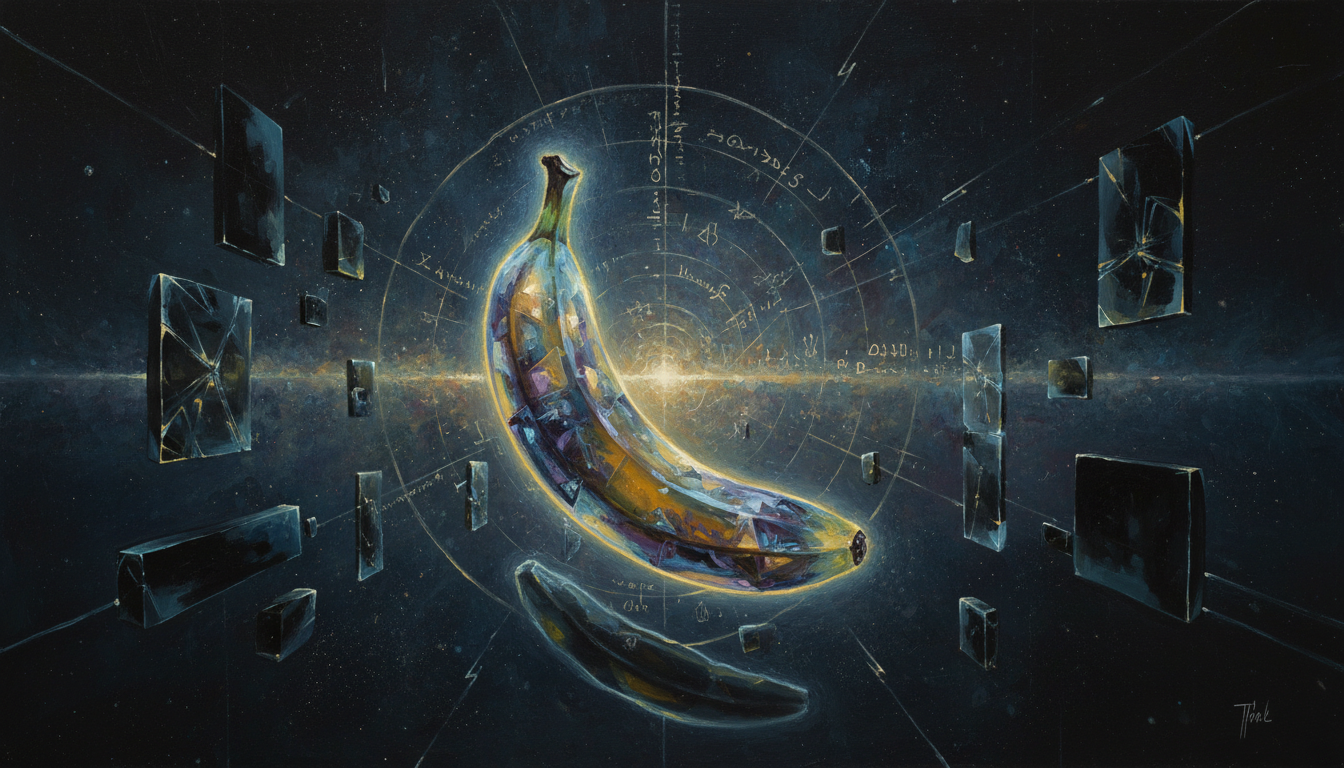
Imagine you are wearing a pair of blue-tinted glasses that you cannot take off. Everything you see—trees, clouds, hands—looks blue. You might think “blueness” is a property of the world. But Kant taps you on the shoulder and says: “The blueness is not in the object. It is in your lens.”
This is the distinction between Matter and Form:
- Matter (Sensation): The raw data hitting your senses. The light rays. The sound waves. This comes from outside and is chaotic.
- Form (Ordering): The structure your mind imposes. The “blueness” (in our analogy), or specifically for Kant: Space and Time. This comes from inside and is orderly.
You are in a stressful team meeting. Voices are raised. Papers are flying.
The Matter: Rapid changes in air pressure (sound), photons hitting your retina (sight), increased heart rate.
The Form: You organize this into “Coworker A is interrupting,” “The meeting is running late,” “This is disrespectful.”
The Takeaway: You cannot stop the sound waves (Matter). But you can recognize that the framework of “disrespect” or “lateness” is a structure you are applying to order the data. Recognizing the Form gives you a wedge of agency in a deterministic world.
We usually think of Space as a big, empty warehouse (“Newtonian Container”) that sits there waiting for us to put stuff in it. We think: “If I disappeared, Space would still be there.”
Kant says NO. Space is not a warehouse. It is the Canvas of Experience—but a specific kind of canvas. It is not a thing that exists apart from the painter.
- It is Active: Space is the way your mind “spaces out” sensations so they don’t all happen at once in a single confusing point.
- It is Necessary: You cannot imagine an object without Space. Try it. You can imagine a room with no chairs, but you cannot imagine a chair with no space.
If Space is a structure we bring to the world, then the limitations of Space (distance, separation) are not enemies to be fought. They are the rules of the game we are designed to play.
- Embrace Geometry as Grounding: When you feel overwhelmed, remember that your mind is designed to order things spatially. Use this. Write tasks on a physical whiteboard. Move your body to a different room. You are engaging the “Pure Form of Intuition” to help order the “Matter” of your anxiety.
- The “Impossible” is Your Foundation: Limits (like “I cannot be in two places at once”) are not failures of time management. They are necessary truths. Stop fighting the architecture of your own existence.
“Space is nothing but the form of all appearances of outer sense.” — Kant (A26/B42)
The world you live in is a joint venture. The Universe delivers the paint (Sensation). You bring the Canvas (Space/Time). The resulting masterpiece—your life—depends on both. You cannot control the paint, but you are the Canvas.
Next Up: To deeply understand how we connect these sensations, we must look at the Logic and the Categories.
Kant establishes the vocabulary of the critical philosophy immediately.
B34 / A20: The Form/Matter Argument
In the appearance, I call that which corresponds to sensation T: matter, but that which so determines the manifold of appearance that it allows of being ordered in certain relations, I call the T: form of appearance. That in which alone the sensations can be posited and ordered in a certain form, P: cannot itself be sensation; and therefore, while the matter of all appearance is given to us P: a posteriori only, its form must lie ready for the sensations C: a priori in the mind, and so must allow of being considered C: apart from all sensation.
| Term | Kant’s Definition (Paraphrased/Quoted) |
|---|---|
| Intuition | That through which knowledge is in immediate relation to objects. |
| Sensibility | The capacity (receptivity) for receiving representations through the mode in which we are affected by objects. |
| Sensation | The effect of an object upon the faculty of representation. |
| Appearance | The undetermined object of an empirical intuition. |
| Matter | That in the appearance which corresponds to sensation. |
| Form | That which determines the manifold of appearance to be ordered. |
Kant argues that while the matter of appearance (sensation) is given a posteriori, the form must be a priori.
- P1 (Matter): Matter corresponds to sensation, which requires an object to affect us (Empirical/A Posteriori).
- P2 (Form): Form is the ordering principle that allows the manifold of appearance to be arranged.
- P3 (Separation): The container (ordering principle) cannot be the same as the content (sensation).
- C1: Therefore, Form is not Sensation.
- C2: Since it is not empirical (given by objects), it must lie ready in the mind a priori.
We visualize this argument, including the "Inseparability" attack and Kant’s "Logical Priority" defense.
(See Figure 1: ASPIC+ Reconstruction of the Form/Matter Distinction)
The Insight: We often confuse the content of our experience (what happens to us) with the structure we impose on it (how we receive it).
- Scenario: A chaotic work meeting.
- Matter (Sensation): The noise, the specific words spoken, the angry tone (given from outside).
- Form (A Priori): The framework of "professionalism," "time-slots," or "hierarchy" that we bring to the meeting to make sense of the noise.
- Application: We cannot change the matter (the noise) instantly, but we can examine the form (our interpretive framework). Realizing the form is "in us" gives us agency.
Kant’s Critique of Pure Reason isn’t a monologue. It’s a systematic dismantling of two dominant errors: Dogmatism (the arrogance that we can know everything through pure reason) and Skepticism (the despair that we can know nothing with certainty).
To understand the Transcendental Aesthetic and the system of categories, you need to see who Kant is fighting and what weapons he deploys.
This diagram maps all six major philosophical opponents Kant confronts, showing their attacks on knowledge and Kant’s defensive strategy through his critical system.
graph TB
    K[KANT Transcendental Idealism]
    Forms[Forms Space and Time]
    Cats[Categories of Understanding]
    Limit[Thing-in-Itself Limit]
    APriori[A Priori Conditions]
    Synth[Synthetic A Priori]

    Hume[HUME Causation is habit]
    Quine[QUINE No a priori]
    Leibniz[LEIBNIZ Pure reason proves reality]
    Berkeley[BERKELEY Objects are ideas]
    Hegel[HEGEL Thing-in-itself incoherent]
    Reid[REID Direct perception]

    Hume --> K
    K --> Cats
    Cats --> Hume

    Quine --> APriori
    APriori --> Synth
    Synth --> Quine

    Leibniz --> K
    K --> Forms
    Forms --> Leibniz

    Berkeley --> K
    K --> Forms
    Forms --> Berkeley

    Hegel --> Limit
    Limit --> K
    K --> Hegel

    Reid --> K
    K --> Cats
    Cats --> Reid
Hume’s Attack: “Causation is just habit—we observe succession, not necessity. Science is built on custom, not knowledge.”
Kant’s Defense: Causality isn’t derived from experience—it’s a condition for having experience at all. Without causal structure, we’d have no objects, just unconnected sensations.
graph LR
    H1[Hume Observed succession]
    H2[Causation is Habit]
    K1[Experience]
    K2[Categories Causality]
    K3[Objective Experience]
    K4[Without causality no objects]

    H1 --> H2
    H2 --> K1
    K1 --> K2
    K2 --> K3
    K3 --> H2
    K3 --> K4
Stakes: If Hume wins, science collapses into mere psychology of habit. Kant rescues necessity by making it transcendental—part of the mind’s structure, not nature’s.
Leibniz’s Attack: “Pure reason can deduce the nature of reality—souls, God, substances—without needing sensory input.”
Kant’s Defense: “Concepts without intuition are empty.” Knowledge requires both concepts (Understanding) and intuitions (Sensibility). Reason alone produces illusions.
graph TD
    L1[Leibniz Pure Reason]
    L2[Soul God Substance]
    K1[Limits of Knowledge]
    K2A[Concepts]
    K2B[Intuitions]
    K3[Empty concepts]
    K4[Space and Time]
    K5[Knowledge Phenomena only]

    L1 --> L2
    L2 --> K1
    K1 --> K2A
    K1 --> K2B
    K2A --> K3
    K2B --> K4
    K3 --> L2
    K4 --> K5
Stakes: Rationalist dogmatism claims knowledge of the supersensible. Kant builds a wall: reason works on phenomena (appearances within space/time), not noumena (things-in-themselves).
Berkeley’s Attack: “Esse est percipi—to be is to be perceived. Objects are just collections of ideas in minds.”
Kant’s Defense: Appearances are objective—not because they exist independently of minds, but because they exist under universal forms (space/time) shared by all rational subjects.
graph LR
    B1[Berkeley To be is to be perceived]
    B2[Objects are Ideas in mind]
    K1[Objectivity]
    K2[Universal Forms]
    K3[Shared structure]
    K4[Objective appearances]
    K5[Space in us but objects real]

    B1 --> B2
    B2 --> K1
    K1 --> K2
    K2 --> K3
    K3 --> K4
    K4 --> B2
    K4 --> K5
Stakes: Berkeley dissolves the world into subjective ideas. Kant saves objectivity by making the structure of experience (not its existence) mind-dependent.
Reid’s Attack: “The mind directly perceives external objects—no need for Kant’s complicated ‘machinery’ of forms and categories.”
Kant’s Defense: Direct realism can’t explain necessary truths (mathematics, logic). Objectivity requires rules—sensation without understanding is blind.
graph TD
    R1[Reid Direct Perception]
    R2[Mind sees world as-is]
    K1[Need cognitive machinery]
    K2[Necessary truths]
    K3[Mathematics Logic]
    K4[Understanding applies rules]
    K5[Objective knowledge]
    K6[Sensation blind without Understanding]

    R1 --> R2
    R2 --> K1
    K1 --> K2
    K2 --> K3
    K3 --> R2
    K4 --> K5
    K5 --> R2
    K4 --> K6
Stakes: Common sense realism feels intuitive but can’t ground a priori knowledge. Kant insists: an active mind constructs the stable, rule-governed world we experience.
Hegel’s Attack: “The thing-in-itself is incoherent—if you can think the limit, you’ve already transcended it.”
Kant’s Defense: The limit isn’t an error—it’s discipline. The thing-in-itself prevents reason from claiming knowledge of the unconditioned.
graph LR
    H1[Hegel Thinking limit is Crossing it]
    H2[Thing-in-itself]
    K1[Kants Limit Concept]
    K2[Disciplines Reason]
    K3[Prevents Metaphysical overreach]
    K4[Scientific knowledge]
    K5[Barrier is Condition for sanity]

    H1 --> H2
    H2 --> K1
    K1 --> K2
    K2 --> K3
    K3 --> K4
    K4 --> H1
    K2 --> K5
Stakes: Hegel wants to dissolve the barrier between thought and being. Kant insists: the barrier is what keeps us scientific. Lose it, and philosophy becomes speculative fantasy.
Quine’s Attack: “There’s no a priori knowledge—everything is revisable. Even logic and mathematics can change if empirical data demands it.”
Kant’s Defense: Some structures (space, time, causality) are conditions for having experience—they’re the operating system, not the apps. You can’t revise the tools you use to revise.
graph TD
    Q1[Quine No a priori]
    Q2[Logic and Math contingent]
    K1[A Priori Knowledge]
    K2A[Operating System]
    K2B[Applications]
    K3[Conditions for experience]
    K4[Revisable content]
    K5[Tools for revision]
    K6[OS vs Apps distinction]

    Q1 --> Q2
    Q2 --> K1
    K1 --> K2A
    K1 --> K2B
    K2A --> K3
    K2B --> K4
    K3 --> K5
    K5 --> Q2
    K3 --> K6
Stakes: Modern empiricism threatens to make everything contingent. Kant’s transcendental move: some structures are necessarily presupposed by experience itself.
All six defenses depend on the same core architecture—Kant’s revolutionary claim that knowledge has two sources that must work together:
graph TD
    TiT[Thing-in-Itself Unknowable]
    Sens[SENSIBILITY]
    Matter[Matter of sensation]
    Forms[Forms SPACE and TIME]
    Int[Intuitions]
    Und[UNDERSTANDING]
    Cats[Categories Causality etc]
    Exp[EXPERIENCE Objective appearances]
    Fail1[Without Forms Chaos]
    Fail2[Without Categories Blind sensation]
    Fail3[Beyond phenomena Empty concepts]

    TiT --> Sens
    Sens --> Matter
    Sens --> Forms
    Forms --> Int
    Int --> Und
    Und --> Cats
    Cats --> Exp
    Exp --> TiT
    Forms --> Fail1
    Cats --> Fail2
    TiT --> Fail3
Key insight: Each opponent attacks one part of this system—Hume attacks categories, Leibniz ignores intuition, Berkeley dissolves objectivity, Reid bypasses the machinery, Hegel denies the limit, Quine questions the a priori. Kant’s architecture defeats them all by showing how each component is necessary for experience.
Kant’s insight has direct application: Your experience isn’t just raw data (Matter)—it’s always already structured (Form). When you feel “this is bad” or “they’re disrespecting me,” you’re applying forms (threat framing, status hierarchy) to sensations.
Debug your mind: Name the matter (what’s actually given). Name the form (your framing). Ask: what can I responsibly treat as objective vs. what’s “extra”?
See Layer 2: Practical Application for the full operator.
Kant first establishes that space is not an empirical concept derived from outer experience, but the necessary condition for it.
§ 2, Nr. 1 (Presupposition)
Der Raum ist kein empirischer Begriff, der von äußeren Erfahrungen abgezogen worden. Denn damit gewisse Empfindungen auf etwas außer mir bezogen werden (d. i. auf etwas in einem andern Orte des Raumes, als darin ich mich befinde), imgleichen damit ich sie als außer und neben einander, mithin nicht bloß verschieden, sondern als in verschiedenen Orten vorstellen könne, dazu muß die Vorstellung des Raumes schon zum Grunde liegen. Demnach kann die Vorstellung des Raumes nicht aus den Verhältnissen der äußern Erscheinung durch Erfahrung erborgt sein, sondern diese äußere Erfahrung ist selbst nur durch gedachte Vorstellung allererst möglich.(Kant, KrV B 38)
§ 2, Nr. 2 (Necessity)
Der Raum ist eine nothwendige Vorstellung a priori, die allen äußeren Anschauungen zum Grunde liegt. Man kann sich niemals eine Vorstellung davon machen, daß kein Raum sei, ob man sich gleich ganz wohl denken kann, daß keine Gegenstände darin angetroffen werden. Er wird also als die Bedingung der Möglichkeit der Erscheinungen und nicht als eine von ihnen abhängende Bestimmung angesehen und ist eine Vorstellung a priori, die nothwendiger Weise äußeren Erscheinungen zum Grunde liegt.(Kant, KrV B 38)
To: Point 1 – The Outer Sense Argument
Space is C: not an empirical concept which has been derived from outer experiences. For in order that certain sensations be referred to something outside me (that is, to something in another region of space from that in which I find myself), and similarly in order that I may be able to represent them as outside and alongside one another, and accordingly as not only different but as in different places, the representation of space must be P: presupposed. The representation of space cannot, therefore, be empirically obtained from the relations of outer appearance. On the contrary, this outer experience is itself possible at all only through that representation.(B38 / A23)
To: Point 2 – The Necessity Argument
Space is a C: necessary a priori representation, which underlies all outer intuitions. We can never represent to ourselves the P: absence of space, though we can quite well think it as empty of objects. It must therefore be regarded as the condition of the possibility of appearances, and not as a determination dependent upon them. It is an a priori representation, which necessarily underlies outer appearances.(B38 / A24)
Argument Reconstruction: Space is A Priori
- Point 1 (Outer Sense): To refer sensations to something “outside me,” I must already have the representation of space. Therefore, space is not derived from outer experience; outer experience is derived from space.
- Point 2 (Necessity): We can think of space empty of objects, but never of objects without space. Space is a necessary representation a priori.
Argument A (Not Empirical / Outer Sense)
  Premises:
    P1: Referring sensations "outside me" requires the representation of space (Strict).
    P2: "Outside me" means structurally distinct in location, not just distinct in sensation (Strict).
    P3: The condition of possibility (Space) cannot be derived from what it makes possible (Experience) (Strict).
  Conclusion:
    C1: Representation of space precedes outer experience (Space is not empirical).

  Attacks:
    - Empiricist Attack (Undercut): Space is an abstraction from the relations of objects (Leibniz/Hume).
      * Defense (Circular): To abstract "relations" of placement, one must already presuppose the space in which they are placed (P1).

Argument B (Necessity / A Priori)
  Premises:
    P4: We can represent space without objects (Empty Space) (Strict).
    P5: We cannot represent objects without space (Strict).
  Conclusion:
    C2: Space is a necessary representation (A Priori Condition).

  Attacks:
    - Nominalist Attack (Rebuttal): Space is a fiction/concept, not a real necessity.
      * Defense (Necessity): A fiction can be removed from thought; Space cannot be removed without collapsing the possibility of outer intuition (P5).
Having established space as a priori, Kant must prove it is an intuition (singular, immediate) rather than a concept (general, discursive). This is crucial for grounding the synthetic a priori nature of geometry.
§ 2, Nr. 3 (Singularity)
Der Raum ist kein discursiver oder, wie man sagt, allgemeiner Begriff von Verhältnissen der Dinge überhaupt, sondern eine reine Anschauung. Denn erstlich kann man sich nur einen einigen Raum vorstellen, und wenn man von vielen Räumen redet, so versteht man darunter nur Theile eines und desselben alleinigen Raumes.(Kant, KrV B 39)
§ 2, Nr. 4 (Infinity)
Der Raum wird als eine unendliche gegebene Größe vorgestellt… kein Begriff als ein solcher kann so gedacht werden, als ob er eine unendliche Menge von Vorstellungen in sich enthielte. Gleichwohl wird der Raum so gedacht (denn alle Theile des Raumes ins unendliche sind zugleich). Also ist die ursprüngliche Vorstellung vom Raume Anschauung a priori und nicht Begriff.(Kant, KrV B 40)
B39 / A25: Point 3 – The Singularity Argument
Space is C: not a discursive or, as we say, general concept of relations of things in general, but a C: pure intuition. For, in the first place, we can represent to ourselves P: only one space; and if we speak of diverse spaces, we mean thereby only parts of one and the same unique space. These parts cannot precede the one all-embracing space… but can be thought only as P: in it.
B39-40 / A25: Point 4 – The Infinity Argument
Space is represented as an P: infinite given magnitude. Now every concept must be thought as a representation which is contained in an infinite number of different possible representations (as their common character), and which therefore contains these T: under itself; but no concept, as such, can be thought as containing an infinite number of representations T: within itself. It is in this latter way, however, that space is thought; for all the parts of space coexist ad infinitum. Consequently, the original representation of space is an C: a priori intuition, not a concept.
Argument: Space is Pure Intuition
- Point 3 (Singularity): There is only one space. When we speak of “spaces,” we mean parts of the one all-embracing space. Concepts have instances under them; Space has parts within it.
- Point 4 (Infinity): Space is represented as an infinite given magnitude. A concept cannot represent an infinite set as a simultaneous whole (it can only contain infinite instances under it as a rule). Since space is given as a simultaneous whole, it is an intuition.
Argument C (Singularity / The Whole)
  Premises:
    P1: We represent only one Space (Strict)
    P2: Diverse spaces are always parts of the one Space (Strict)
    P3: Parts cannot precede the whole (Strict)
  Conclusion:
    C1: Space is an essential whole (Intuition), not a class of objects (Concept)

Argument D (Infinity / Magnitude)
  Premises:
    P4: Space is given as an infinite magnitude (Strict)
    P5: Concepts contain an infinite number of representations "under" them (extensions)
    P6: Concepts do not contain an infinite number of representations "within" them (parts)
    P7: Space contains infinite parts "within" itself (coexisting)
  Conclusion:
    C2: Space is not a Concept
    C3: Space is an A Priori Intuition
Unlike the Metaphysical Exposition (which analyzes what space is), the Transcendental Exposition explains space as a principle that makes other synthetic a priori knowledge possible.
B40: Definition
I understand by a T: transcendental exposition the explanation of a concept, as a principle from which the possibility of other T: synthetic a priori knowledge can be understood. For this purpose it is required: (1) that such knowledge does really flow from the given concept, (2) that this knowledge is possible only on the assumption of a given mode of explaining the concept.
Kant asks: How is geometry possible? Geometry determines the properties of space synthetically (going beyond definition) yet a priori (with necessity).
B40-41: The Argument
Geometry is a science which determines the properties of space T: synthetically, and yet T: a priori. What, then, must be our representation of space, in order that such knowledge of it may be possible? It must be originally C: intuition; for from a mere concept no propositions can be obtained which go beyond the concept… But this intuition must be found in the mind C: a priori, that is, before all perception of objects… For geometrical propositions are all P: apodictic, that is, bound up with the consciousness of their necessity; as that space has only three dimensions. Such propositions cannot be empirical…
Argument: The Possibility of Geometry
- P1 (Synthetic): Geometry adds predicates not contained in the subject (e.g., “triangle angles sum to 180”). Concepts alone are analytic. Therefore, space must be an Intuition.
- P2 (Apodictic): Geometric truths are necessary and universal. Experience yields only contingent truths. Therefore, space must be A Priori.
- C1: Space is a Pure A Priori Intuition.
- C2 (Subjectivity): An intuition that precedes objects cannot be a property of the objects themselves. It must be the Form of Sensibility in the subject (the capacity to be affected).
The Insight: We often think “facts” are just “out there.” Kant shows that the most certain facts (math/geometry) are certain only because they reflect the structure of our own minds.
- Scenario: Trying to solve a problem that seems “impossible” (e.g., fitting a square peg in a round hole).
- Kant’s View: The impossibility isn’t just a random accident of the wood; it’s a necessary truth derived from the spatial form we impose on the world.
- Application: When we hit a “hard constraint” (like time or logic), we are hitting the walls of our own cognitive architecture. This isn’t a failure; it’s the ground of certainty. We can rely on these constraints to build stable structures (like engineering or scheduling) precisely because they cannot be otherwise.
Kant first establishes that space is not an empirical concept derived from outer experience, but the necessary condition for it.


John Doe
Great article! Very informative.
Jane Smith
I really enjoyed reading this. Thanks for sharing.
Vania Novikau
You are very welcome! Glad you found it useful.
Mike Johnson
Interesting perspective. I hadn’t thought about it that way.
Sarah Williams
Could you elaborate more on the second point?
Vania Novikau
The second point refers to the modularity of the system, allowing for easier updates.