Before Isaac Newton wrote down the law of gravity in 1687, roughly 1.4 trillion person-years of human life had already passed under it. Every one of those people watched apples fall, rivers run downhill and the Moon cross the sky. What if all that looking leaves a trace? And could a whole civilisation, looking hard enough at a new idea, ever change what is real?
This is the question behind a theory I call Collective Perceptual Trace Theory (CPTT). Below I put it into mathematics, run the numbers, check them against real physics, and say plainly what the model shows and what it does not. The full 13-page report is free to download at the end.
In one minute
- The idea: every act of perceiving something adds to a shared “trace”. Memory, language, writing and science turn that trace into stable shared models, such as Newton’s law.
- The number: humanity’s modelled trace for gravity before Newton is about 3.8 × 1030 neuron-snapshots.
- The thought experiment: 8 billion people focused fully on one new idea (say, anti-gravity) would match that trace in about 174 years.
- The honest result: the maths of collective representation works. A direct effect of belief on physical law is not shown, and no fundamental constant falls out of the numbers. The report says exactly what experiment would be needed.
Two levels: seeing the world and changing it
Every observer builds an incomplete inner picture of the world. Repetition makes it familiar. Talking, writing, photographs, measurements and 3D models move parts of that picture out of single heads and into shared media. Finally a civilisation compresses millions of separate experiences into one short predictive law. Newton’s gravity is the classic example: one formula that explains a falling apple and the orbit of the Moon.
CPTT keeps two claims strictly apart, because they need very different evidence:
Level A · Representation
How shared observations pile up, fade and compress into common models, like Newton’s law. This uses ordinary mathematics and can be checked with data from psychology, history and information science.
Testable todayLevel B · Modification
The bold claim: that concentrated collective attention could change physical reality itself. This needs a new physical interaction and independent experiments. No such effect has been measured.
Open hypothesisWhat is a “trace”?
A trace is a modelled record of perception aimed at one target R: “objects fall to the ground”, “gravity is universal”, or “levitation could exist”. It can live in a brain, a photograph, a scientific paper or an institution. Traces can cause large social and technological change. But a trace existing does not prove the claim it is about. Ideas about a deity, anti-gravity or a new force all get the same treatment here: they are hypotheses or beliefs, not facts certified by repetition.
Knowledge is compression
In the language of the minimum description length principle, a good model makes the data cheaper to describe. The model plus whatever it fails to explain must be shorter than the raw observations:
The inequality is a test to run on real data and real models. It does not mean every elegant formula is true. Newton’s law works inside its domain, and general relativity later refined that domain.
The core equation
The simplest way to count a collective trace is to add up, over time, how many people there were, how many neurons each one has, how often we take a “snapshot”, and what share of that activity goes to the target R:
| Symbol | Meaning | Value used |
|---|---|---|
| N(t) | Number of people alive at time t | Historical reconstruction |
| n | Neurons per person (adult reference) | 86 × 109 |
| fh | Snapshot rate, by convention one per heartbeat | 1 per second |
| qR(t) | Share of activity assigned to R (0 to 1) | 1 (upper bound) |
| t0, T | Start and end of the period | 50,000 BCE → 1687 |
The flow of trace per second is simply ΦR(t) = n · fh · N(t) · qR(t).
To be clear about what this counts: it is an activity proxy, not a measured number of thoughts. The heartbeat clock is a simplification, not a claim that perception ticks with the heart. Setting q = 1 is a mathematical ceiling, not a picture of real minds. Nobody thinks about gravity all day.
Repetition is not independent evidence
If one person looks at the same thing every day, the raw trace grows, but the independent evidence does not grow at the same rate. With m observations that share a correlation ρ, the effective number of independent samples is:
Perfect memory is not perfect independence. This one line stops a billion repetitions of a belief from passing as a billion independent measurements.
How much did humanity “look at” gravity before Newton?
Take the period from 50,000 BCE (a modelling boundary, not the start of consciousness) to 1687, the year of the Principia. The Population Reference Bureau gives anchor points: 2 million people in 50,000 BCE, 5 million in 8,000 BCE, 300 million in 1 CE, 450 million in 1200, 500 million in 1650 and 795 million in 1750. Joining them smoothly on a logarithmic scale gives the curve below.
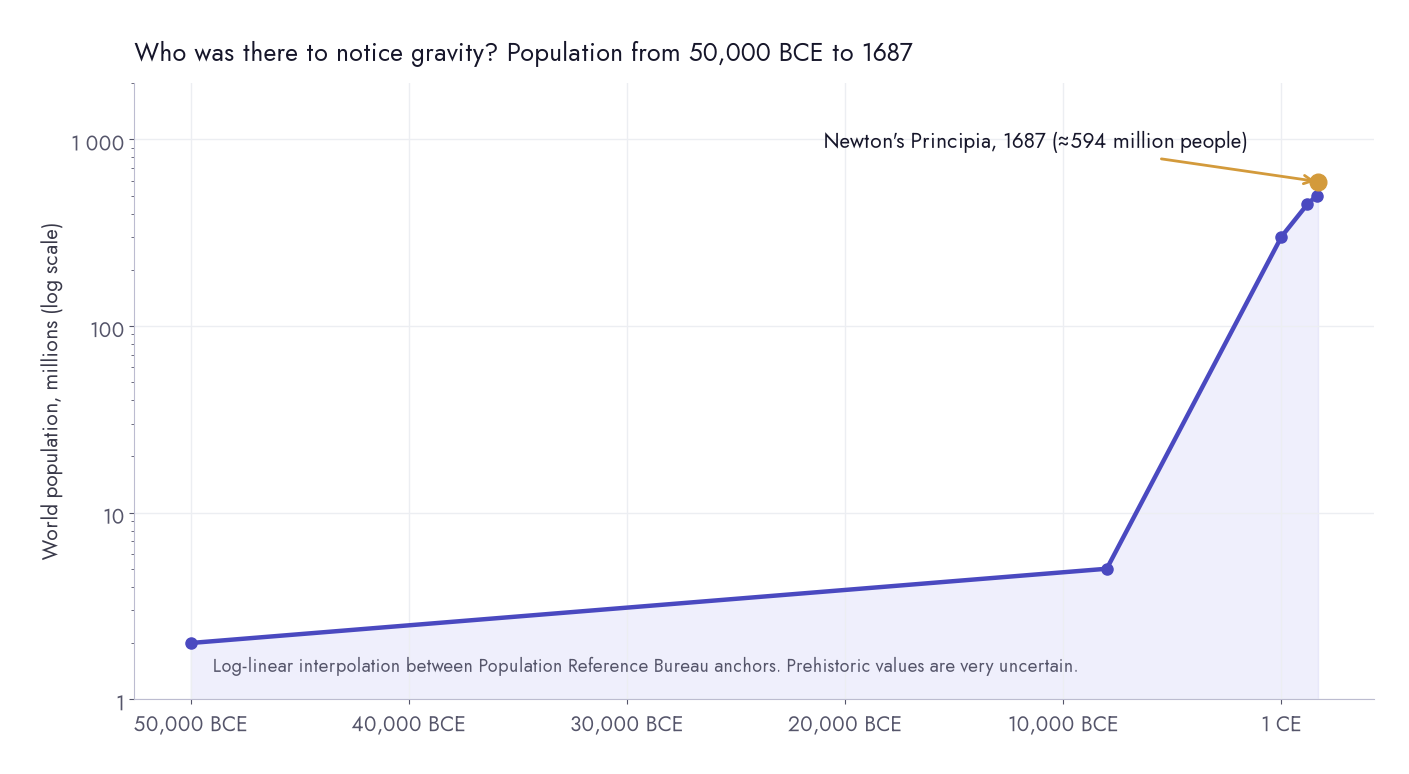
Integrating that curve gives 1.3913 × 10¹² person-years. Multiply by 86 billion neurons and 31,557,600 seconds per year and you get:
Thought experiment: 8 billion people and anti-gravity
Now picture today’s 8 billion people directing all their perception at one new concept, say anti-gravity. Use the pre-Newton gravity trace A* as a yardstick only, without assuming that reaching it creates any force. With a constant population and no forgetting:
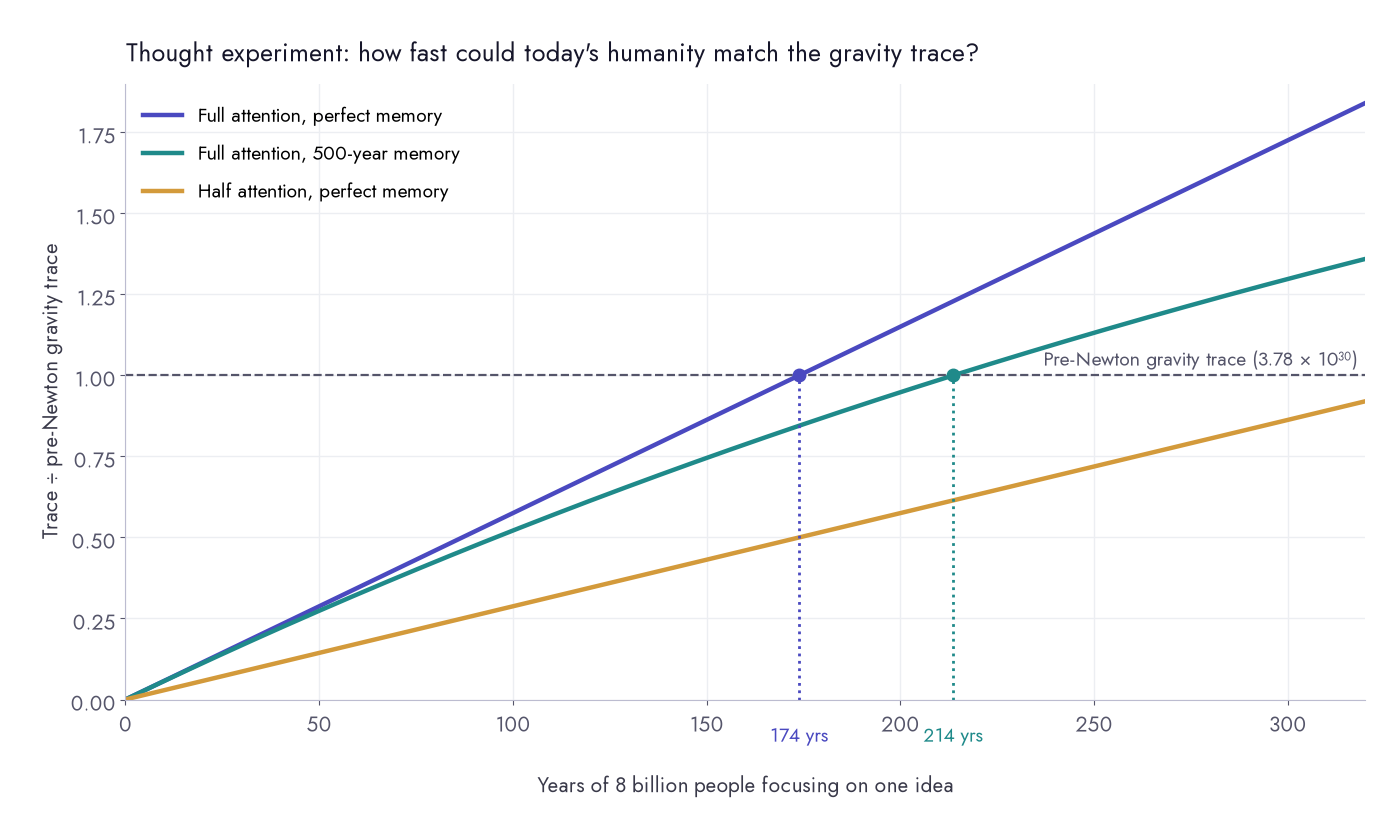
- Full attention (q = 1): about 159 years for the first-pass trace and 174 years for the reconstructed one.
- One-tenth attention (q = 0.1): about 1,590 and 1,739 years.
- Full attention, but memory that fades over 500 years: about 214 years.
Memory, forgetting and the moment an idea “sets”
Real memory fades. Add a forgetting time τ to the incoming flow J:
Two consequences matter. First, with perfect memory (τ → ∞) the trace never settles. It just keeps growing. Second, if a culture forgets fast, a target may be out of reach forever: with τ = 50 years the equilibrium is below the gravity yardstick, so 8 billion fully focused people would never match it.
An idea can also become “normal” long before repetitions stop. To describe that, the model adds a consolidation index that saturates:
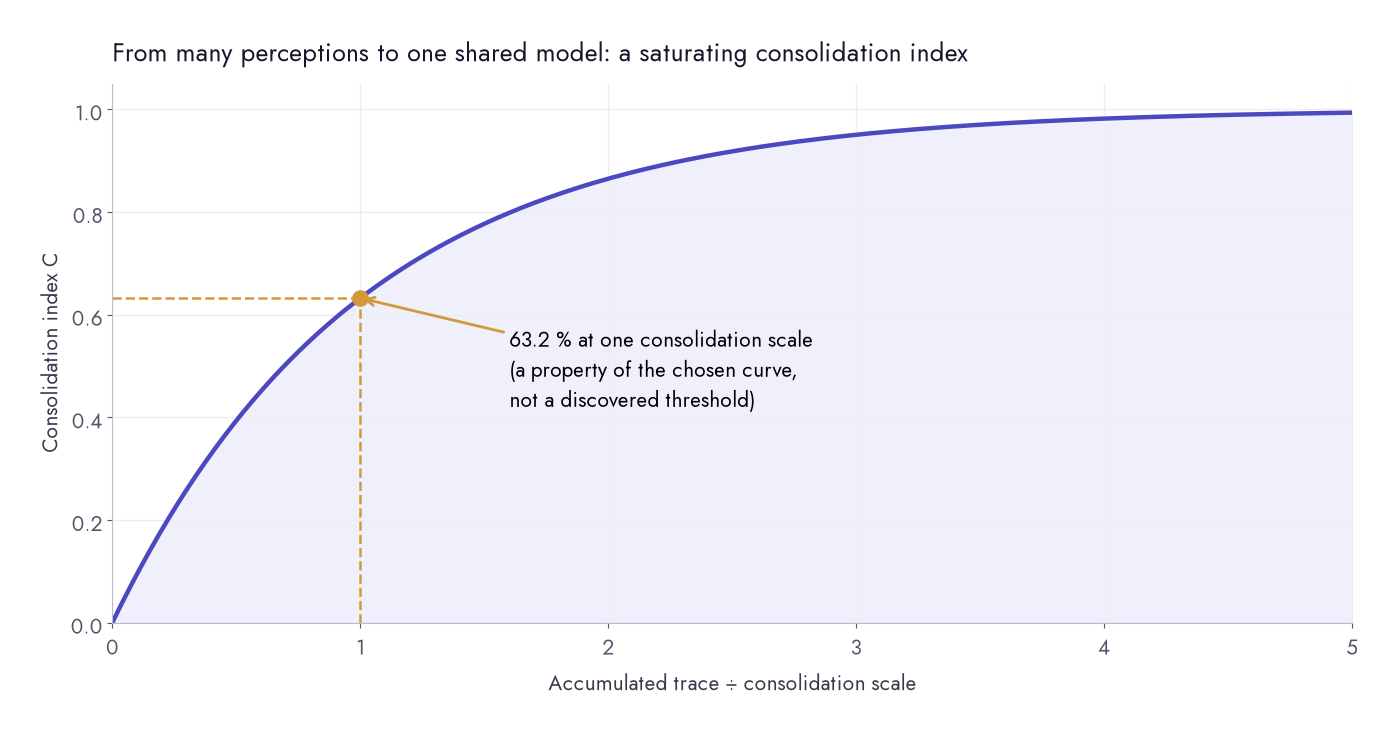
The 63.2 % comes from the exponential curve I chose. It is not a discovered threshold of the mind. Other cultural processes may need other curves.
Reality check: energy and entropy
A model of perception should at least agree with the physics of brains. An awake adult brain uses about 10–20 watts. With 20 W for every person-year before Newton, the total metabolic budget is about 8.8 × 10²⁰ J. That is the whole brain’s energy, not energy spent on gravity.
Physics does link information and heat. Landauer’s principle, confirmed experimentally in 2012, says that erasing one bit at temperature T costs at least kBT ln 2. At body temperature (310 K) that is about 2.97 × 10⁻²¹ J. If, purely for illustration, every neuron-snapshot were one erased bit, the whole pre-Newton trace would need only about 1.1 × 10¹⁰ J, some 78 billion times less than the brains actually used. Brains are not ideal erasers, and perception is not erasure.
That entropy rate is a genuine physical quantity. It still does not measure conscious information, belief, or an “entropy of humanity”.
Does the trace explain G or ħ? No, and here is why
It is tempting to multiply and divide big numbers until something looks like Newton’s constant. That is not a derivation. A count of neural events has no metres, kilograms or joule-seconds in it. Example: the per-neuron energy per one-second snapshot is about 2.33 × 10⁻¹⁰ J. Call that an “action” and you get 2.21 × 1024 ħ. Change the assumed interval and the number changes, so it is neither a match nor an invariant.
| Constant | Value (CODATA 2022) | Link to CPTT |
|---|---|---|
| kB | 1.380649 × 10⁻²³ J/K | Real entropy and erasure bound |
| ħ | 1.054571817 × 10⁻³⁴ J s | None no natural match |
| G | 6.67430 × 10⁻¹¹ m3 kg−1 s−2 | None cannot come from a pure count |
| tP | 5.391 × 10−44 s | None no link to heartbeat snapshots |
| κ = 1/τ | depends on the model | Model memory relaxation, not universal |
There are real bridges between entropy and gravity, and they are worth knowing. The Bekenstein–Hawking formula gives a black hole an entropy proportional to its horizon area, S = kBc3A / 4Għ. Ted Jacobson derived Einstein’s field equations from thermodynamics of local horizons (1995). Erik Verlinde proposed, controversially, that gravity is an entropic force, F = T ∂S/∂x (2011). These count physical states of spacetime, not human observations. None of them supports an observer-driven change in G.
How could “reality generation” be tested?
The strong version of the theory needs a specific physical mechanism. The smallest possible version is a coupling λ between Newton’s constant and a measured collective-consolidation index:
A fair test would have to:
- define how CR is measured before looking at any result;
- randomise or carefully match “attention” and “no attention” conditions;
- run blinded, high-precision gravity measurements;
- control temperature, vibration, tides, instrument drift and ordinary forces;
- pre-register the statistics and be replicated by independent labs.
This is hard. Even the best measurements of G today still disagree with each other more than their error bars suggest (the 2026 BIPM torsion-balance redetermination at NIST is a good example).
| Hypothesis | What you can measure | Status |
|---|---|---|
| Cultural consolidation | Idea adoption, agreement, memory retention, communication networks | Feasible |
| Knowledge compression | Model length versus prediction error on held-out data | Feasible |
| Information efficiency | Independent bits retained per joule in a defined learning task | Feasible, difficult |
| Direct gravity coupling | Pre-declared change in gravity measurements tied to an independent CR | Unsupported |
The same care applies to religion and culture. A shared belief can produce real buildings, rituals, texts and institutions. Those are physical effects of actions driven by belief. They do not settle whether the belief’s supernatural object exists. The framework must keep measuring a belief separate from testing what the belief is about, or the reasoning becomes circular.
What the numbers establish
- The equations are internally consistent as proxies, once their assumptions are stated.
- Pre-Newton gravity trace: 3.44 × 1030 (first pass) or 3.78 × 1030 (population reconstruction).
- Eight billion fully focused observers would match it in 159 or 174 years.
- Finite memory gives a real relaxation time and an equilibrium. Landauer’s bound gives an energy benchmark, and P/T gives a genuine entropy rate.
- No fundamental constant was derived. No direct causal effect of consciousness on gravity was shown. The historical count cannot predict when discoveries must happen.
Known limitations
- Prehistoric population is very uncertain, and the 50,000 BCE start is arbitrary.
- An adult neuron count does not apply unchanged to children or to every historical observer.
- A heartbeat is not a validated “snapshot clock”, and qR has not been measured.
- Repeated traces are strongly correlated, so repetition is not independent evidence.
- Entropy (J/K), information (bits), energy (J) and raw counts are different quantities.
- The decay and saturation laws are workable assumptions, not fitted to data.
Check the numbers yourself
Every headline number in this post was recomputed independently from the published anchors. The whole calculation fits in a few lines of Python:
import math
yr, n, Nc = 31_557_600, 86e9, 8e9           # s/yr, neurons, people today
A = [(-50000,2e6),(-8000,5e6),(1,300e6),(1200,450e6),(1650,500e6),(1750,795e6)]
seg = lambda a,Na,b,Nb: (Nb-Na) / (math.log(Nb/Na)/(b-a))   # exact log-linear integral
N1687 = 500e6 * math.exp(math.log(795/500)/100 * 37)        # ≈ 593.6 million
P = sum(seg(*A[i],*A[i+1]) for i in range(4)) + seg(1650,500e6,1687,N1687)
trace = P * yr * n
print(f"person-years {P:.4e}")                    # 1.3913e+12
print(f"gravity trace {trace:.3e}")               # 3.776e+30 neuron-snapshots
print(f"years to match {trace/(Nc*n)/yr:.0f}")    # 174
tau = 500*yr; J = Nc*n
print(f"with 500-yr memory {-tau*math.log(1-trace/(J*tau))/yr:.0f}") # 214Sources and evidence
- Royal Society (2014), Principia, first edition (1687). royalsociety.org
- Kaneda, T. & Haub, C. (2022), “How Many People Have Ever Lived on Earth?” Population Reference Bureau. prb.org
- Azevedo, F. A. C. et al. (2009), “Equal numbers of neuronal and nonneuronal cells make the human brain an isometrically scaled-up primate brain.” J. Comp. Neurol. doi:10.1002/cne.21974
- Regulation of Cerebral Metabolic Rate, NCBI Bookshelf. ncbi.nlm.nih.gov
- Bérut, A. et al. (2012), “Experimental verification of Landauer’s principle linking information and thermodynamics.” Nature 483:187–189. nature.com
- NIST CODATA (2022 adjustment), Recommended values of the fundamental physical constants. physics.nist.gov
- “The Minimum Description Length Principle” (2016), Association for Psychological Science. psychologicalscience.org
- Bekenstein, J. D. (1973), “Black Holes and Entropy.” Phys. Rev. D 7:2333. doi:10.1103/PhysRevD.7.2333
- Hawking, S. W. (1976), “Black holes and thermodynamics.” Phys. Rev. D 13:191. doi:10.1103/PhysRevD.13.191
- Jacobson, T. (1995), “Thermodynamics of Spacetime: The Einstein Equation of State.” Phys. Rev. Lett. 75:1260. doi:10.1103/PhysRevLett.75.1260
- Verlinde, E. (2011), “On the origin of gravity and the laws of Newton.” JHEP 2011:29. doi:10.1007/JHEP04(2011)029
- Schlamminger, S. et al. (2026), “Redetermination of the gravitational constant with the BIPM torsion balance at NIST.” Metrologia. doi:10.1088/1681-7575/ae570f
Source status: population history is reconstructed from sparse evidence. The constants and physiological reference values have empirical support. The snapshot mapping, the consolidation function and the hypothetical coupling λ are introduced by CPTT. Values are rounded on purpose, to reflect the uncertainty of the assumptions rather than measurement precision.
What do you think: is there a better clock than the heartbeat, or a better measure of “attention” than q? Ask the AI assistant on this page about any equation, or leave a comment below.