Last time ended on an objection, and Kant says he heard it so often, from so many intelligent people, that he assumed every new reader would have it too. It goes like this. Things change. I can watch my own thoughts change even if I doubt everything outside me. Change only happens in time. So time is real — not just a form of mine.
You would expect a philosopher to start picking at the premises. Kant does something stranger. He writes: “I grant the whole argument.”
Change is real. Time is real. What he disputes is the word real, or rather where it points. Time is real, he says, as the actual form in which you meet yourself — “not indeed as object but as the mode of representation of myself as object.” Your afternoon really happened. It happened to you in order. Kant is not taking the afternoon away. He is asking where the order lives.
Example: The Song and the Waveform
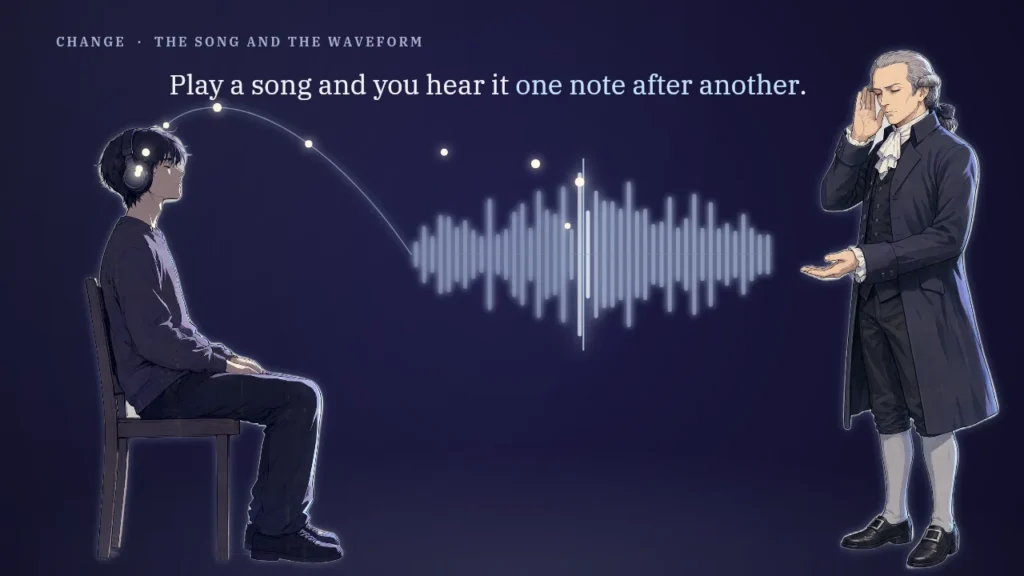
Play a song and you hear it one note after another: there is no other way for a listener to have it. Now open the same file in an audio editor. The whole track lies on the screen at once, a single shape, every note present together.
Nothing has been lost. The same notes, the same structure. What is gone is the before and after, because that was never in the shape. It was in the listening.
That is close to Kant’s own thought experiment. If something could take in your inner life without our kind of sensibility, he says, “the very same determinations which we now represent to ourselves as alterations” would be known, but time — and with it change — “would in no way enter.” The analogy limps where all analogies limp: the waveform is still something you look at in space. Kant’s point has no picture. But the direction is right. The content is real; the one-after-another is the form it takes for us.
Why do people object about time and not about space? Kant’s answer is sharp. Most of us are willing to doubt the outside world — perhaps it is all a dream — but nobody doubts their own inner life. I can doubt the room; I cannot doubt that I am doubting it. So the inner world, and the time it runs on, feels like solid ground. Kant’s reply: both sides are in the same position. The room and the doubting are both appearances, both perfectly real as what you meet, neither of them given to you as it is in itself.
He also clears the ground of the two pictures most people carry around. Either time is a vast empty container that would run on with nothing in it, or it is just a pattern we abstract from events. The first, he says, makes time a giant “non-entity” that exists only to hold everything real. The second cannot explain why mathematics is necessary rather than merely likely. His view — time as the form of our intuition — is meant to keep what each gets right and drop what each gets wrong.
In §8 Kant stops and restates his position as plainly as he can, “to avoid all misapprehension”. What you intuit is appearance. Things are not in themselves what they appear to be. Take away the subject and space and time themselves would vanish. What things are in themselves “remains completely unknown to us.”
Then he blocks the most comfortable way out. The comfortable reading says: fine, our senses give us a blurry picture of reality, and science sharpens it. Kant says no — and it is the single most important “no” in this part of the book. Even if our intuition were raised “to the highest degree of clearness”, we would come no nearer to things in themselves.
Example: Zooming In
Zoom into a digital photograph and you get more detail, then pixels. You never reach the street the camera was pointed at. A sharper photo is a better photo; it is not a step toward stepping out of the photo.
The philosophers Kant was arguing with thought the senses were a blurry version of the real thing. Kant says they are a different kind of thing: clarity is not the issue at all.
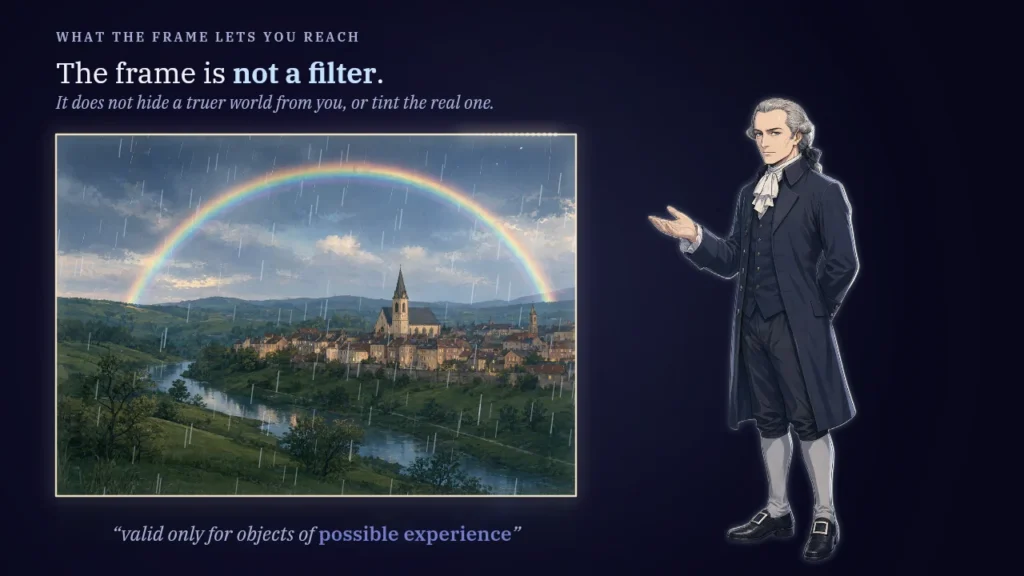
His own example is better than any of ours. After a sunny shower you see a rainbow. Everyone will tell you the rainbow is “just an appearance” — it moves when you move, it depends on where you stand — while the rain is the real thing. Kant agrees, as far as it goes. In the everyday, physical sense that is exactly right.
Now ask the next question. Is the rain the thing in itself? Here Kant’s answer is the one that makes people sit up: the drops are appearances too. So is their round shape. So is “the space in which they fall.” The difference between rainbow and rain is a real difference — but it is a difference inside the world of appearance, not a door out of it.
That is the takeaway in one line: there are two distinctions, and most people only ever draw the first. The rainbow and the rain is the ordinary one, and it stays. Underneath it is a second, between everything we can meet at all and what things might be apart from any meeting. Forget the second and you start believing, as Kant puts it, that you know things in themselves — while in fact, however deeply you investigate, you are dealing with nothing but appearances.

Kant does not want his view to be merely plausible. He wants it certain, and he picks one test case to make it so: geometry.
Here is the puzzle. Geometry tells you things that are necessarily true, and true everywhere, without your going anywhere to check. Two straight lines cannot enclose a space. Three straight lines can. Where does that kind of knowledge come from?
Example: The Napkin Proof
Try to prove from definitions alone that two straight lines cannot enclose a space. Turn the words “straight”, “line” and “two” over as long as you like: the result is not in them.
Now pick up a pen and draw it, or picture it. Two straight lines, and you can see they will never close. You did not learn this from experience — you did not measure every pair of lines in the universe. You constructed one case and saw that it had to be so.
Kant runs through the options. Experience could only ever tell you how things have turned out so far, never that they must. Definitions only unpack what you already put in. So geometry needs something you can construct in, before any experience: a pure intuition.
And then the decisive step. Suppose the triangle you construct were a thing in itself, out there and independent of you. Why on earth should what is necessary for your way of constructing triangles hold of it? It would be a lucky coincidence at best — and a coincidence cannot give you necessity. The only way the napkin proof can bind every triangle you will ever meet is if every triangle you will ever meet is an appearance, shaped by the same form of intuition you constructed in.
“It is, therefore, not merely possible or probable, but indubitably certain, that space and time … are merely subjective conditions of all our intuition.”
One honest footnote from our side, not Kant’s. Kant’s geometry is Euclid’s, and since Einstein physicists describe physical space with other geometries. Critics take that as a blow to this argument; defenders reply that Kant’s claim is about the form in which anything spatial can be given to us at all, not about which equations physics should use. Either way, the shape of his reasoning is worth keeping: if you can know something about every possible case in advance, that knowledge is about the conditions of meeting cases, not about the cases on their own.
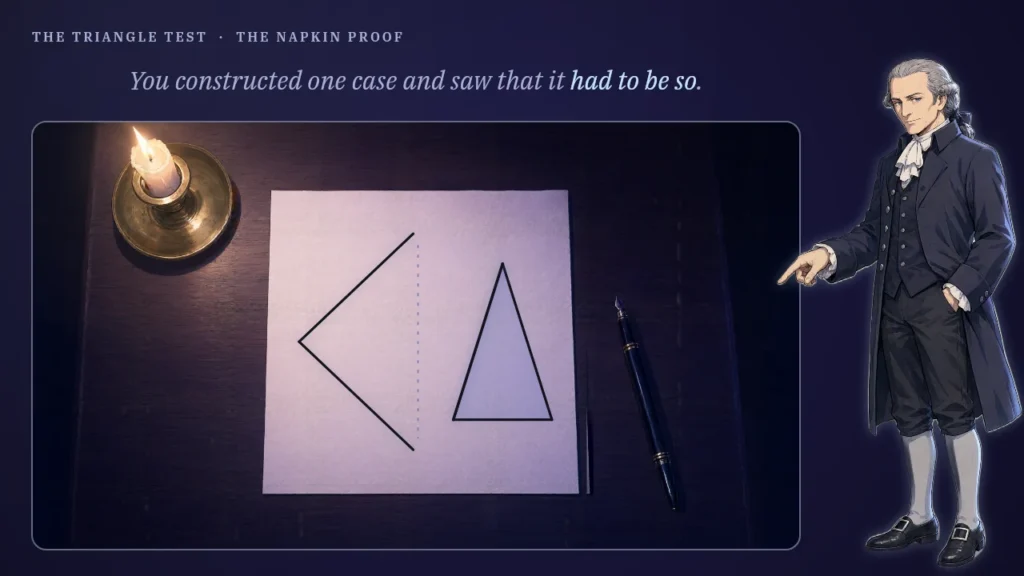
In the 1787 edition Kant added three more remarks. The first starts from an observation that sounds dry and turns out to be strange: everything our senses tell us about the world is relations. Where things are. How their positions change. The laws by which they change. What actually sits in a place, what a thing is in its own right — that never arrives.
Example: The Chess Piece
You can know everything about a knight in chess and never know what it is made of. Wood, plastic, pixels, a coin standing in for a lost piece — none of it matters. A knight just is the way it moves relative to the board and the other pieces.
Kant’s claim is that the physical world, as we can know it, is like that all the way down: positions, motions, forces. And from relations alone, he says, you never get the thing in itself.
Then he turns the same point on you. Your inner life also comes in relations: this thought after that one, this feeling at the same time as that, something that stays while other things pass. That is time. And to notice anything in yourself at all, Kant says, the mind has to “affect” itself — to set its own representations before itself and take them in.
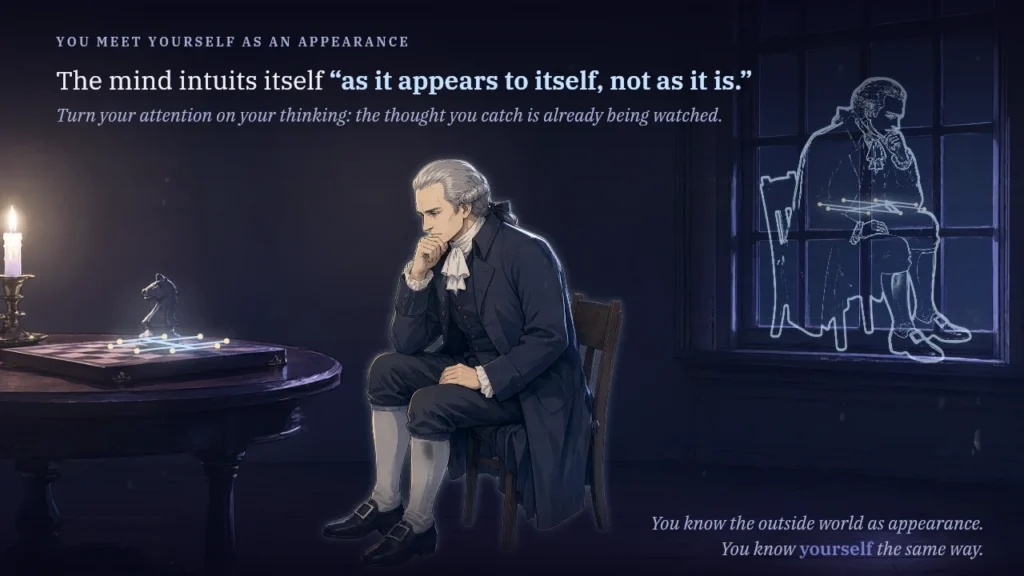
The consequence is one of the most unsettling sentences in the book. The mind intuits itself “as it appears to itself, not as it is.” You know the outside world as appearance. You know yourself the same way.
Try it. Turn your attention on your own thinking right now. Notice that the act of noticing changes what you find; the thought you catch is already a thought being watched. Kant later uses attention as exactly this kind of example. He also admits, with real honesty, that how a mind can look at itself at all is “the whole difficulty” — and that it is “a difficulty common to every theory,” not a problem he invented.
So the self that feels most certain to you — the one doing the doubting in the first row — is, as known, in the same boat as the rain. Real, given, yours. Not given as it is in itself.
By now the obvious complaint is loud. So it’s all an illusion? Kant saw it coming and wrote the next remark against it.
No, he says. Appearance and illusion are different things, and confusing them is “my own fault” if I do it. In appearance the objects and their qualities “are always regarded as something actually given.” An illusion is something else: it is when you hand an object, taken on its own, a property that belongs to it only in relation to you.
Example: Saturn’s Handles
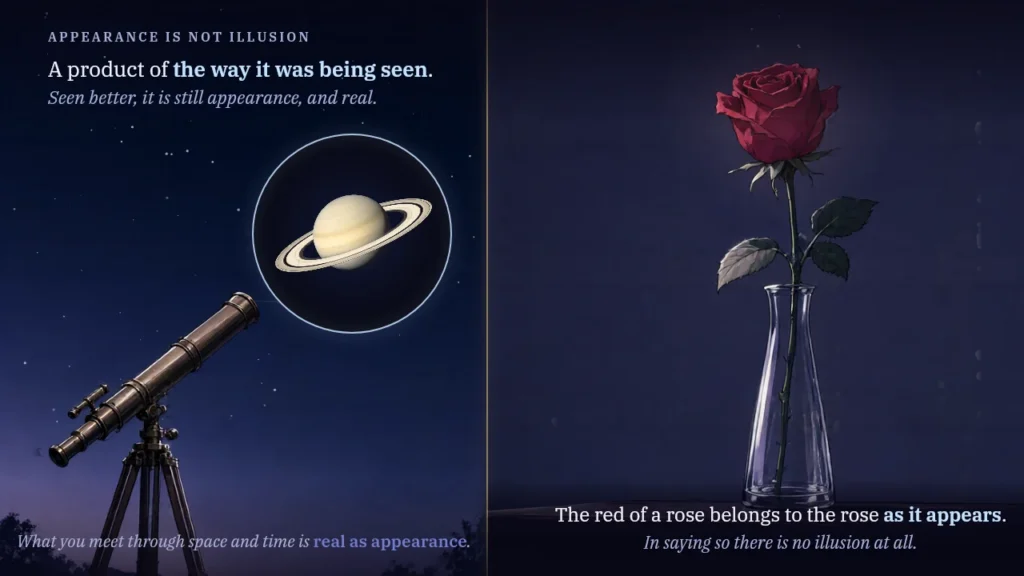
The red of a rose and its scent belong to the rose as it appears — and in saying so there is no illusion at all. That is simply what the rose is, for any of us.
When the first telescopes were pointed at Saturn, observers saw two odd bulges on either side and described them as handles or ears. They ascribed to the planet itself what was a product of the way it was being seen. Kant uses exactly this case: “the two handles which were formerly ascribed to Saturn.” That is illusion.
And the line runs further than you might think: call the rose red in itself, or call outer things extended in themselves, and you have crossed it.
Then Kant turns the accusation round, and this is the best move in the remark. It is not his view that turns the world into illusion. It is the opposite view. Make space and time real things in their own right — infinite, not substances, yet existing even if everything else were removed — and you are stuck with two enormous somethings that are neither things nor properties of things. Faced with that, Kant says:
“We cannot blame the good Berkeley for degrading bodies to mere illusion.”
Berkeley was the philosopher who concluded that matter is nothing but ideas. Kant’s point is that Berkeley was driven there by taking space as a real thing and finding it absurd. Worse still, your own existence, made to depend on time as a self-standing thing, would dissolve into illusion along with it — “an absurdity of which no one has yet been guilty.”
So the theory that sounds most like “it’s all in your head” is, by Kant’s lights, the one that saves the world from being an illusion. What you meet through space and time is real as appearance, and the only way to lose it is to ask it to be more than that.
One last remark before the end. People who think about God usually take for granted that God is not in space and time — that God’s knowing is not a step-by-step affair. Kant asks: with what right, if space and time are real conditions of all things? They would have to be conditions of God’s existence too. Remove them from God and you have already admitted they are not conditions of things as such.
That lets Kant name the two kinds of intuition. One kind would give its object existence just by intuiting it; he calls it original, and allows it, if to anything, only to the first being. Ours is the other kind: derivative. It depends on being affected by objects that are already there. Perhaps every finite mind shares our space and time — Kant says we cannot know — but even then it would be sensibility, not a window onto things in themselves. And he is careful to say this remark is an illustration, not part of the proof.
Then the Aesthetic closes. The big question of the whole book is how we can know anything necessary about the world before experiencing it. Here, Kant says, is one of the factors needed for the answer: the pure intuitions of space and time. When a judgment goes beyond its concept, this is where it finds the extra — and this is also where it stops. Such judgments “can never extend beyond objects of the senses; they are valid only for objects of possible experience.”
That is the takeaway of the whole Aesthetic, and it cuts both ways. The frame is not a filter. It does not hide a truer world from you or tint the real one. It is the condition of there being a world for you at all — which is why you can know so much in advance about everything you will ever meet, and nothing at all about what lies beyond meeting.
Next: space and time are only half the toolkit. You do not just see; you think. The Transcendental Logic begins, and with it the question of where the concepts that organise experience come from.
The last part of the Transcendental Aesthetic — §7 and §8 and the closing paragraph, A36–A49 / B53–B73. Sections I and II built the case that space and time are forms of our sensibility. Here Kant stops building and defends it: one objection answered, one misreading refused, one test case offered to make the result certain, then three further remarks the 1787 edition added. Where the editions differ, both are mapped.
Kant opens §7 by reporting that he has heard one objection “from men of intelligence” so unanimously that he supposes it occurs “to every reader to whom this way of thinking is unfamiliar”. Post #3 set it up. Here it is, in the form Kant gives it:
P1. Alterations are real — “this being proved by change of our own representations”, even if all outer appearances, together with their alterations, are denied.
P2. Alterations are possible only in time.
∴ Time is something real.
Kant’s answer is the surprising part: “I grant the whole argument.” Every premise and the conclusion. What he refuses is a reading of the word real.
| Kant’s position | His words (Kemp Smith) | |
|---|---|---|
| Granted | Time is real — as the actual form of inner intuition. I really do have the representation of time and of my states in it. | “Certainly time is something real, namely, the real form of inner intuition. It has therefore subjective reality in respect of inner experience” |
| Granted | Empirical reality: time is the condition of all our experience. | “Thus empirical reality has to be allowed to time, as the condition of all our experiences” |
| Denied | Absolute reality: time as a property of the object rather than of the way the object is given. | “it is only its absolute reality that has to be denied. It is nothing but the form of our inner intuition.” |
The pivot sentence is this one: time is to be regarded as real “not indeed as object but as the mode of representation of myself as object”. The objection proves that something real changes. It cannot prove that the order in which I meet the changes belongs to the changing thing rather than to me.
Kant adds a counterfactual that is easy to skip and should not be. If I could intuit myself — or another being could intuit me — without this condition of sensibility, “the very same determinations which we now represent to ourselves as alterations would yield knowledge into which the representation of time, and therefore also of alteration, would in no way enter.” The determinations stay. The succession is the form they take for us. And his footnote to this paragraph says the same thing at the level of grammar: “I can indeed say that my representations follow one another; but this is only to say that we are conscious of them as in a time-sequence, that is, in conformity with the form of inner sense.”
Kant’s diagnosis is psychological and historical, and it is sharp. The people who press this objection have, he says, “nothing very convincing to say against the doctrine of the ideality of space”. Why the difference?
P1. They had no hope of proving the absolute reality of space apodeictically, because idealism already teaches that the reality of outer objects “does not allow of strict proof”.
P2. But the reality of the object of inner sense — myself and my state — is, they argue, “immediately evident through consciousness”.
∴ Kant: they missed that “both are in the same position”. Neither’s reality as representation can be questioned, and both “belong only to appearance”.
“Appearance”, Kant then says, “always has two sides”: the object considered in itself, whose nature “remains always problematic”, and the form of the intuition of that object, which is “not to be looked for in the object in itself, but in the subject to which the object appears” — and which nevertheless “belongs really and necessarily to the appearance of this object”. That last clause is transcendental idealism in a single line. The form comes from the subject; it is not therefore unreal.
Interpretation, not Kant’s text: the people who doubt outer objects but trust inner ones are recognisably Descartes’ heirs. Kant names no one here; in 1787 he answered them directly in the new Refutation of Idealism (B274–279), which argues the reverse — that inner experience is possible only through outer.
The second half of §7 turns from defence to accounting. Space and time are “two sources of knowledge, from which bodies of a priori synthetic knowledge can be derived” — pure mathematics being “a brilliant example”. And because they are “merely conditions of our sensibility”, they “determine their own limits”: they apply to objects only as appearances. “This is the sole field of their validity; should we pass beyond it, no objective use can be made of them.”
Kant then adds a reassurance that matters for everything after: this ideality “leaves, however, the certainty of empirical knowledge unaffected”. (Kant printed Realität here, in both editions; Kemp Smith, following Laas, Adickes and Vaihinger, reads Idealität, which is why the English panel says “ideality”.) Whether space and time inhere in things or only in our intuition of them, experience is exactly as certain as it was.
Then the two rivals, which he treats as a fork:
| Space and time as subsistent | Space and time as inherent relations | |
|---|---|---|
| Held by | “mathematical students of nature” | “certain metaphysical students of nature” |
| The view | “two eternal and infinite self-subsistent non-entities” (Undinge) “which are there (yet without there being anything real) only in order to contain in themselves all that is real” | relations of appearances, side by side or in succession, abstracted from experience and “in this isolation confusedly represented” |
| What it gains | keeps the field of appearances open for mathematics | space and time do not get in the way when judging objects “merely in their relation to the understanding” |
| What it costs | trouble the moment the understanding tries to go beyond that field | cannot explain a priori mathematics, nor bring experience into necessary agreement with it; its a priori concepts of space and time become “creatures of the imagination” |
“On our theory of the true character of these two original forms of sensibility, both difficulties are removed.” Interpretation: the first column is usually read as Newton and Clarke, the second as Leibniz. Kant names neither. Post #3’s L1 met the same pair in Conclusion (a) of the Time section.
§7 ends by closing the list. The Transcendental Aesthetic “cannot contain more than these two elements”. Every other concept belonging to sensibility presupposes something empirical. Motion needs “something movable”, and in space considered in itself nothing moves, so the movable is “an empirical datum”. Alteration likewise is not an a priori datum: “Time itself does not change, but only something which is in time.” What changes has to be met in experience.
This is not in tension with post #3’s §5, where the concept of time explains “the possibility of alteration”. Time is a priori; the concept of a particular alteration needs a perceived thing whose states succeed one another. §5 says what makes change thinkable; §7 says change itself is still something you have to find.
§8 opens by restating the doctrine as plainly as Kant can. It is worth having as a list, because every later misreading of Kant contradicts one of these sentences:
1. All our intuition is “nothing but the representation of appearance”.
2. The things we intuit “are not in themselves what we intuit them as being, nor their relations so constituted in themselves as they appear to us”.
3. Remove the subject — or even only the subjective constitution of the senses — and “the whole constitution and all the relations of objects in space and time, nay space and time themselves, would vanish”.
4. What objects may be in themselves “remains completely unknown to us”. We know only our mode of perceiving them, “peculiar to us, and not necessarily shared in by every being, though, certainly, by every human being”.
Then a sentence that defeats the most natural hope: even if our intuition were raised “to the highest degree of clearness”, we “should not thereby come any nearer to the constitution of objects in themselves”. Better eyesight, better instruments, better physics — all of it is a clearer view of appearance.
The rationalist school had an answer ready: sensibility is knowledge of things as they are, only confused — a heap of marks we have not sorted. Kant rejects this as a falsification of the concept of sensibility. His argument:
P1. “The difference between a confused and a clear representation is merely logical, and does not concern the content.”
P2. The concept of right shows it: in everyday use it already contains “all that the subtlest speculation can develop out of it”. It is confused, yet nobody calls it sensible — “‘right’ can never be an appearance; it is a concept in the understanding”.
P3. The representation of a body in intuition, conversely, “contains nothing that can belong to an object in itself”, however clear it becomes.
∴ The difference between sensible and intelligible “is quite evidently transcendental”. It concerns origin and content, not clarity. Through sensibility we do not know things in themselves confusedly; “we do not apprehend them in any fashion whatsoever.”
Kant’s own example, and the one most worth remembering:
| The empirical distinction | The transcendental distinction | |
|---|---|---|
| Appearance | the rainbow — it depends on where you stand | the rain, its drops, their round shape, “nay even the space in which they fall” |
| “Thing in itself” | the rain — the same for every observer from every position | “the transcendental object”, which “remains unknown to us” |
| Status | “correct, if the latter concept be taken in a merely physical sense” | the question “becomes transcendental” once we ask whether even the rain represents an object in itself |
The empirical distinction is legitimate, and Kant does not ask anyone to give it up. The mistake is to stop there — to treat what is constant for all human senses as if it were the thing in itself. Do that, and “our transcendental distinction is lost”.
Kant wants more than a plausible hypothesis. His theory is to have “that certainty and freedom from doubt which is required of any theory that is to serve as an organon”. To show it, he picks a case — space, because there the evidence is richest — and, in 1787 only, adds that it will “set what has been said in §3 in a clearer light”. The 1781 text has no §3 to point to, so that clause is missing from the A panel.
The form is a reductio: “Let us suppose that space and time are in themselves objective”.
P1. The propositions of geometry are synthetic a priori and known with apodeictic certainty.
P2. There is “no other way than through concepts or through intuitions”, each given either a priori or a posteriori.
P3. Empirical concepts and empirical intuition yield only empirical propositions, which “can never possess the necessity and absolute universality” of geometry.
P4. Mere concepts yield only analytic knowledge. Try deriving “Two straight lines cannot enclose a space” from the concepts straight line and two: “All your labour is vain”.
P5. So the object must be given a priori in intuition.
P6. But if that object — “the triangle” — were something in itself, apart from any relation to you, nothing guarantees that what lies in your subjective conditions for constructing a triangle “must of necessity belong to the triangle itself”.
∴ “It is, therefore, not merely possible or probable, but indubitably certain, that space and time … are merely subjective conditions of all our intuition”, and all objects in relation to them “mere appearances”. Much can be said a priori about the form of appearances; “nothing whatsoever can be asserted of the thing in itself”.
P6 carries the weight. The geometer constructs a figure and reads necessary truths off the construction. That works only if the object has to conform to the conditions of construction — which it does if, and only if, the object is an appearance whose form those conditions are.
Commentary, not Kant’s text: the classic objection to this step was pressed by Trendelenburg in the nineteenth century and is known as the “neglected alternative”: why could space not be both a form of our intuition and a feature of things in themselves? Kant’s P6 is his answer in advance. A merely lucky match between our construction and the things would not give necessity — and necessity is what geometry has.
Remarks II–IV and the Conclusion are absent from the first edition; the A panel stops at the end of the geometry paragraph. II offers a further confirmation, and it is one of the densest pages in the Aesthetic.
%%{init: {
  "theme": "base",
  "themeCSS": ".marker { fill:#ccc !important; stroke:#ccc !important; } .edge-thickness-normal { stroke:#ccc !important; }",
  "themeVariables": {
    "fontFamily": "'IBM Plex Serif','IBM Plex Sans',serif",
    "textColor": "#e2e8f0",
    "lineColor": "#cccccc",
    "edgeLabelBackground": "transparent"
  }
}}%%
flowchart TD
  R["Everything in our knowledge that belongs to intuition
 contains NOTHING BUT RELATIONS"] --> O["outer sense: locations (extension),
 change of location (motion),
 laws of that change (moving forces)"]
  O --> N["what is IN the location, or at work in the things themselves,
 is not given"]
  N --> T["a thing in itself cannot be known
 through mere relations"]
  T --> OC["outer sense gives only the relation
 of an object to the subject"]
  R --> I["inner sense: its material is the representations of outer sense;
 its form, time, holds only relations:
 succession, coexistence, the enduring"]
  I --> A["that form is the way the mind is affected
 by its own activity of positing its representations"]
  A --> S["so the subject intuits itself
 as it APPEARS to itself, not as it is"]
The left branch is the outer half of the argument. Everything intuition gives us about bodies is relational: where things are, how places change, by what laws. What occupies a place, or what a thing does “apart from change of location”, is never given. And “a thing in itself cannot be known through mere relations”. So outer sense presents only how objects stand to us.
The right branch applies the same point to ourselves, and this is where it gets hard. Time, Kant says, contains nothing but “relations of succession, coexistence, and of that which is coexistent with succession, the enduring”. A form of intuition that contains nothing but relations, and represents nothing except as something is “posited in the mind”, can only be “the mode in which the mind is affected through its own activity”. That is what inner sense is.
| Term | Kant’s gloss |
|---|---|
| Apperception (Apperception) | “The consciousness of self … is the simple representation of the ‘I'” — the bare thought I, which by itself gives no manifold to intuit. |
| Intellectual intuition | an intuition that would be “self-activity only”: if everything manifold in the subject were given by the self’s own activity, inner intuition “would be intellectual”. Ours is not. |
| Self-affection | in us, the manifold must be given, so the mind must “affect” itself to become conscious of what lies in it, and it intuits itself “as it is affected by itself, and therefore as it appears to itself, not as it is”. |
Kant concedes that “the whole difficulty is as to how a subject can inwardly intuit itself”, and adds at once that “this is a difficulty common to every theory”. He is not answering it here; he is pointing out that his opponents owe an answer too. The full treatment comes in the 1787 Transcendental Deduction (§24, B152–157), with a footnote that offers attention as the everyday case of the mind affecting itself. That is a forward reference, not part of this span.
The most predictable misreading of the Aesthetic is “so it’s all an illusion”. III is written against it.
When I say objects are represented “as they appear”, “I do not mean to say that these objects are a mere illusion“. In appearance, the objects and even the properties we ascribe to them “are always regarded as something actually given”. Kant’s footnote then draws the line with two examples:
| What it is | Kant’s example | |
|---|---|---|
| Appearance (Erscheinung) | what is “not to be met with in the object in itself, but always in its relation to the subject”, and inseparable from the representation of the object. Ascribing it to the object as appearance is correct. | red colour and scent, ascribed to the rose; space and time, ascribed to objects of the senses — “in this there is no illusion” |
| Illusion (Schein) | ascribing to the object, “taken by itself, what belongs to it only in relation to the senses” | “the two handles which were formerly ascribed to Saturn” |
| Where illusion begins | when the relation to the subject is forgotten | redness ascribed to the rose in itself, or extension to outer objects in themselves |
(Kemp Smith puts the Saturn sentence in square brackets, and the later mention of the handles too, with a note of his own: the bracketed passage “conflicts with the main argument, and is probably a later addition carelessly inserted”. The brackets are in the English panel; his note is not. The German panels print the sentence without any mark.)
Then the turn that makes III more than a defence. It is the opposite view that turns everything into illusion. Give space and time objective reality — make them infinite, non-substantial things that would “continue to exist, even although all existing things be removed” — and “we cannot blame the good Berkeley for degrading bodies to mere illusion”. Worse: our own existence, made dependent on “the self-subsistent reality of a non-entity, such as time”, would become illusion too, “an absurdity of which no one has yet been guilty”.
Natural theology thinks of an object — God — whose intuition must be free of space and time, since all his knowledge “must be intuition, and not thought, which always involves limitations”. Kant asks with what right theology removes space and time from that intuition, if they are forms of things in themselves. As conditions of all existence, “they must also be conditions of the existence of God”. The theologian who keeps God outside time has already conceded that time is not a condition of things as such.
| intuitus originarius — original | intuitus derivativus — derivative |
|---|---|
| gives the existence of its object; “so far as we can judge, can belong only to the primordial being” | “dependent upon the existence of the object”, possible “only if the subject’s faculty of representation is affected by that object” |
| would be intellectual intuition | is sensibility — “however universal this mode of sensibility may be” |
The note of humility is exact: all finite thinking beings may share our forms of space and time, “although we are not in a position to judge whether this is actually so”. If they do, that does not make the forms any less sensible. And Kant labels the whole remark: “only … an illustration of our aesthetic theory, not as forming part of the proof.”
The Critique‘s guiding question was announced in the B Introduction: how are synthetic a priori judgments possible? The Aesthetic’s Conclusion says what it has contributed — “one of the factors required for solution”, not the solution.
When an a priori judgment goes beyond its concept, the pure intuitions are where it finds “that which cannot be discovered in the concept but which is certainly found a priori in the intuition corresponding to the concept”. The same fact sets the limit. Such judgments “can never extend beyond objects of the senses; they are valid only for objects of possible experience.”
The other factor — the pure concepts of the understanding — is the business of the Transcendental Logic, which is where post #5 begins.
| A (1781) | B (1787) |
|---|---|
| Erläuterung, unnumbered | §7 Erläuterung — same four paragraphs; streitet → bestreitet twice, Er lautet so → also |
| Allgemeine Anmerkungen, one undivided text | §8, its first part numbered I — the same seven paragraphs |
| “…woran dessen Gültigkeit augenscheinlich werden kann.” | adds “…und zu mehrer Klarheit dessen, was § 3 angeführt worden, dienen kann” — A had no §3 |
| — the Aesthetic ends here (A49) — | II, III (with Kant’s note on the rose and Saturn), IV: new |
| — | Conclusion of the Transcendental Aesthetic: new |
So the 1787 additions all come at the end, and all point the same way: II at the self, III at Berkeley, IV at theology, the Conclusion at the question the B Introduction had just made explicit. The 1781 Aesthetic ended on geometry.
Wider diese Theorie, welche der Zeit empirische Realität zugesteht,aber die absolute und transscendentale streitet, habe ich von einsehendenMännern einen Einwurf so einstimmig vernommen, daß ich daraus abnehme,er müsse sich natürlicher Weise bei jedem Leser, dem diese Betrachtungenungewohnt sind, vorfinden. Er lautet so: Veränderungen sindwirklich (dies beweiset der Wechsel unserer eigenen Vorstellungen, wennman gleich alle äußere Erscheinungen sammt deren Veränderungen leugnenwollte). Nun sind Veränderungen nur in der Zeit möglich, folglichist die Zeit etwas Wirkliches. Die Beantwortung hat keine Schwierigkeit.Ich gebe das ganze Argument zu. Die Zeit ist allerdings etwas Wirkliches,nämlich die wirkliche Form der innern Anschauung. Sie hat alsosubjective Realität in Ansehung der innern Erfahrung, d. i. ich habewirklich die Vorstellung von der Zeit und meinen Bestimmungen in ihr.Sie ist also wirklich, nicht als Object, sondern als die Vorstellungsartmeiner selbst als Objects anzusehen. Wenn aber ich selbst, oder ein anderWesen mich ohne diese Bedingung der Sinnlichkeit anschauen könnte, sowürden eben dieselben Bestimmungen, die wir uns jetzt als Veränderungenvorstellen, eine Erkenntniß geben, in welcher die Vorstellung der Zeit,mithin auch der Veränderung gar nicht vorkäme. Es bleibt also ihreempirische Realität als Bedingung aller unsrer Erfahrungen. Nur dieabsolute Realität kann ihr nach dem oben Angeführten nicht zugestandenwerden. Sie ist nichts, als die Form unsrer inneren Anschauung.*)Wenn man von ihr die besondere Bedingung unserer Sinnlichkeit wegnimmt,so verschwindet auch der Begriff der Zeit, und sie hängt nicht anden Gegenständen selbst, sondern blos am Subjecte, welches sie anschauet.
*) Ich kann zwar sagen: meine Vorstellungen folgen einander; aber dasheißt nur: wir sind uns ihrer als in einer Zeitfolge, d. i. nach der Form desinnern Sinnes, bewußt. Die Zeit ist darum nicht etwas an sich selbst, auch keineden Dingen objectiv anhängende Bestimmung.
Die Ursache aber, weswegen dieser Einwurf so einstimmig gemachtwird und zwar von denen, die gleichwohl gegen die Lehre von der Idealitätdes Raumes nichts Einleuchtendes einzuwenden wissen, ist diese. Dieabsolute Realität des Raumes hofften sie nicht apodiktisch darthun zukönnen, weil ihnen der Idealismus entgegen steht, nach welchem dieWirklichkeit äußerer Gegenstände keines strengen Beweises fähig ist: dagegendie des Gegenstandes unserer innern Sinnen (meiner selbst undmeines Zustandes) unmittelbar durchs Bewußtsein klar ist. Jene konntenein bloßer Schein sein, dieser aber ist ihrer Meinung nach unleugbaretwas Wirkliches. Sie bedachten aber nicht, daß beide, ohne daß manihre Wirklichkeit als Vorstellungen bestreiten darf, gleichwohl nur zur Erscheinunggehören, welche jederzeit zwei Seiten hat, die eine, da das Objectan sich selbst betrachtet wird (unangesehen der Art, dasselbe anzuschauen,dessen Beschaffenheit aber eben darum jederzeit problematischbleibt), die andere, da auf die Form der Anschauung dieses Gegenstandesgesehen wird, welche nicht in dem Gegenstande an sich selbst, sondern imSubjecte, dem derselbe erscheint, gesucht werden muß, gleichwohl aber derErscheinung dieses Gegenstandes wirklich und nothwendig zukommt.
Zeit und Raum sind demnach zwei Erkenntnißquellen, aus denen a prioriverschiedene synthetische Erkenntnisse geschöpft werden können, wie vornehmlichdie reine Mathematik in Ansehung der Erkenntnisse vom Raumeund dessen Verhältnissen ein glänzendes Beispiel giebt. Sie sind nämlichbeide zusammen genommen reine Formen aller sinnlichen Anschauungund machen dadurch synthetische Sätze a priori möglich. Aber diese Erkenntnißquellena priori bestimmen sich eben dadurch (daß sie blos Bedingungender Sinnlichkeit sind) ihre Grenzen, nämlich daß sie blos aufGegenstände gehen, so fern sie als Erscheinungen betrachtet werden, nichtaber Dinge an sich selbst darstellen. Jene allein sind das Feld ihrer Gültigkeit,woraus wenn man hinausgeht, weiter kein objectiver Gebrauchderselben statt findet. Diese Realität des Raumes und der Zeit läßtübrigens die Sicherheit der Erfahrungserkenntniß unangetastet: denn wirsind derselben eben so gewiß, ob diese Formen den Dingen an sich selbst,oder nur unsrer Anschauung dieser Dinge nothwendiger Weise anhängen.Dagegen die, so die absolute Realität des Raumes und der Zeit behaupten,sie mögen sie nun als subsistirend oder nur inhärirend annehmen,mit den Principien der Erfahrung selbst uneinig sein müssen. Denn entschließensie sich zum ersteren (welches gemeiniglich die Partei der mathematischenNaturforscher ist), so müssen sie zwei ewige und unendliche fürsich bestehende Undinge (Raum und Zeit) annehmen, welche da sind, (ohnedaß doch etwas Wirkliches ist) nur um alles Wirkliche in sich zu befassen.Nehmen sie die zweite Partei (von der einige metaphysische Naturlehrersind) und Raum und Zeit gelten ihnen als von der Erfahrung abstrahirte,obzwar in der Absonderung verworren vorgestellte Verhältnisse der Erscheinungen(neben oder nach einander), so müssen sie den mathematischenLehren a priori in Ansehung wirklicher Dinge (z. E. im Raume) ihreGültigkeit, wenigstens die apodiktische Gewißheit streiten, indem diesea posteriori gar nicht statt findet, und die Begriffe a priori von Raumund Zeit dieser Meinung nach nur Geschöpfe der Einbildungskraft sind,deren Quell wirklich in der Erfahrung gesucht werden muß, aus deren abstrahirtenVerhältnissen die Einbildung etwas gemacht hat, was zwar dasAllgemeine derselben enthält, aber ohne die Restrictionen, welche die Naturmit denselben verknüpft hat, nicht statt finden kann. Die erstere gewinnenso viel, daß sie für die mathematische Behauptungen sich das Feld derErscheinungen frei machen. Dagegen verwirren sie sich sehr durch ebendiese Bedingungen, wenn der Verstand über dieses Feld hinausgehen will.Die zweite gewinnen zwar in Ansehung des letzteren, nämlich daß dieVorstellungen von Raum und Zeit ihnen nicht in den Weg kommen,wenn sie von Gegenständen nicht als Erscheinungen, sondern blos imVerhältniß auf den Verstand urtheilen wollen; können aber weder vonder Möglichkeit mathematischer Erkenntnisse a priori (indem ihnen einewahre und objectiv gültige Anschauung a priori fehlt) Grund angeben,noch die Erfahrungssätze mit jenen Behauptungen in nothwendige Einstimmungbringen. In unserer Theorie von der wahren Beschaffenheitdieser zwei ursprünglichen Formen der Sinnlichkeit ist beiden Schwierigkeitenabgeholfen.
Daß schließlich die transscendentale Ästhetik nicht mehr als diesezwei Elemente, nämlich Raum und Zeit, enthalten könne, ist daraus klar,weil alle andre zur Sinnlichkeit gehörige Begriffe, selbst der der Bewegung,welcher beide Stücke vereinigt, etwas Empirisches voraussetzen.Denn diese setzt die Wahrnehmung von etwas Beweglichem voraus. ImRaum, an sich selbst betrachtet, ist aber nichts Bewegliches: daher dasBewegliche etwas sein muß, was im Raume nur durch Erfahrunggefunden wird, mithin ein empirisches Datum. Eben so kann die transscendentaleÄsthetik nicht den Begriff der Veränderung unter ihre Dataa priori zählen: denn die Zeit selbst verändert sich nicht, sondern etwas,das in der Zeit ist. Also wird dazu die Wahrnehmung von irgend einemDasein und der Succession seiner Bestimmungen, mithin Erfahrung erfordert.
Zuerst wird es nöthig sein, uns so deutlich als möglich zu erklären,was in Ansehung der Grundbeschaffenheit der sinnlichen Erkenntniß überhauptunsre Meinung sei, um aller Mißdeutung derselben vorzubeugen.
Wir haben also sagen wollen: daß alle unsre Anschauung nichts alsdie Vorstellung von Erscheinung sei; daß die Dinge, die wir anschauen,nicht das an sich selbst sind, wofür wir sie anschauen, noch ihre Verhältnisseso an sich selbst beschaffen sind, als sie uns erscheinen, und daß, wennwir unser Subject oder auch nur die subjective Beschaffenheit der Sinneüberhaupt aufheben, alle die Beschaffenheit, alle Verhältnisse der Objekteim Raum und Zeit, ja selbst Raum und Zeit verschwinden würden undals Erscheinungen nicht an sich selbst, sondern nur in uns existiren können.Was es für eine Bewandtniß mit den Gegenständen an sich und abgesondertvon aller dieser Receptivität unserer Sinnlichkeit haben möge, bleibtuns gänzlich unbekannt. Wir kennen nichts als unsere Art, sie wahrzunehmen,die uns eigenthümlich ist, die auch nicht nothwendig jedem Wesen,obzwar jedem Menschen zukommen muß. Mit dieser haben wir es lediglichzu thun. Raum und Zeit sind die reine Formen derselben, Empfindungüberhaupt die Materie. Jene können wir allein a priori, d. i. voraller wirklichen Wahrnehmung, erkennen, und sie heißt darum reine Anschauung;diese aber ist das in unserm Erkenntniß, was da macht, daß esErkenntniß a posteriori, d. i. empirische Anschauung, heißt. Jene hängenunsrer Sinnlichkeit schlechthin nothwendig an, welcher Art auch unsereEmpfindungen sein mögen; diese können sehr verschieden sein. Wenn wirdiese unsre Anschauung auch zum höchsten Grade der Deutlichkeit bringenkönnten, so würden wir dadurch der Beschaffenheit der Gegenstände ansich selbst nicht näher kommen. Denn wir würden auf allen Fall dochnur unsre Art der Anschauung, d. i. unsere Sinnlichkeit, vollständig erkennenund diese immer nur unter den dem Subject ursprünglich anhängendenBedingungen von Raum und Zeit; was die Gegenstände an sichselbst sein mögen, würde uns durch die aufgeklärteste Erkenntniß der Erscheinungderselben, die uns allein gegeben ist, doch niemals bekanntwerden.
Daß daher unsere ganze Sinnlichkeit nichts als die verworrene Vorstellungder Dinge sei, welche lediglich das enthält, was ihnen an sichselbst zukommt, aber nur unter einer Zusammenhäufung von Merkmalenund Theilvorstellungen, die wir nicht mit Bewußtsein auseinander setzen,ist eine Verfälschung des Begriffs von Sinnlichkeit und von Erscheinung,welche die ganze Lehre derselben unnütz und leer macht. Der Unterschiedeiner undeutlichen von der deutlichen Vorstellung ist blos logisch und betrifftnicht den Inhalt. Ohne Zweifel enthält der Begriff von Recht,dessen sich der gesunde Verstand bedient, eben dasselbe, was die subtilsteSpeculation aus ihm entwickeln kann, nur daß im gemeinen und praktischenGebrauche man sich dieser mannigfaltigen Vorstellungen in diesemGedanken nicht bewußt ist. Darum kann man nicht sagen, daß der gemeineBegriff sinnlich sei und eine bloße Erscheinung enthalte; denn dasRecht kann gar nicht erscheinen, sondern sein Begriff liegt im Verstandeund stellt eine Beschaffenheit (die moralische) der Handlungen vor, dieihnen an sich selbst zukommt. Dagegen enthält die Vorstellung einesKörpers in der Anschauung gar nichts, was einem Gegenstande an sichselbst zukommen könnte, sondern blos die Erscheinung von Etwas und dieArt, wie wir dadurch afficirt werden; und diese Receptivität unserer Erkenntnißfähigkeitheißt Sinnlichkeit und bleibt von der Erkenntniß desGegenstandes an sich selbst, ob man jene (die Erscheinung) gleich bis aufden Grund durchschauen möchte, dennoch himmelweit unterschieden.
Die Leibniz=Wolffische Philosophie hat daher allen Untersuchungenüber die Natur und den Ursprung unserer Erkenntnisse einen ganz unrechtenGesichtspunkt angewiesen, indem sie den Unterschied der Sinnlichkeitvom Intellectuellen blos als logisch betrachtete, da er offenbar transscendentalist und nicht blos die Form der Deutlichkeit oder Undeutlichkeit,sondern den Ursprung und den Inhalt derselben betrifft, so daß wirdurch die erstere die Beschaffenheit der Dinge an sich selbst nicht blos undeutlich,sondern gar nicht erkennen, und so bald wir unsre subjectiveBeschaffenheit wegnehmen, das vorgestellte Objekt mit den Eigenschaften,die ihm die sinnliche Anschauung beilegte, überall nirgend anzutreffen ist,noch angetroffen werden kann, indem eben diese subjective Beschaffenheitdie Form desselben als Erscheinung bestimmt.
Wir unterscheiden sonst wohl unter Erscheinungen das, was der Anschauungderselben wesentlich anhängt und für jeden menschlichen Sinnüberhaupt gilt, von demjenigen, was derselben nur zufälliger Weise zukommt,indem es nicht auf die Beziehung der Sinnlichkeit überhaupt,sondern nur auf eine besondre Stellung oder Organisation dieses oderjenes Sinnes gültig ist. Und da nennt man die erstere Erkenntniß einesolche, die den Gegenstand an sich selbst vorstellt, die zweite aber nur dieErscheinung desselben. Dieser Unterschied ist aber nur empirisch. Bleibtman dabei stehen (wie es gemeiniglich geschieht) und sieht jene empirischeAnschauung nicht wiederum (wie es geschehen sollte) als bloße Erscheinungan, so daß darin gar nichts, was irgend eine Sache an sich selbst anginge,anzutreffen ist, so ist unser transscendentaler Unterschied verloren, undwir glauben alsdann doch, Dinge an sich zu erkennen, ob wir es gleichüberall (in der Sinnenwelt), selbst bis zu der tiefsten Erforschung ihrerGegenstände, mit nichts als Erscheinungen zu thun haben. So werdenwir zwar den Regenbogen eine bloße Erscheinung bei einem Sonnregennennen, diesen Regen aber die Sache an sich selbst, welches auch richtigist, so fern wir den letztern Begriff nur physisch verstehen als das, wasin der allgemeinen Erfahrung unter allen verschiedenen Lagen zu denSinnen, doch in der Anschauung so und nicht anders bestimmt ist. Nehmenwir aber dieses Empirische überhaupt und fragen, ohne uns an dieEinstimmung desselben mit jedem Menschensinne zu kehren, ob auch dieseseinen Gegenstand an sich selbst (nicht die Regentropfen, denn die sinddann schon als Erscheinungen empirische Objecte) vorstelle: so ist dieFrage von der Beziehung der Vorstellung auf den Gegenstand transscendental,und nicht allein diese Tropfen sind bloße Erscheinungen, sondernselbst ihre runde Gestalt, ja sogar der Raum, in welchem sie fallen, sindnichts an sich selbst, sondern bloße Modificationen oder Grundlagen unserersinnlichen Anschauung; das transscendentale Object aber bleibt unsunbekannt.
Die zweite wichtige Angelegenheit unserer transscendentalen Ästhetikist, daß sie nicht blos als scheinbare Hypothese einige Gunst erwerbe, sondernso gewiß und ungezweifelt sei, als jemals von einer Theorie gefordertwerden kann, die zum Organon dienen soll. Um diese Gewißheitvöllig einleuchtend zu machen, wollen wir irgend einen Fall wählen, worandessen Gültigkeit augenscheinlich werden kann.
Setzet demnach, Raum und Zeit seien an sich selbst objectiv und Bedingungender Möglichkeit der Dinge an sich selbst, so zeigt sich erstlich:daß von beiden a priori apodiktische und synthetische Sätze in großer Zahl,vornehmlich vom Raum, vorkommen, welchen wir darum vorzüglich hierzum Beispiel untersuchen wollen. Da die Sätze der Geometrie synthetischa priori, und mit apodiktischer Gewißheit erkannt werden, so frage ich:woher nehmt ihr dergleichen Sätze, und worauf stützt sich unser Verstand,um zu dergleichen schlechthin nothwendigen und allgemein gültigen Wahrheitenzu gelangen? Es ist kein anderer Weg, als durch Begriffe oderdurch Anschauungen; beide aber als solche, die entweder a priori odera posteriori gegeben sind. Die letztere, nämlich empirische Begriffe, imgleichendas, worauf sie sich gründen, die empirische Anschauung, könnenkeinen synthetischen Satz geben, als nur einen solchen, der auch blos empirisch,d. i. ein Erfahrungssatz ist, mithin niemals Nothwendigkeit undabsolute Allgemeinheit enthalten kann, dergleichen doch das Charakteristischealler Sätze der Geometrie ist. Was aber das erstere und einzigeMittel sein würde, nämlich durch bloße Begriffe oder durch Anschauungena priori zu dergleichen Erkenntnissen zu gelangen, so ist klar, daß ausbloßen Begriffen gar keine synthetische Erkenntniß, sondern lediglich analytischeerlangt werden kann. Nehmet nur den Satz, daß durch zwei geradeLinien sich gar kein Raum einschließen lasse, mithin keine Figurmöglich sei, und versucht ihn aus dem Begriff von geraden Linien undder Zahl zwei abzuleiten, oder auch, daß aus drei geraden Linien eineFigur möglich sei, und versucht es eben so blos aus diesen Begriffen. Alleeure Bemühung ist vergeblich, und ihr seht euch genöthigt, zur Anschauungeure Zuflucht zu nehmen, wie es die Geometrie auch jederzeit thut. Ihrgebt euch also einen Gegenstand in der Anschauung; von welcher Art aberist diese, ist es eine reine Anschauung a priori oder eine empirische? Wäredas letzte, so könnte niemals ein allgemein gültiger, noch weniger ein apodiktischerSatz daraus werden: denn Erfahrung kann dergleichen niemalsliefern. Ihr müßt also euren Gegenstand a priori in der Anschauunggeben und auf diesen euren synthetischen Satz gründen. Läge nun in euchnicht ein Vermögen, a priori anzuschauen; wäre diese subjective Bedingungder Form nach nicht zugleich die allgemeine Bedingung a priori,unter der allein das Object dieser (äußeren) Anschauung selbst möglichist; wäre der Gegenstand (der Triangel) etwas an sich selbst ohne Beziehungauf euer Subject: wie könntet ihr sagen, daß, was in euren subjectivenBedingungen einen Triangel zu construiren nothwendig liegt, auchdem Triangel an sich selbst nothwendig zukommen müsse? Denn ihrkönntet doch zu euren Begriffen (von drei Linien) nichts Neues (die Figur)hinzufügen, welches darum nothwendig an dem Gegenstande angetroffenwerden müßte, da dieser vor eurer Erkenntniß und nicht durch dieselbe gegebenist. Wäre also nicht der Raum (und so auch die Zeit) eine bloßeForm eurer Anschauung, welche Bedingungen a priori enthält, unterdenen allein Dinge für euch äußere Gegenstände sein können, die ohnediese subjective Bedingungen an sich nichts sind, so könntet ihr a prioriganz und gar nichts über äußere Objecte synthetisch ausmachen. Es istalso ungezweifelt gewiß und nicht blos möglich oder auch wahrscheinlich,daß Raum und Zeit, als die nothwendige Bedingungen aller (äußernund innern) Erfahrung, blos subjective Bedingungen aller unsrer Anschauungsind, im Verhältniß auf welche daher alle Gegenstände bloßeErscheinungen und nicht für sich in dieser Art gegebene Dinge sind, vondenen sich auch um deswillen, was die Form derselben betrifft, vielesa priori sagen läßt, niemals aber das Mindeste von dem Dinge an sichselbst, das diesen Erscheinungen zum Grunde liegen mag.
Wider diese Theorie, welche der Zeit empirische Realität zugesteht,aber die absolute und transscendentale bestreitet, habe ich von einsehendenMännern einen Einwurf so einstimmig vernommen, daß ich daraus abnehme,er müsse sich natürlicher Weise bei jedem Leser, dem diese Betrachtungenungewohnt sind, vorfinden. Er lautet also: Veränderungen sindwirklich (dies beweiset der Wechsel unserer eigenen Vorstellungen, wennman gleich alle äußere Erscheinungen sammt deren Veränderungen leugnenwollte). Nun sind Veränderungen nur in der Zeit möglich, folglichist die Zeit etwas Wirkliches. Die Beantwortung hat keine Schwierigkeit.Ich gebe das ganze Argument zu. Die Zeit ist allerdings etwas Wirkliches,nämlich die wirkliche Form der innern Anschauung. Sie hat alsosubjective Realität in Ansehung der innern Erfahrung, d. i. ich habe wirklichdie Vorstellung von der Zeit und meinen Bestimmungen in ihr. Sieist also wirklich, nicht als Object, sondern als die Vorstellungsart meinerselbst als Objects anzusehen. Wenn aber ich selbst oder ein ander Wesenmich ohne diese Bedingung der Sinnlichkeit anschauen könnte, so würdeneben dieselben Bestimmungen, die wir uns jetzt als Veränderungen vorstellen,eine Erkenntniß geben, in welcher die Vorstellung der Zeit, mithinauch der Veränderung gar nicht vorkäme. Es bleibt also ihre empirischeRealität als Bedingung aller unsrer Erfahrungen. Nur die absolute Realitätkann ihr nach dem oben Angeführten nicht zugestanden werden.Sie ist nichts, als die Form unsrer inneren Anschauung.*) Wenn manvon ihr die besondere Bedingung unserer Sinnlichkeit wegnimmt, so verschwindetauch der Begriff der Zeit, und sie hängt nicht an den Gegenständenselbst, sondern bloß am Subjecte, welches sie anschauet.
*) Ich kann zwar sagen: meine Vorstellungen folgen einander; aber das heißtnur, wir sind uns ihrer als in einer Zeitfolge, d. i. nach der Form des innernSinnes, bewußt. Die Zeit ist darum nicht etwas an sich selbst, auch keine den Dingenobjectiv anhängende Bestimmung.
Die Ursache aber, weswegen dieser Einwurf so einstimmig gemachtwird und zwar von denen, die gleichwohl gegen die Lehre von der Idealitätdes Raumes nichts Einleuchtendes einzuwenden wissen, ist diese. Dieabsolute Realität des Raumes hofften sie nicht apodiktisch darthun zukönnen, weil ihnen der Idealismus entgegensteht, nach welchem die Wirklichkeitäußerer Gegenstände keines strengen Beweises fähig ist: dagegendie des Gegenstandes unserer innern Sinnen (meiner selbst und meinesZustandes) unmittelbar durchs Bewußtsein klar ist. Jene konnten einbloßer Schein sein, dieser aber ist ihrer Meinung nach unleugbar etwasWirkliches. Sie bedachten aber nicht, daß beide, ohne daß man ihre Wirklichkeitals Vorstellungen bestreiten darf, gleichwohl nur zur Erscheinunggehören, welche jederzeit zwei Seiten hat, die eine, da das Object an sichselbst betrachtet wird (unangesehen der Art, dasselbe anzuschauen, dessenBeschaffenheit aber eben darum jederzeit problematisch bleibt), die andere,da auf die Form der Anschauung dieses Gegenstandes gesehen wird, welchenicht in dem Gegenstande an sich selbst, sondern im Subjecte, dem derselbeerscheint, gesucht werden muß, gleichwohl aber der Erscheinung dieses Gegenstandeswirklich und nothwendig zukommt.
Zeit und Raum sind demnach zwei Erkenntnißquellen, aus denena priori verschiedene synthetische Erkenntnisse geschöpft werden können,wie vornehmlich die reine Mathematik in Ansehung der Erkenntnisse vomRaume und dessen Verhältnissen ein glänzendes Beispiel giebt. Sie sindnämlich beide zusammengenommen reine Formen aller sinnlichen Anschauungund machen dadurch synthetische Sätze a priori möglich. Aberdiese Erkenntnißquellen a priori bestimmen sich eben dadurch (daß sie bloßBedingungen der Sinnlichkeit sind) ihre Grenzen, nämlich daß sie bloßauf Gegenstände gehen, sofern sie als Erscheinungen betrachtet werden,nicht aber Dinge an sich selbst darstellen. Jene allein sind das Feld ihrerGültigkeit, woraus, wenn man hinausgeht, weiter kein objectiver Gebrauchderselben stattfindet. Diese Realität des Raumes und der Zeit läßt übrigensdie Sicherheit der Erfahrungserkenntniß unangetastet: denn wirsind derselben eben so gewiß, ob diese Formen den Dingen an sich selbst,oder nur unsrer Anschauung dieser Dinge nothwendiger Weise anhängen.Dagegen die, so die absolute Realität des Raumes und der Zeit behaupten,sie mögen sie nun als subsistirend oder nur inhärirend annehmen,mit den Principien der Erfahrung selbst uneinig sein müssen. Denn entschließensie sich zum ersteren (welches gemeiniglich die Partei der mathematischenNaturforscher ist), so müssen sie zwei ewige und unendliche fürsich bestehende Undinge (Raum und Zeit) annehmen, welche dasind (ohnedaß doch etwas Wirkliches ist), nur um alles Wirkliche in sich zu befassen.Nehmen sie die zweite Partei (von der einige metaphysische Naturlehrersind), und Raum und Zeit gelten ihnen als von der Erfahrung abstrahirte,obzwar in der Absonderung verworren vorgestellte, Verhältnisse derErscheinungen (neben oder nach einander): so müssen sie den mathematischenLehren a priori in Ansehung wirklicher Dinge (z. E. im Raume)ihre Gültigkeit, wenigstens die apodiktische Gewißheit bestreiten, indemdiese a posteriori gar nicht stattfindet, und die Begriffe a priori vonRaum und Zeit dieser Meinung nach nur Geschöpfe der Einbildungskraftsind, deren Quell wirklich in der Erfahrung gesucht werden muß, aus derenabstrahirten Verhältnissen die Einbildung etwas gemacht hat, waszwar das Allgemeine derselben enthält, aber ohne die Restrictionen, welchedie Natur mit denselben verknüpft hat, nicht stattfinden kann. Die ersterengewinnen so viel, daß sie für die mathematischen Behauptungen sich dasFeld der Erscheinungen frei machen. Dagegen verwirren sie sich sehr durcheben diese Bedingungen, wenn der Verstand über dieses Feld hinausgehenwill. Die zweiten gewinnen zwar in Ansehung des letzteren, nämlich daßdie Vorstellungen von Raum und Zeit ihnen nicht in den Weg kommen,wenn sie von Gegenständen nicht als Erscheinungen, sondern bloß im Verhältnißauf den Verstand urtheilen wollen; können aber weder von derMöglichkeit mathematischer Erkenntnisse a priori (indem ihnen eine wahreund objectiv gültige Anschauung a priori fehlt) Grund angeben, noch dieErfahrungssätze mit jenen Behauptungen in nothwendige Einstimmungbringen. In unserer Theorie von der wahren Beschaffenheit dieser zweiursprünglichen Formen der Sinnlichkeit ist beiden Schwierigkeiten abgeholfen.
Daß schließlich die transscendentale Ästhetik nicht mehr als diese zweiElemente, nämlich Raum und Zeit, enthalten könne, ist daraus klar, weilalle andre zur Sinnlichkeit gehörige Begriffe, selbst der der Bewegung,welcher beide Stücke vereinigt, etwas Empirisches voraussetzen. Denndiese setzt die Wahrnehmung von etwas Beweglichem voraus. Im Raum,an sich selbst betrachtet, ist aber nichts Bewegliches: daher das Beweglicheetwas sein muß, was im Raume nur durch Erfahrung gefundenwird, mithin ein empirisches Datum. Eben so kann die transscendentaleÄsthetik nicht den Begriff der Veränderung unter ihre Data a priori zählen:denn die Zeit selbst verändert sich nicht, sondern etwas, das in derZeit ist. Also wird dazu die Wahrnehmung von irgend einem Daseinund der Succession seiner Bestimmungen, mithin Erfahrung erfordert.
I Zuerst wird es nöthig sein, uns so deutlich als möglich zu erklären,was in Ansehung der Grundbeschaffenheit der sinnlichen Erkenntnißüberhaupt unsere Meinung sei, um aller Mißdeutung derselben vorzubeugen.
Wir haben also sagen wollen: daß alle unsre Anschauung nichts alsdie Vorstellung von Erscheinung sei; daß die Dinge, die wir anschauen,nicht das an sich selbst sind, wofür wir sie anschauen, noch ihre Verhältnisseso an sich selbst beschaffen sind, als sie uns erscheinen, und daß, wenn wirunser Subject oder auch nur die subjective Beschaffenheit der Sinne überhauptaufheben, alle die Beschaffenheit, alle Verhältnisse der Objecte imRaum und Zeit, ja selbst Raum und Zeit verschwinden würden und alsErscheinungen nicht an sich selbst, sondern nur in uns existiren können.Was es für eine Bewandtniß mit den Gegenständen an sich und abgesondertvon aller dieser Receptivität unserer Sinnlichkeit haben möge,bleibt uns gänzlich unbekannt. Wir kennen nichts als unsere Art, siewahrzunehmen, die uns eigenthümlich ist, die auch nicht nothwendig jedemWesen, ob zwar jedem Menschen, zukommen muß. Mit dieser haben wires lediglich zu thun. Raum und Zeit sind die reinen Formen derselben,Empfindung überhaupt die Materie. Jene können wir allein a priori, d. i.vor aller wirklichen Wahrnehmung, erkennen, und sie heißt darum reineAnschauung; diese aber ist das in unserm Erkenntniß, was da macht, daßes Erkenntniß a posteriori, d. i. empirische Anschauung, heißt. Jene hängenunsrer Sinnlichkeit schlechthin nothwendig an, welcher Art auch unsereEmpfindungen sein mögen; diese können sehr verschieden sein. Wenn wirdiese unsre Anschauung auch zum höchsten Grade der Deutlichkeit bringenkönnten, so würden wir dadurch der Beschaffenheit der Gegenstände ansich selbst nicht näher kommen. Denn wir würden auf allen Fall doch nurunsre Art der Anschauung, d. i. unsere Sinnlichkeit, vollständig erkennenund diese immer nur unter den dem Subject ursprünglich anhängendenBedingungen von Raum und Zeit; was die Gegenstände an sich selbstsein mögen, würde uns durch die aufgeklärteste Erkenntniß der Erscheinungderselben, die uns allein gegeben ist, doch niemals bekanntwerden.
Daß daher unsere ganze Sinnlichkeit nichts als die verworrene Vorstellungder Dinge sei, welche lediglich das enthält, was ihnen an sichselbst zukommt, aber nur unter einer Zusammenhäufung von Merkmalenund Theilvorstellungen, die wir nicht mit Bewußtsein auseinander setzen,ist eine Verfälschung des Begriffs von Sinnlichkeit und von Erscheinung,welche die ganze Lehre derselben unnütz und leer macht. Der Unterschiedeiner undeutlichen von der deutlichen Vorstellung ist bloß logisch und betrifftnicht den Inhalt. Ohne Zweifel enthält der Begriff von Recht,dessen sich der gesunde Verstand bedient, eben dasselbe, was die subtilsteSpeculation aus ihm entwickeln kann, nur daß im gemeinen und praktischenGebrauche man sich dieser mannigfaltigen Vorstellungen in diesemGedanken nicht bewußt ist. Darum kann man nicht sagen, daß der gemeineBegriff sinnlich sei und eine bloße Erscheinung enthalte, denn dasRecht kann gar nicht erscheinen, sondern sein Begriff liegt im Verstandeund stellt eine Beschaffenheit (die moralische) der Handlungen vor, dieihnen an sich selbst zukommt. Dagegen enthält die Vorstellung einesKörpers in der Anschauung gar nichts, was einem Gegenstande an sichselbst zukommen könnte, sondern bloß die Erscheinung von etwas und dieArt, wie wir dadurch afficirt werden, und diese Receptivität unserer Erkenntnißfähigkeitheißt Sinnlichkeit und bleibt von der Erkenntniß desGegenstandes an sich selbst, ob man jene (die Erscheinung) gleich bis aufden Grund durchschauen möchte, dennoch himmelweit unterschieden.
Die Leibniz=Wolffische Philosophie hat daher allen Untersuchungenüber die Natur und den Ursprung unserer Erkenntnisse einen ganz unrechtenGesichtspunkt angewiesen, indem sie den Unterschied der Sinnlichkeitvom Intellectuellen bloß als logisch betrachtete, da er offenbar transscendentalist und nicht bloß die Form der Deutlichkeit der Undeutlichkeit,sondern den Ursprung und den Inhalt derselben betrifft, so daß wir durchdie erstere die Beschaffenheit der Dinge an sich selbst nicht bloß undeutlich,sondern gar nicht erkennen, und, so bald wir unsre subjective Beschaffenheitwegnehmen, das vorgestellte Object mit den Eigenschaften, die ihmdie sinnliche Anschauung beilegte, überall nirgend anzutreffen ist, nochangetroffen werden kann, indem eben diese subjective Beschaffenheit dieForm desselben als Erscheinung bestimmt.
Wir unterscheiden sonst wohl unter Erscheinungen das, was der Anschauungderselben wesentlich anhängt und für jeden menschlichen Sinnüberhaupt gilt, von demjenigen, was derselben nur zufälliger Weise zukommt,indem es nicht auf die Beziehung der Sinnlichkeit überhaupt, sondernnur auf eine besondre Stellung oder Organisation dieses oder jenesSinnes gültig ist. Und da nennt man die erstere Erkenntniß eine solche,die den Gegenstand an sich selbst vorstellt, die zweite aber nur die Erscheinungdesselben. Dieser Unterschied ist aber nur empirisch. Bleibt mandabei stehen (wie es gemeiniglich geschieht) und sieht jene empirische Anschauungnicht wiederum (wie es geschehen sollte) als bloße Erscheinungan, so daß darin gar nichts, was irgend eine Sache an sich selbst anginge,anzutreffen ist, so ist unser transscendentaler Unterschied verloren, undwir glauben alsdann doch, Dinge an sich zu erkennen, ob wir es gleichüberall (in der Sinnenwelt) selbst bis zu der tiefsten Erforschung ihrerGegenstände mit nichts als Erscheinungen zu thun haben. So werdenwir zwar den Regenbogen eine bloße Erscheinung bei einem Sonnenregennennen, diesen Regen aber die Sache an sich selbst, welches auch richtigist, so fern wir den letztern Begriff nur physisch verstehen, als das, wasin der allgemeinen Erfahrung unter allen verschiedenen Lagen zu denSinnen doch in der Anschauung so und nicht anders bestimmt ist. Nehmenwir aber dieses Empirische überhaupt und fragen, ohne uns an die Einstimmungdesselben mit jedem Menschensinne zu kehren, ob auch dieseseinen Gegenstand an sich selbst (nicht die Regentropfen, denn die sind dannschon als Erscheinungen empirische Objecte) vorstelle, so ist die Frage vonder Beziehung der Vorstellung auf den Gegenstand transscendental, undnicht allein diese Tropfen sind bloße Erscheinungen, sondern selbst ihrerunde Gestalt, ja sogar der Raum, in welchem sie fallen, sind nichts ansich selbst, sondern bloße Modificationen oder Grundlagen unserer sinnlichenAnschauung, das transscendentale Object aber bleibt uns unbekannt.
Die zweite wichtige Angelegenheit unserer transscendentalen Ästhetikist, daß sie nicht bloß als scheinbare Hypothese einige Gunst erwerbe, sondernso gewiß und ungezweifelt sei, als jemals von einer Theorie gefordertwerden kann, die zum Organon dienen soll. Um diese Gewißheitvöllig einleuchtend zu machen, wollen wir irgend einen Fall wählen, worandessen Gültigkeit augenscheinlich werden und zu mehrer Klarheit dessen,was § 3 angeführt worden, dienen kann.
Setzet demnach, Raum und Zeit seien an sich selbst objectiv und Bedingungender Möglichkeit der Dinge an sich selbst, so zeigt sich erstlich:daß von beiden a priori apodiktische und synthetische Sätze in großer Zahl,vornehmlich vom Raum, vorkommen, welchen wir darum vorzüglich hierzum Beispiel untersuchen wollen. Da die Sätze der Geometrie synthetischa priori und mit apodiktischer Gewißheit erkannt werden, so frage ich:woher nehmt ihr dergleichen Sätze, und worauf stützt sich unser Verstand,um zu dergleichen schlechthin nothwendigen und allgemein gültigen Wahrheitenzu gelangen? Es ist kein anderer Weg, als durch Begriffe oderdurch Anschauungen, beide aber als solche, die entweder a priori odera posteriori gegeben sind. Die letztern, nämlich empirische Begriffe, imgleichendas, worauf sie sich gründen, die empirische Anschauung, könnenkeinen synthetischen Satz geben als nur einen solchen, der auch bloß empirisch,d. i. ein Erfahrungssatz, ist, mithin niemals Nothwendigkeit undabsolute Allgemeinheit enthalten kann, dergleichen doch das charakteristischealler Sätze der Geometrie ist. Was aber das erstere und einzigeMittel sein würde, nämlich durch bloße Begriffe oder durch Anschauungena priori zu dergleichen Erkenntnissen zu gelangen, so ist klar, daß ausbloßen Begriffen gar keine synthetische Erkenntniß, sondern lediglich analytischeerlangt werden kann. Nehmet nur den Satz, daß durch zweigerade Linien sich gar kein Raum einschließen lasse, mithin keine Figurmöglich sei, und versucht ihn aus dem Begriff von geraden Linien undder Zahl zwei abzuleiten; oder auch, daß aus drei geraden Linien eineFigur möglich sei, und versucht es eben so bloß aus diesen Begriffen. Alleeure Bemühung ist vergeblich, und ihr seht euch genöthigt, zur Anschauungeure Zuflucht zu nehmen, wie es die Geometrie auch jederzeit thut.Ihr gebt euch also einen Gegenstand in der Anschauung; von welcher Artaber ist diese, ist es eine reine Anschauung a priori oder eine empirische?Wäre das letzte, so könnte niemals ein allgemein gültiger, noch wenigerein apodiktischer Satz daraus werden: denn Erfahrung kann dergleichenniemals liefern. Ihr müßt also euren Gegenstand a priori in der Anschauunggeben und auf diesen euren synthetischen Satz gründen. Lägenun in euch nicht ein Vermögen, a priori anzuschauen; wäre diese subjectiveBedingung der Form nach nicht zugleich die allgemeine Bedingunga priori, unter der allein das Object dieser (äußeren) Anschauung selbstmöglich ist; wäre der Gegenstand (der Triangel) etwas an sich selbst ohneBeziehung auf euer Subject: wie könntet ihr sagen, daß, was in eurensubjectiven Bedingungen einen Triangel zu construiren nothwendig liegt,auch dem Triangel an sich selbst nothwendig zukommen müsse? Denn ihrkönntet doch zu euren Begriffen (von drei Linien) nichts neues (die Figur)hinzufügen, welches darum nothwendig an dem Gegenstande angetroffenwerden müßte, da dieser vor eurer Erkenntniß und nicht durch dieselbegegeben ist. Wäre also nicht der Raum (und so auch die Zeit) eine bloßeForm eurer Anschauung, welche Bedingungen a priori enthält, unterdenen allein Dinge für euch äußere Gegenstände sein können, die ohnediese subjective Bedingungen an sich nichts sind: so könntet ihr a prioriganz und gar nichts über äußere Objecte synthetisch ausmachen. Es istalso ungezweifelt gewiß und nicht bloß möglich oder auch wahrscheinlich,daß Raum und Zeit, als die nothwendigen Bedingungen aller (äußernund innern) Erfahrung, bloß subjective Bedingungen aller unsrer Anschauungsind, im Verhältniß auf welche daher alle Gegenstände bloßeErscheinungen und nicht für sich in dieser Art gegebene Dinge sind, vondenen sich auch um deswillen, was die Form derselben betrifft, vielesa priori sagen läßt, niemals aber das Mindeste von dem Dinge an sichselbst, das diesen Erscheinungen zum Grunde liegen mag.
II Zur Bestätigung dieser Theorie von der Idealität des äußerensowohl als inneren Sinnes, mithin aller Objecte der Sinne als bloßerErscheinungen kann vorzüglich die Bemerkung dienen: daß alles, was inunserem Erkenntniß zur Anschauung gehört (also Gefühl der Lust undUnlust und den Willen, die gar nicht Erkenntnisse sind, ausgenommen)nichts als bloße Verhältnisse enthalte, der Örter in einer Anschauung(Ausdehnung), Veränderung der Örter (Bewegung) und Gesetze, nachdenen diese Veränderung bestimmt wird (bewegende Kräfte). Was aberin dem Orte gegenwärtig sei, oder was es außer der Ortveränderung inden Dingen selbst wirke, wird dadurch nicht gegeben. Nun wird durchbloße Verhältnisse doch nicht eine Sache an sich erkannt: also ist wohl zuurtheilen, daß, da uns durch den äußeren Sinn nichts als bloße Verhältnißvorstellungengegeben werden, dieser auch nur das Verhältnißeines Gegenstandes auf das Subject in seiner Vorstellung enthaltenkönne und nicht das Innere, was dem Objecte an sich zukommt. Mit derinneren Anschauung ist es eben so bewandt. Nicht allein, daß darin dieVorstellungen äußerer Sinne den eigentlichen Stoff ausmachen, womitwir unser Gemüth besetzen, sondern die Zeit, in die wir diese Vorstellungensetzen, die selbst dem Bewußtsein derselben in der Erfahrung vorhergehtund als formale Bedingung der Art, wie wir sie im Gemüthe setzen,zum Grunde liegt, enthält schon Verhältnisse des Nacheinander=, des Zugleichseinsund dessen, was mit dem Nacheinandersein zugleich ist (desBeharrlichen). Nun ist das, was als Vorstellung vor aller Handlungirgend etwas zu denken vorhergehen kann, die Anschauung und, wenn sienichts als Verhältnisse enthält, die Form der Anschauung, welche, da sienichts vorstellt, außer so fern etwas im Gemüthe gesetzt wird, nichts anderssein kann als die Art, wie das Gemüth durch eigene Thätigkeit, nämlichdieses Setzen seiner Vorstellung, mithin durch sich selbst afficirt wird, d.i. ein innerer Sinn seiner Form nach. Alles, was durch einen Sinn vorgestelltwird, ist sofern jederzeit Erscheinung, und ein innerer Sinn würdealso entweder gar nicht eingeräumt werden müssen, oder das Subject,welches der Gegenstand desselben ist, würde durch denselben nur als Erscheinungvorgestellt werden können, nicht wie es von sich selbst urtheilenwürde, wenn seine Anschauung bloße Selbstthätigkeit, d. i. intellectuell,wäre. Hiebei beruht alle Schwierigkeit nur darauf, wie ein Subject sichselbst innerlich anschauen könne; allein diese Schwierigkeit ist jeder Theoriegemein. Das Bewußtsein seiner selbst (Apperception) ist die einfacheVorstellung des Ich, und wenn dadurch allein alles Mannigfaltige imSubject selbstthätig gegeben wäre, so würde die innere Anschauung intellectuellsein. Im Menschen erfordert dieses Bewußtsein innere Wahrnehmungvon dem Mannigfaltigen, was im Subjecte vorher gegebenwird, und die Art, wie dieses ohne Spontaneität im Gemüthe gegebenwird, muß um dieses Unterschiedes Willen Sinnlichkeit heißen. Wenn dasVermögen sich bewußt zu werden das, was im Gemüthe liegt, aufsuchen(apprehendiren) soll, so muß es dasselbe afficiren und kann allein aufsolche Art eine Anschauung seiner selbst hervorbringen, deren Form aber,die vorher im Gemüthe zum Grunde liegt, die Art, wie das Mannigfaltigeim Gemüthe beisammen ist, in der Vorstellung der Zeit bestimmt;da es denn sich selbst anschauet, nicht wie es sich unmittelbar selbstthätigvorstellen würde, sondern nach der Art wie es von innen afficirt wird,folglich wie es sich erscheint, nicht wie es ist.
III Wenn ich sage: im Raum und der Zeit stellt die Anschauungsowohl der äußeren Objecte, als auch die Selbstanschauung des Gemüthsbeides vor, so wie es unsere Sinne afficirt, d. i. wie es erscheint, so willdas nicht sagen, daß diese Gegenstände ein bloßer Schein wären. Dennin der Erscheinung werden jederzeit die Objecte, ja selbst die Beschaffenheiten,die wir ihnen beilegen, als etwas wirklich Gegebenes angesehen,nur daß, so fern diese Beschaffenheit nur von der Anschauungsart desSubjects in der Relation des gegebenen Gegenstandes zu ihm abhängt,dieser Gegenstand als Erscheinung von ihm selber als Object an sichunterschieden wird. So sage ich nicht, die Körper scheinen bloß außermir zu sein, oder meine Seele scheint nur in meinem Selbstbewußtseingegeben zu sein, wenn ich behaupte, daß die Qualität des Raums und derZeit, welcher als Bedingung ihres Daseins gemäß ich beide setze, in meinerAnschauungsart und nicht in diesen Objecten an sich liege. Es wäremeine eigene Schuld, wenn ich aus dem, was ich zur Erscheinung zählensollte, bloßen Schein machte.*) Dieses geschieht aber nicht nach unseremPrincip der Idealität aller unserer sinnlichen Anschauungen; vielmehrwenn man jenen Vorstellungsformen objective Realität beilegt, sokann man nicht vermeiden, daß nicht alles dadurch in bloßen Schein verwandeltwerde. Denn wenn man den Raum und die Zeit als Beschaffenheitenansieht, die ihrer Möglichkeit nach in Sachen an sich angetroffenwerden müßten, und überdenkt die Ungereimtheiten, in die man sich alsdannverwickelt, indem zwei unendliche Dinge, die nicht Substanzen, auchnicht etwas wirklich den Substanzen Inhärirendes, dennoch aber Existirendes,ja die nothwendige Bedingung der Existenz aller Dinge seinmüssen, auch übrig bleiben, wenn gleich alle existirende Dinge aufgehobenwerden: so kann man es dem guten Berkeley wohl nicht verdenken, wenner die Körper zu bloßem Schein herabsetzte; ja es müßte sogar unsereeigene Existenz, die auf solche Art von der für sich bestehenden Realitäteines Undinges wie die Zeit abhängig gemacht wäre, mit dieser in lauterSchein verwandelt werden, eine Ungereimtheit, die sich bisher noch niemandhat zu Schulden kommen lassen.
*) Die Prädicate der Erscheinung können dem Objecte selbst beigelegt werdenin Verhältniß auf unseren Sinn, z. B. der Rose die rothe Farbe oder der Geruch;aber der Schein kann niemals als Prädicat dem Gegenstande beigelegt werden, ebendarum weil er, was diesem nur in Verhältniß auf die Sinne oder überhaupt aufsSubject zukommt, dem Object für sich beilegt, z. B. die zwei Henkel, die man anfänglichdem Saturn beilegte. Was gar nicht am Objecte an sich selbst, jederzeitaber im Verhältnisse desselben zum Subject anzutreffen und von der Vorstellung desletzteren unzertrennlich ist, ist Erscheinung, und so werden die Prädicate des Raumesund der Zeit mit Recht den Gegenständen der Sinne als solchen beigelegt, und hierinist kein Schein. Dagegen wenn ich der Rose an sich die Röthe, dem Saturn dieHenkel, oder allen äußeren Gegenständen die Ausdehnung an sich beilege, ohne aufein bestimmtes Verhältniß dieser Gegenstände zum Subject zu sehen und mein Urtheildarauf einzuschränken, alsdann allererst entspringt der Schein.
IV In der natürlichen Theologie, da man sich einen Gegenstanddenkt, der nicht allein für uns gar kein Gegenstand der Anschauung, sondernder ihm selbst durchaus kein Gegenstand der sinnlichen Anschauungsein kann, ist man sorgfältig darauf bedacht, von aller seiner Anschauung(denn dergleichen muß alles sein Erkenntniß sein und nicht denken, welchesjederzeit Schranken beweiset) die Bedingungen der Zeit und desRaumes wegzuschaffen. Aber mit welchem Rechte kann man dieses thun,wenn man beide vorher zu Formen der Dinge an sich selbst gemacht hatund zwar solchen, die als Bedingungen der Existenz der Dinge a prioriübrig bleiben, wenn man gleich die Dinge selbst aufgehoben hätte: dennals Bedingungen alles Daseins überhaupt müßten sie es auch vom DaseinGottes sein. Es bleibt nichts übrig, wenn man sie nicht zu objectivenFormen aller Dinge machen will, als daß man sie zu subjectiven Formenunserer äußeren sowohl als inneren Anschauungsart macht, die darumsinnlich heißt, weil sie nicht ursprünglich, d. i. eine solche, ist, durchdie selbst das Dasein des Objects der Anschauung gegeben wird (und die,so viel wir einsehen, nur dem Urwesen zukommen kann), sondern von demDasein des Objects abhängig, mithin nur dadurch, daß die Vorstellungsfähigkeitdes Subjects durch dasselbe afficirt wird, möglich ist.
Es ist auch nicht nöthig, daß wir die Anschauungsart in Raum undZeit auf die Sinnlichkeit des Menschen einschränken; es mag sein, daßalles endliche denkende Wesen hierin mit dem Menschen nothwendig übereinkommenmüsse (wiewohl wir dieses nicht entscheiden können), so hörtsie um dieser Allgemeingültigkeit Willen doch nicht auf Sinnlichkeit zu sein,eben darum weil sie abgeleitet (intuitus derivativus), nicht ursprünglich(intuitus originarius), mithin nicht intellectuelle Anschauung ist, alswelche aus dem eben angeführten Grunde allein dem Urwesen, niemalsaber einem seinem Dasein sowohl als seiner Anschauung nach (die seinDasein in Beziehung auf gegebene Objecte bestimmt) abhängigen Wesenzuzukommen scheint; wiewohl die letztere Bemerkung zu unserer ästhetischenTheorie nur als Erläuterung, nicht als Beweisgrund gezählt werdenmuß.
Hier haben wir nun eines von den erforderlichen Stücken zur Auflösungder allgemeinen Aufgabe der Transscendentalphilosophie: wiesind synthetische Sätze a priori möglich?, nämlich reine Anschauungena priori, Raum und Zeit, in welchen wir, wenn wir im Urtheile a prioriüber den gegebenen Begriff hinausgehen wollen, dasjenige antreffen,was nicht im Begriffe, wohl aber in der Anschauung, die ihm entspricht,a priori entdeckt werden und mit jenem synthetisch verbunden werdenkann, welche Urtheile aber aus diesem Grunde nie weiter, als auf Gegenständeder Sinne reichen und nur für Objecte möglicher Erfahrung geltenkönnen.
Against this theory, which admits the empirical reality oftime, but denies its absolute and transcendental reality, I haveheard men of intelligence so unanimously voicing an objection,that I must suppose it to occur spontaneously to every readerto whom this way of thinking is unfamiliar. The objection isthis. Alterations are real, this being proved by change of ourown representations — even if all outer appearances, togetherwith their alterations, be denied. Now alterations are possibleonly in time, and time is therefore something real. There is nodifficulty in meeting this objection. I grant the whole argument.Certainly time is something real, namely, the real form of innerintuition. It has therefore subjective reality in respect of innerexperience; that is, I really have the representation of time andof my determinations in it. Time is therefore to be regardedas real, not indeed as object but as the mode of representationof myself as object. If without this condition of sensibility Icould intuit myself, or be intuited by another being, the verysame determinations which we now represent to ourselves asalterations would yield knowledge into which the representa-tion of time, and therefore also of alteration, would in noway enter. Thus empirical reality has to be allowed to time, asthe condition of all our experiences; on our theory, it is onlyits absolute reality that has to be denied. It is nothing but theform of our inner intuition. If we take away from our innerintuition the peculiar condition of our sensibility, the conceptof time likewise vanishes; it does not inhere in the objects, butmerely in the subject which intuits them.
I can indeed say that my representations follow one another;but this is only to say that we are conscious of them as in a time-sequence, that is, in conformity with the form of inner sense. Timeis not, therefore, something in itself, nor is it an objective determina-tion inherent in things.
But the reason why this objection is so unanimously urged,and that too by those who have nothing very convincing to sayagainst the doctrine of the ideality of space, is this. They haveno expectation of being able to prove apodeictically the abso-lute reality of space; for they are confronted by idealism,which teaches that the reality of outer objects does not allowof strict proof. On the other hand, the reality of the object ofour inner sense (the reality of myself and my state) is, [theyargue,] immediately evident through consciousness. Theformer may be merely an illusion; the latter is, on their view,undeniably something real. What they have failed, how-ever, to recognise is that both are in the same position; inneither case can their reality as representations be questioned,and in both cases they belong only to appearance, whichalways has two sides, the one by which the object is viewed inand by itself (without regard to the mode of intuiting it — itsnature therefore remaining always problematic), the otherby which the form of the intuition of this object is taken intoaccount. This form is not to be looked for in the object in it-self, but in the subject to which the object appears; neverthe-less, it belongs really and necessarily to the appearance of thisobject.
Time and space are, therefore, two sources of knowledge,from which bodies of a priori synthetic knowledge can bederived. (Pure mathematics is a brilliant example of suchknowledge, especially as regards space and its relations. )Time and space, taken together, are the pure forms of allsensible intuition, and so are what make a priori syntheticpropositions possible. But these a priori sources of know-ledge, being merely conditions of our sensibility, just bythis very fact determine their own limits, namely, that theyapply to objects only in so far as objects are viewed as appear-ances, and do not present things as they are in themselves. Thisis the sole field of their validity; should we pass beyond it, noobjective use can be made of them. This ideality of spaceand time leaves, however, the certainty of empirical know-ledge unaffected, for we are equally sure of it, whether theseforms necessarily inhere in things in themselves or onlyin our intuition of them. Those, on the other hand, whomaintain the absolute reality of space and time, whether assubsistent or only as inherent, must come into conflict withthe principles of experience itself. For if they decide for theformer alternative (which is generally the view taken bymathematical students of nature), they have to admit twoeternal and infinite self-subsistent non-entities (space andtime), which are there (yet without there being anything real)only in order to contain in themselves all that is real. If theyadopt the latter alternative (as advocated by certain meta-physical students of nature), and regard space and time asrelations of appearances, alongside or in succession to oneanother — relations abstracted from experience, and in thisisolation confusedly represented — they are obliged to denythat a priori mathematical doctrines have any validity inrespect of real things (for instance, in space), or at least todeny their apodeictic certainty. For such certainty is not tobe found in the a posteriori. On this view, indeed, thea priori concepts of space and time are merely creatures of the im-agination, whose source must really be sought in experience,the imagination framing out of the relations abstracted fromexperience something that does indeed contain what isgeneral in these relations, but which cannot exist withoutthe restrictions which nature has attached to them. Theformer thinkers obtain at least this advantage, that they keepthe field of appearances open for mathematical propositions.On the other hand, they have greatly embarrassed them-selves by those very conditions [space and time, eternal,infinite, and self-subsistent], when with the understandingthey endeavour to go out beyond this field. The latter haveindeed an advantage, in that the representations of spaceand time do not stand in their way if they seek to judgeof objects, not as appearances but merely in their relationto the understanding. But since they are unable to appeal toa true and objectively valid a priori intuition, they can neitheraccount for the possibility of a priori mathematical know-ledge, nor bring the propositions of experience into necessaryagreement with it. On our theory of the true character ofthese two original forms of sensibility, both difficulties areremoved.
Lastly, transcendental aesthetic cannot contain more thanthese two elements, space and time. This is evident from thefact that all other concepts belonging to sensibility, eventhat of motion, in which both elements are united, presupposesomething empirical. Motion presupposes the perception ofsomething movable. But in space, considered in itself, thereis nothing movable; consequently the movable must besomething that is found in space only through experience,and must therefore be an empirical datum. For the samereason, transcendental aesthetic cannot count the conceptof change among its a priori data. Time itself does notchange, but only something which is in time. The concept oftime thus presupposes the perception of something existingand of the succession of its determinations; that is to say, itpresupposes experience.
I. To avoid all misapprehension, it is necessary to ex-plain, as clearly as possible, what our view is regarding thefundamental constitution of sensible knowledge in general.
What we have meant to say is that all our intuition isnothing but the representation of appearance; that the thingswhich we intuit are not in themselves what we intuit themas being, nor their relations so constituted in themselves asthey appear to us, and that if the subject, or even only thesubjective constitution of the senses in general, be removed,the whole constitution and all the relations of objects inspace and time, nay space and time themselves, would vanish.As appearances, they cannot exist in themselves, but onlyin us. What objects may be in themselves, and apart fromall this receptivity of our sensibility, remains completelyunknown to us. We know nothing but our mode of perceivingthem — a mode which is peculiar to us, and not necessarilyshared in by every being, though, certainly, by every humanbeing. With this alone have we any concern. Space and timeare its pure forms, and sensation in general its matter. Theformer alone can we know a priori, that is, prior to all actualperception; and such knowledge is therefore called pureintuition. The latter is that in our knowledge which leads toits being called a posteriori knowledge, that is, empiricalintuition. The former inhere in our sensibility with absolutenecessity, no matter of what kind our sensations may be; thelatter can exist in varying modes. Even if we could bring ourintuition to the highest degree of clearness, we should notthereby come any nearer to the constitution of objects inthemselves. We should still know only our mode of intuition,that is, our sensibility. We should, indeed, know it completely,but always only under the conditions of space and time —conditions which are originally inherent in the subject.What the objects may be in themselves would never be-come known to us even through the most enlightenedknowledge of that which is alone given us, namely, theirappearance.
The concept of sensibility and of appearance would befalsified, and our whole teaching in regard to them would berendered empty and useless, if we were to accept the view thatour entire sensibility is nothing but a confused representationof things, containing only what belongs to them in themselves,but doing so under an aggregation of characters and partialrepresentations that we do not consciously distinguish. Forthe difference between a confused and a clear representationis merely logical, and does not concern the content. No doubtthe concept of ‘right’, in its common-sense usage, contains allthat the subtlest speculation can develop out of it, though inits ordinary and practical use we are not conscious of themanifold representations comprised in this thought. But wecannot say that the common concept is therefore sensible, con-taining a mere appearance. For ‘right’ can never be an appear-ance; it is a concept in the understanding, and represents aproperty (the moral property) of actions, which belongs tothem in themselves. The representation of a body in intuition,on the other hand, contains nothing that can belong to anobject in itself, but merely the appearance of something, andthe mode in which we are affected by that something; and thisreceptivity of our faculty of knowledge is termed sensibility.Even if that appearance could become completely transparentto us, such knowledge would remain toto coelo different fromknowledge of the object in itself.
The philosophy of Leibniz and Wolff, in thus treating thedifference between the sensible and the intelligible as merelylogical, has given a completely wrong direction to all in-vestigations into the nature and origin of our knowledge. Thisdifference is quite evidently transcendental. It does not merelyconcern their [logical] form, as being either clear or confused.It concerns their origin and content. It is not that by oursensibility we cannot know the nature of things in themselvesin any save a confused fashion; we do not apprehend them inany fashion whatsoever. If our subjective constitution be re-moved, the represented object, with the qualities which sen-sible intuition bestows upon it, is nowhere to be found, andcannot possibly be found. For it is this subjective constitutionwhich determines its form as appearance.
We commonly distinguish in appearances that which isessentially inherent in their intuition and holds for sense in allhuman beings, from that which belongs to their intuitionaccidentally only, and is valid not in relation to sensibility ingeneral but only in relation to a particular standpoint or to apeculiarity of structure in this or that sense. The former kindof knowledge is then declared to represent the object in itself,the latter its appearance only. But this distinction is merelyempirical. If, as generally happens, we stop short at this point,and do not proceed, as we ought, to treat the empirical in-tuition as itself mere appearance, in which nothing that belongsto a thing in itself can be found, our transcendental distinctionis lost. We then believe that we know things in themselves,and this in spite of the fact that in the world of sense, how-ever deeply we enquire into its objects, we have to do withnothing but appearances. The rainbow in a sunny shower maybe called a mere appearance, and the rain the thing in itself.This is correct, if the latter concept be taken in a merelyphysical sense. Rain will then be viewed only as that which,in all experience and in all its various positions relative to thesenses, is determined thus, and not otherwise, in our intuition.But if we take this empirical object in its general character,and ask, without considering whether or not it is the samefor all human sense, whether it represents an object initself (and by that we cannot mean the drops of rain, for theseare already, as appearances, empirical objects), the questionas to the relation of the representation to the object at oncebecomes transcendental. We then realise that not only are thedrops of rain mere appearances, but that even their roundshape, nay even the space in which they fall, are nothing inthemselves, but merely modifications or fundamental forms ofour sensible intuition, and that the transcendental objectremains unknown to us.
The second important concern of our Transcendental Aes-thetic is that it should not obtain favour merely as a plausiblehypothesis, but should have that certainty and freedom fromdoubt which is required of any theory that is to serve as anorganon. To make this certainty completely convincing, weshall select a case by which the validity of the position adoptedwill be rendered obvious, and which will serve to set what hasbeen said in §3 in a clearer light.
Let us suppose that space and time are in themselvesobjective, and are conditions of the possibility of things inthemselves. In the first place, it is evident that in regard toboth there is a large number of a priori apodeictic and syn-thetic propositions. This is especially true of space, to whichour chief attention will therefore be directed in this enquiry.Since the propositions of geometry are synthetic a priori, andare known with apodeictic certainty, I raise the question,whence do you obtain such propositions, and upon what doesthe understanding rely in its endeavour to achieve such abso-lutely necessary and universally valid truths? There is noother way than through concepts or through intuitions; andthese are given either a priori or a posteriori. In their latterform, namely, as empirical concepts, and also as that uponwhich these are grounded, the empirical intuition, neither theconcepts nor the intuitions can yield any synthetic propositionexcept such as is itself also merely empirical (that is, a pro-position of experience), and which for that very reason cannever possess the necessity and absolute universality which arecharacteristic of all geometrical propositions. As regards thefirst and sole means of arriving at such knowledge, namely,in a priori fashion through mere concepts or through in-tuitions, it is evident that from mere concepts only analyticknowledge, not synthetic knowledge, is to be obtained. Take,for instance, the proposition, "Two straight lines cannot en-close a space, and with them alone no figure is possible",and try to derive it from the concept of straight lines and ofthe number two. Or take the proposition, "Given three straightlines, a figure is possible", and try, in like manner, to deriveit from the concepts involved. All your labour is vain; and youfind that you are constrained to have recourse to intuition, as isalways done in geometry. You therefore give yourself an objectin intuition. But of what kind is this intuition? Is it a pure apriori intuition or an empirical intuition? Were it the latter,no universally valid proposition could ever arise out of it —still less an apodeictic proposition — for experience can neveryield such. You must therefore give yourself an object a prioriin intuition, and ground upon this your synthetic proposition.If there did not exist in you a power of a priori intuition; andif that subjective condition were not also at the same time, asregards its form, the universal a priori condition under whichalone the object of this outer intuition is itself possible; if theobject (the triangle) were something in itself, apart from anyrelation to you, the subject, how could you say that whatnecessarily exist in you as subjective conditions for the con-struction of a triangle, must of necessity belong to the triangleitself? You could not then add anything new (the figure) toyour concepts (of three lines) as something which must neces-sarily be met with in the object, since this object is [on thatview] given antecedently to your knowledge, and not by meansof it. If, therefore, space (and the same is true of time) werenot merely a form of your intuition, containing conditions apriori, under which alone things can be outer objects to you,and without which subjective conditions outer objects are inthemselves nothing, you could not in regard to outer objectsdetermine anything whatsoever in an a priori and syntheticmanner. It is, therefore, not merely possible or probable, butindubitably certain, that space and time, as the necessaryconditions of all outer and inner experience, are merely sub-jective conditions of all our intuition, and that in relation tothese conditions all objects are therefore mere appearances,and not given us as things in themselves which exist in thismanner. For this reason also, while much can be said a priorias regards the form of appearances, nothing whatsoever canbe asserted of the thing in itself, which may underlie theseappearances.
II. In confirmation of this theory of the ideality of bothouter and inner sense, and therefore of all objects of the senses,as mere appearances, it is especially relevant to observe thateverything in our knowledge which belongs to intuition —feeling of pleasure and pain, and the will, not being know-ledge, are excluded — contains nothing but mere relations;namely, of locations in an intuition (extension), of changeof location (motion), and of laws according to which thischange is determined (moving forces). What it is that ispresent in this or that location, or what it is that is operativein the things themselves apart from change of location, is notgiven through intuition. Now a thing in itself cannot beknown through mere relations; and we may therefore concludethat since outer sense gives us nothing but mere relations, thissense can contain in its representation only the relation of anobject to the subject, and not the inner properties of the objectin itself. This also holds true of inner sense, not only becausethe representations of the outer senses constitute the propermaterial with which we occupy our mind, but because thetime in which we set these representations, which is itself ante-cedent to the consciousness of them in experience, and whichunderlies them as the formal condition of the mode in whichwe posit them in the mind, itself contains [only] relations ofsuccession, coexistence, and of that which is coexistent withsuccession, the enduring. Now that which, as representation,can be antecedent to any and every act of thinking any-thing, is intuition; and if it contains nothing but relations, itis the form of intuition. Since this form does not representanything save in so far as something is posited in the mind, itcan be nothing but the mode in which the mind is affectedthrough its own activity (namely, through this positing of itsrepresentation), and so is affected by itself; in other words, it isnothing but an inner sense in respect of the form of that sense.Everything that is represented through a sense is so far alwaysappearance, and consequently we must either refuse to admitthat there is an inner sense, or we must recognise that the sub-ject, which is the object of the sense, can be represented throughit only as appearance, not as that subject would judge of itselfif its intuition were self-activity only, that is, were intellectual.The whole difficulty is as to how a subject can inwardly intuititself; and this is a difficulty common to every theory. The con-sciousness of self (apperception) is the simple representationof the ‘I’, and if all that is manifold in the subject were givenby the activity of the self, the inner intuition would be intel-lectual. In man this consciousness demands inner perceptionof the manifold which is antecedently given in the subject,and the mode in which this manifold is given in the mindmust, as non-spontaneous, be entitled sensibility. If thefaculty of coming to consciousness of oneself is to seek out (toapprehend) that which lies in the mind, it must affect the mind,and only in this way can it give rise to an intuition of itself.But the form of this intuition, which exists antecedently in themind, determines, in the representation of time, the mode inwhich the manifold is together in the mind, since it then in-tuits itself not as it would represent itself if immediately self-active, but as it is affected by itself, and therefore as it appearsto itself, not as it is.
III. When I say that the intuition of outer objects and theself-intuition of the mind alike represent the objects and themind, in space and in time, as they affect our senses, that is, asthey appear, I do not mean to say that these objects are a mereillusion. For in an appearance the objects, nay even the pro-perties that we ascribe to them, are always regarded as some-thing actually given. Since, however, in the relation of thegiven object to the subject, such properties depend upon themode of intuition of the subject, this object as appearanceis to be distinguished from itself as object in itself. Thus when Imaintain that the quality of space and of time, in conformitywith which, as a condition of their existence, I posit both bodiesand my own soul, lies in my mode of intuition and not in thoseobjects in themselves, I am not saying that bodies merely seemto be outside me, or that my soul only seems to be given in my self-consciousness. It would be my own fault, if out of that whichI ought to reckon as appearance, I made mere illusion. Thatdoes not follow as a consequence of our principle of the idealityof all our sensible intuitions — quite the contrary. It is only if weascribe objective reality to these forms of representation, thatit becomes impossible for us to prevent everything beingthereby transformed into mere illusion. For if we regard spaceand time as properties which, if they are to be possible at all,must be found in things in themselves, and if we reflect on theabsurdities in which we are then involved, in that two infinitethings, which are not substances, nor anything actually in-hering in substances, must yet have existence, nay, mustbe the necessary condition of the existence of all things, andmoreover must continue to exist, even although all existingthings be removed, — we cannot blame the good Berkeleyfor degrading bodies to mere illusion. Nay, even our ownexistence, in being made thus dependent upon the self-sub-sistent reality of a non-entity, such as time, would necessarilybe changed with it into sheer illusion — an absurdity of whichno one has yet been guilty.
The predicates of the appearance can be ascribed to the objectitself, in relation to our sense, for instance, the red colour or thescent to the rose. [But what is illusory can never be ascribed aspredicate to an object (for the sufficient reason that we then attributeto the object, taken by itself, what belongs to it only in relation tothe senses, or in general to the subject), for instance, the two handleswhich were formerly ascribed to Saturn]. That which, while in-separable from the representation of the object, is not to be metwith in the object in itself, but always in its relation to the subject,is appearance. Accordingly the predicates of space and time arerightly ascribed to the objects of the senses, as such; and in this thereis no illusion. On the other hand, if I ascribe redness to the rosein itself [handles to Saturn], or extension to all outer objects in them-selves, without paying regard to the determinate relation of theseobjects to the subject, and without limiting my judgment to thatrelation, illusion then first arises.
IV. In natural theology, in thinking an object [God],who not only can never be an object of intuition to us butcannot be an object of sensible intuition even to himself, weare careful to remove the conditions of time and space fromhis intuition — for all his knowledge must be intuition, and notthought, which always involves limitations. But with whatright can we do this if we have previously made time and spaceforms of things in themselves, and such as would remain, asa priori conditions of the existence of things, even though thethings themselves were removed? As conditions of all existencein general, they must also be conditions of the existence ofGod. If we do not thus treat them as objective forms of allthings, the only alternative is to view them as subjective formsof our inner and outer intuition, which is termed sensible, forthe very reason that it is not original, that is, is not such as canitself give us the existence of its object — a mode of intuitionwhich, so far as we can judge, can belong only to the prim-ordial being. Our mode of intuition is dependent upon theexistence of the object, and is therefore possible only if thesubject’s faculty of representation is affected by that object.
This mode of intuiting in space and time need not belimited to human sensibility. It may be that all finite, thinkingbeings necessarily agree with man in this respect, althoughwe are not in a position to judge whether this is actually so. Buthowever universal this mode of sensibility may be, it doesnot therefore cease to be sensibility. It is derivative (intuitusderivativus), not original (intuitus originarius), and thereforenot an intellectual intuition. For the reason stated above, suchintellectual intuition seems to belong solely to the primordialbeing, and can never be ascribed to a dependent being,dependent in its existence as well as in its intuition, andwhich through that intuition determines its existence solelyin relation to given objects. This latter remark, however,must be taken only as an illustration of our aesthetic theory,not as forming part of the proof.
Here, then, in pure a priori intuitions, space and time,we have one of the factors required for solution of the generalproblem of transcendental philosophy: how are synthetica priori judgments possible? When in a priori judgmentwe seek to go out beyond the given concept, we come in thea priori intuitions upon that which cannot be discovered inthe concept but which is certainly found a priori in the in-tuition corresponding to the concept, and can be connectedwith it synthetically. Such judgments, however, thus basedon intuition, can never extend beyond objects of the senses;they are valid only for objects of possible experience.