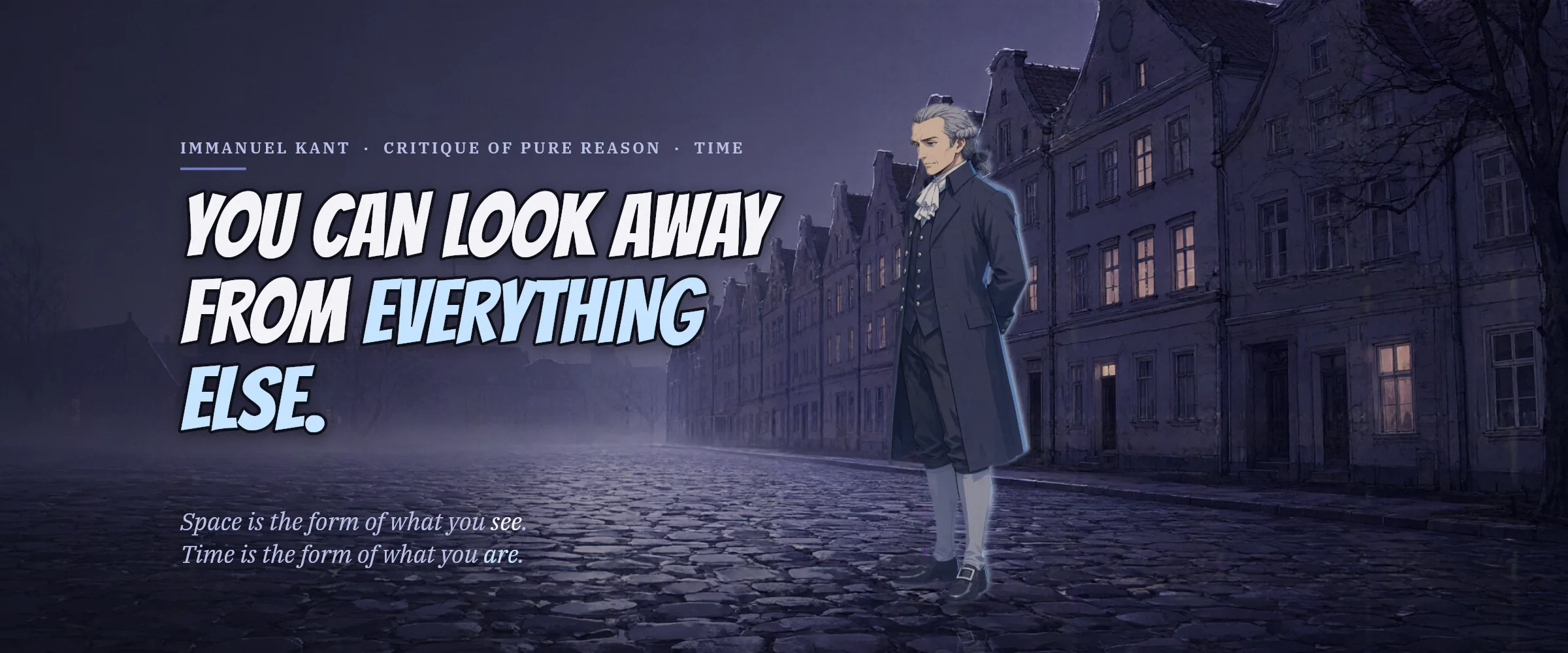
Empty out time. You can do that much — you can picture a stretch of it with nothing happening in it, and Kant says as much: we can quite well think time as void of appearances. Now try the other direction. Try to remove time and keep the rest.
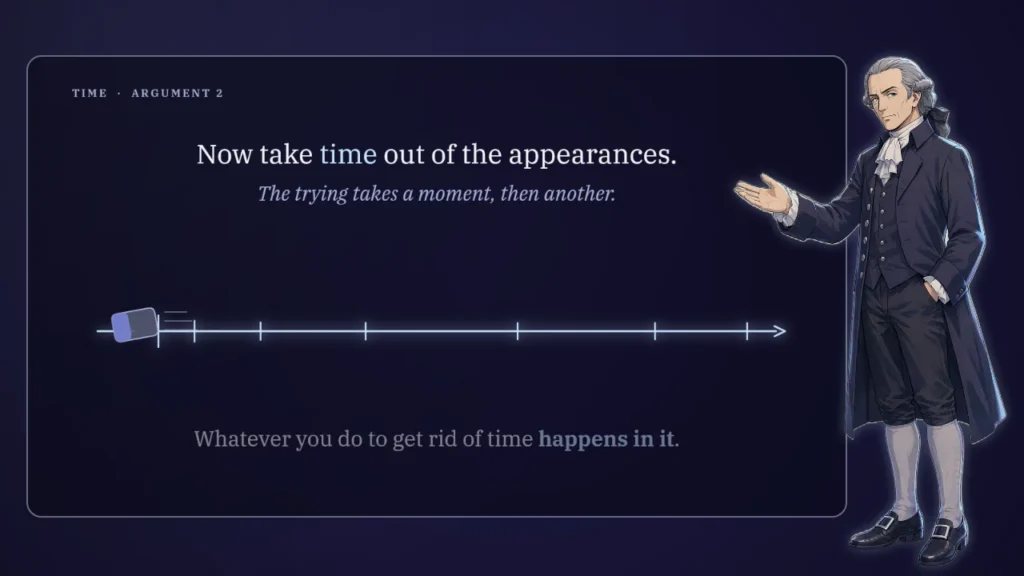
You cannot even get the attempt started. The trying takes a moment, then another. The picture you are forming forms in sequence. Whatever you do to get rid of time happens in it.
Last time we ran the same experiment on an empty room. Take away the furniture, the building, the sky, every object in the universe — and the space stubbornly refuses to leave with them. Kant took that small failure of imagination as evidence, and concluded that space is something you bring rather than something you find. Here is the second of the two forms. Not the one you see things in. The one you live in — and the experiment fails harder here, because with time you cannot even get outside far enough to try.
And notice why that is not just a psychological quirk. Suppose you wanted to argue that we learn about time from watching things happen — first this, then that, and eventually we abstract out the idea of “after”. Kant’s answer is one sentence long and it is very hard to get round: you could not have noticed that one thing came after another unless you already had time to notice it in. Succession is not something perception hands you. It is the shape perception already has.
Which is the claim, stated flatly before we have earned it: time is not something you are moving through. It is the form your own inner life has. The rest of this piece is the argument.
For space, Kant’s big move was geometry: it works, it could not have come from experience, therefore space is something in you. For time he had a shorter route, and he says so almost apologetically — he had already tucked the important part into the earlier arguments, so here he just adds one more thing.
The one more thing is change.
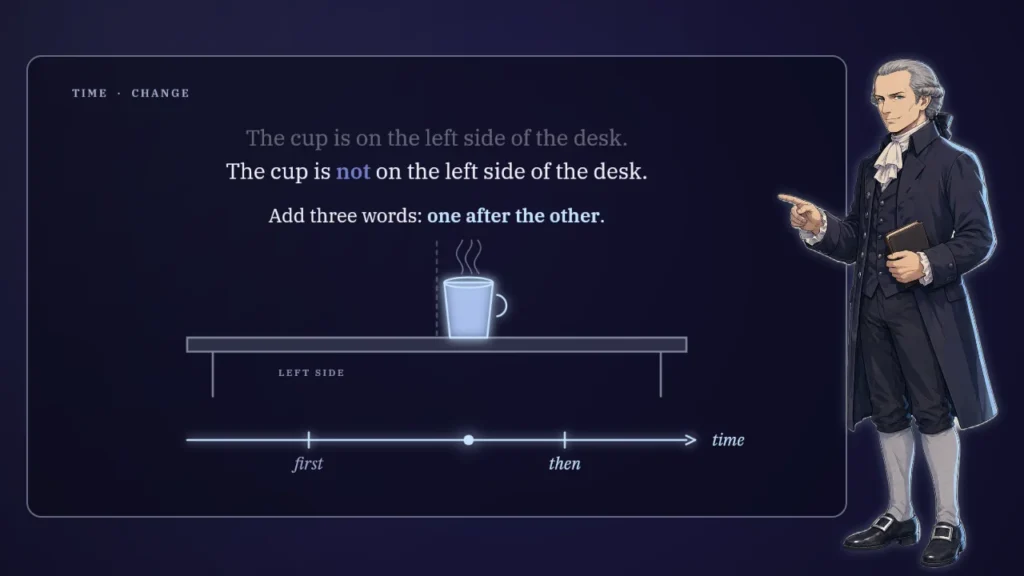
Put a cup on the left side of the desk. Now move it to the right. Something perfectly ordinary has happened, and if you write it down carefully it is a flat contradiction:
Example: The Cup That Is and Is Not There
The cup is on the left side of the desk.
The cup is not on the left side of the desk.
Both are true of the same cup. Held together, that is not a difficult claim — it is a broken one. No amount of thinking about cups, desks or places will make it come out right, because there is nothing in any of those ideas that lets a thing both have and lack the same property.
Add three words and it is not merely fixed, it is obvious: one after the other.
That is the whole argument, and it is worth seeing how little it needs. Kant is not saying time makes contradictions legal. He is saying that succession is the only thing in the world that dissolves this one — and succession is not something you can get from a definition. You cannot derive “and then” from any concept whatsoever. You have to already have the before-and-after, laid out, available, in advance.
So every time anything moves — every dropped glass, every turned page, the whole of physics — you are relying on something you never learned. Kant’s phrase for it is the general doctrine of motion, and his point is that it only makes sense because time was already there to make it make sense.
A note for anyone reading the original columns: this section does not exist in the 1781 edition. Kant wrote it six years later. The German A panel goes straight from the last numbered argument to the conclusions, and nothing is missing — there was simply nothing there yet.
Here is where Kant says what time is, and the answer is not “a dimension” or “a measure”. Time is the form of inner sense: the shape your own inner life has when you look at it.
Which sounds abstract until you notice the problem it creates, and how Kant handles it.
Space gives you shapes. Point at something and you are pointing at a figure with edges, a size, a position. Inner sense gives you nothing of the kind. Your thoughts have no outline. Your mood is not a particular shape. There is nothing there to look at — and yet there is obviously an order to it, one thing after another, all day.
So we cheat. Kant says we make up for the missing shape by borrowing one: we picture time as a line running off to infinity, a single row, one dimension only. You have done this. Everyone has: the timeline, the calendar strip, the bar that fills as the song plays. We reason about time by reasoning about that line.
And then he adds the sentence that makes the whole analogy honest:
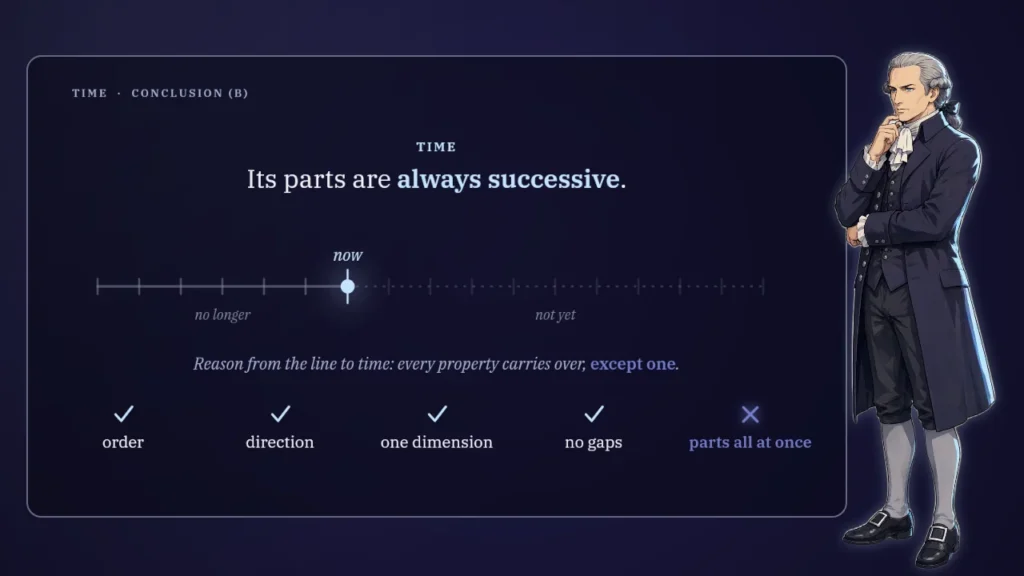
“…we reason from the properties of this line to all the properties of time, with this one exception, that while the parts of the line are simultaneous the parts of time are always successive.”
Read that twice. The line gives us everything — order, direction, one dimension, no gaps — except the single feature that makes a line a line. A line’s parts are all there at once. That is what lets you see it. Time’s parts are never all there at once; that is what makes it time. The picture works precisely because it gets the essential thing wrong.
Kant even turns the borrowing into evidence. If we have to draw time to think about it, and if every relation in time can be laid out as a relation in an outer picture, then the representation of time is not a general idea at all. Ideas do not need diagrams. Time needs one, because it is something we have, not something we define.
The third conclusion is the one to take away, and it is where the two halves of the Aesthetic stop being symmetrical.
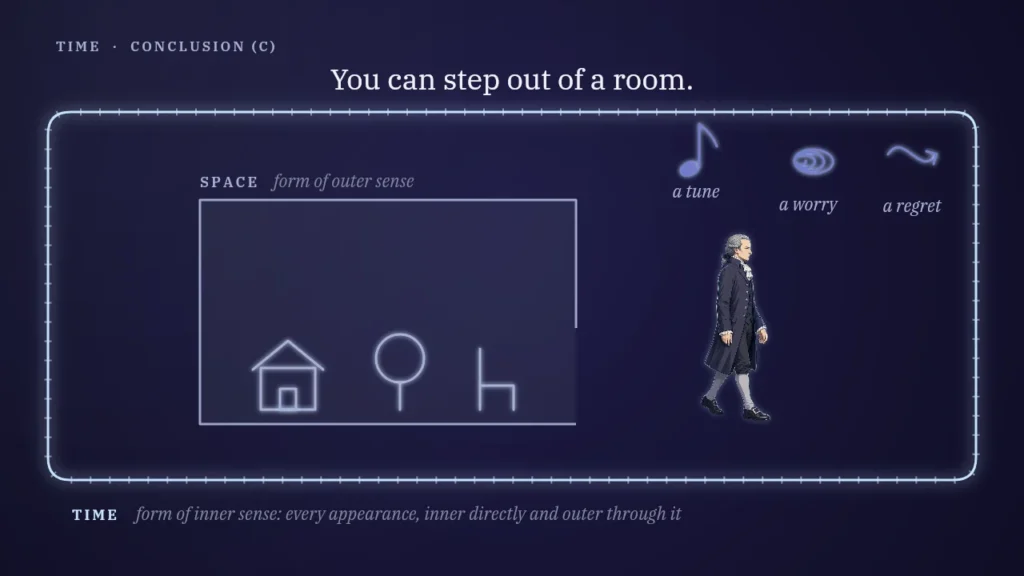
Space, Kant says, is the form of outer sense — and that is a real limit. Plenty of what you have today will not be anywhere in particular. A worry is not three feet to the left. A tune stuck in your head has no coordinates. Regret does not have a size. Space governs the world you look at, and the world you look at is only part of what there is.
Time has no such edge. Every representation you have — the ones about outer things and the ones about nothing outer at all — is, as Kant puts it, a determination of the mind, and so belongs to your inner state. And your inner state runs on time. So time gets everything: directly, all the inner life; and then, by the same route, everything outer too, because seeing a building is also something that happens in you.
“All appearances whatsoever, that is, all objects of the senses, are in time, and necessarily stand in time-relations.”
You can step out of a room. You cannot step out of a moment, and the reason is not that time is very large. It is that stepping out would itself take time. There is no vantage point, because the looking is made of the same stuff as the looked-at.
Then Kant says the thing that always sounds like a retraction and is not. Time is empirically real: nothing will ever be given to you that escapes it, not one object, not ever. And time is transcendentally ideal: subtract the conditions of your having any experience at all, ask what time is apart from any possible experiencer, and the answer is nothing. Not a slow river. Not an empty stage. Nothing.
He is careful, here as with space, to block the cheap version of this. It is not the point that time “feels faster when you’re busy”. Colours and tastes are subjective in that ordinary way, and Kant explicitly refuses the analogy — those are private variations on top of an object that is already assumed to be there. His claim sits one floor below: not that your reading of the clock is yours, but that there being a clock-order at all is.
Which lands somewhere oddly reassuring. Your having a life that happens in sequence — this, then that, and it cannot be undone — is not a fact about the universe that you happen to be caught in. It is the form of your own sensibility. And that is exactly why nothing that ever happens to you will fall outside it.
Next: Kant heard the objection. But changes are real — I can watch my own representations change, so time must be something more than a form of mine. §7 is his reply, and §8 is where he stops arguing for transcendental idealism and starts defending it.
Section II of the Transcendental Aesthetic in full: the five arguments that time is an a priori intuition, the four-sentence transcendental exposition Kant added in 1787, and the three conclusions that make time the condition of everything — not just of the world outside you. Where the 1781 and 1787 editions differ, both are mapped.
Post two took the first of Kant’s two pure forms of sensible intuition. This is the second, and it runs the same machinery over a different concept: a metaphysical exposition asking what kind of representation is this?, then a transcendental exposition asking what does having it make possible?, then the conclusions. Both terms were defined in post two; they are not redefined here.
One thing is different from the start. Section I opened with a paragraph of scene-setting — outer sense, inner sense, and Kant’s question What, then, are space and time? Section II has no preamble at all. The heading ends and argument 1 begins.
| # | Claim | The move | Establishes |
|---|---|---|---|
| 1 | Time is not an empirical concept drawn from any experience | To notice that two things are simultaneous, or that one followed the other, you must already have time. Neither coexistence nor succession would “come within our perception” otherwise. So time is not a result of experience — it is what lets experience have an order. | a priori |
| 2 | Time is a necessary representation underlying all intuitions | You can take the appearances out of time — think time as empty. You cannot take time out of the appearances. They can all vanish; it cannot be removed. | a priori |
| 3 | On this necessity rest the apodeictic axioms of time | Time has only one dimension. Different times are not simultaneous but successive. Experience could only ever report what has been observed so far; it cannot deliver “it must be so”. These principles are rules that make experience possible, and they “instruct us prior to experience, not by means of it” (our translation of belehren uns vor derselben und nicht durch dieselbe, as 1781 and 1787 both print it). The English panel reads “instruct us in regard to the experiences, not by means of them” because Kemp Smith followed the 3rd edition (1790), which has von for vor. | a priori |
| 4 | Time is no discursive concept but a pure form of sensible intuition | Different times are not instances of time — they are parts of one and the same time. A representation that can be given only through a single object is an intuition. And “different times cannot be simultaneous” is a synthetic proposition, so it cannot be squeezed out of concepts. | intuition |
| 5 | The infinitude of time | Every determinate stretch of time is a limitation of one single underlying time — so the original representation must be given as unlimited. Concepts contain only partial representations; a whole that is given before its parts cannot be one. | intuition |
Three arguments for a priori, two for intuition. The division of labour is the same as in the Space section, which had two and two.
Read argument 3 again and notice what it actually is: a claim that there exists a body of necessary, non-empirical knowledge about time. That is exactly the kind of fact a transcendental exposition is supposed to explain — and Kant put it here, inside the metaphysical exposition, rather than saving it. He admits this in §5, and it is why §5 is four sentences long. Hold on to that until the next section.
For space, §3 was a page and a whole separate science: geometry works, therefore space must be a pure intuition. For time, Kant opens by declining to do that again.
“I may here refer to No. 3, where, for the sake of brevity, I have placed under the title of metaphysical exposition what is properly transcendental.”
The transcendental work is already done — the axioms of time are the synthetic a priori knowledge that needs explaining. So §5 adds exactly one new item, and it is a strange and powerful one: change.
%%{init: {
  "theme": "base",
  "themeCSS": ".marker { fill:#ccc !important; stroke:#ccc !important; } .edge-thickness-normal { stroke:#ccc !important; }",
  "themeVariables": {
    "fontFamily": "'IBM Plex Serif','IBM Plex Sans',serif",
    "textColor": "#e2e8f0",
    "lineColor": "#cccccc",
    "edgeLabelBackground": "transparent"
  }
}}%%
flowchart TD
  A["The concept of alteration
 how is it possible at all?"] --> D["To alter is to combine
 CONTRADICTORY predicates
 in one and the same object"]
  D --> X["being at a place
 AND
 not-being at that same place"]
  X -->|"as a bare combination
 this is a flat contradiction"| N["no concept, no matter what it might be,
 could render comprehensible
 the possibility of an alteration"]
  X -->|"but put the two
 ONE AFTER THE OTHER"| T["and they can both be met with
 in the same thing"]
  T --> I["Succession is not given by a concept.
 It is given only in the
 A PRIORI INTUITION OF TIME"]
  N --> I
  I --> C["Therefore the concept of time explains
 the possibility of the general
 doctrine of motion"]
The diagram starts where §5 starts: from the concept of alteration and its possibility. That alteration is real is not a premise of §5. It is the premise of the objection Kant answers in §7: “Alterations are real, this being proved by change of our own representations” (Kemp Smith; Veränderungen sind wirklich, A36–37/B53). Kant grants it there, and turns it round: time is indeed something real, namely the real form of inner intuition.
The pivot is the phrase nach einander — one after the other. Kant’s point is not that time makes contradictions acceptable; it is that succession is the only thing that dissolves this one, and succession is not something a concept can supply. Motion — alteration of place — is then simply the most conspicuous case, which is why the doctrine of motion falls out of it.
This section is absent from the 1781 edition — it has a B pagination (B48–B49) and no A pagination at all, because there is no A text to paginate, and in the L0 panels the German A column runs from argument 5 straight into the conclusions. Be precise about what is new, though. The section is new, the heading is new, and the alteration-and-motion argument is new; the word Veränderung does not appear anywhere in A’s Time section before the Erläuterung. But the material Kant points back to — argument 3, the axioms of time, the part he calls “properly transcendental” — was already in A in 1781, word for word. B did not add the transcendental content here. It gave it a name and one more case.
Two candidates are on the table, and (a) eliminates both: time as something self-subsistent, and time as something inhering in things as an objective determination or order.
Interpretation, not Kant’s text: Kant names no one in (a). Reading the first candidate as Newton’s absolute time (which would go on running in an empty universe) and the second as Leibniz’s relational time is the commentators’ gloss, and ours. The nearest Kant comes is §7, which gives the first view to “mathematical students of nature” and the second to “certain metaphysical students of nature” (Kemp Smith, A39–40/B56).
P1. If time were self-subsistent, it would be “something which would be actual and yet not an actual object” — real without being anything.
P2. If time were a determination or order inhering in things, it could not precede those things as their condition, nor be known and intuited a priori through synthetic propositions.
P3 (implicit; our reconstruction). But it is so known. Kant does not state this step. (a) says only that “this last is quite possible if time is nothing but the subjective condition” of intuition (Kemp Smith). That synthetic a priori knowledge of time actually exists is supplied by the axioms of argument 3, which §5 points back to.
∴ Time is nothing but the subjective condition under which all intuitions can take place in us. And on that account — and only on that account — the form of inner intuition can be represented prior to the objects, that is, a priori.
P2 is the same hinge that did the work in Space’s conclusion (a): anything you can have before the object cannot have come from the object. Kant reuses it deliberately; the two sections are built to the same plan.
Inner sense (innerer Sinn) — the way the mind intuits itself and its own inner state. Not a sixth sense pointed at the world, and not introspection as a hobby: it is the bare fact that your representations show up for you in an order. Where outer sense delivers objects outside you, inner sense delivers you, over time.
Kant’s argument here is short and negative. Time is no determination of outer appearances: it belongs to no shape, no position, nothing you could point at. What it does determine is the relation of representations in our inner state. Therefore that is what it is the form of.
Then comes one of the most-quoted moves in the book, and the reason for it is a problem: inner intuition gives no shape. There is nothing to draw. So, Kant says, we make up for the lack by borrowing a shape from outer intuition — we represent the time-series as a line going on to infinity, and read time’s properties off the line’s.
He is careful to say where the loan stops:
Every property of the line transfers to time except the single one that makes a line a line — that its parts exist all at once. And Kant draws a conclusion from the loan itself, not just from what it delivers: the fact that all of time’s relations can be expressed in an outer intuition is further evidence that the representation of time is itself an intuition and not a concept. A concept would not need a picture.
This is the conclusion with no counterpart in Section I, and it is why time, not space, carries the rest of the Critique.
P1. Space, as the pure form of all outer intuition, is restricted as an a priori condition to outer appearances only.
P2. But all representations — whether or not they have outer things for their object — belong, in themselves, as determinations of the mind, to the inner state.
P3. The inner state stands under the formal condition of inner intuition, which is time.
∴ Time is an a priori condition of all appearance whatsoever — the immediate condition of inner appearances, and by exactly that route the mediate condition of outer ones too.
| Space | Time | |
|---|---|---|
| Form of | outer sense | inner sense |
| Applies to | outer appearances | all appearances |
| How | directly, and only there | directly to inner; mediately to outer, because every perception of an outer thing is also a state of your mind |
| Anything it misses? | yes — a thought, a mood, a decision is nowhere in particular | no — there is nothing in you that is not in time |
The asymmetry is Kant’s own, in his own words: space “serves as the a priori condition only of outer appearances” — ist als Bedingung a priori bloß auf äußere Erscheinungen eingeschränkt — whereas “all appearances whatsoever, that is, all objects of the senses, are in time, and necessarily stand in time-relations.” (Both in Kemp Smith’s English.) The shorthand is mine, not his: space has an outside; time has none.
This is the claim the Analytic will cash — a forward reference, not part of §6. When Kant comes to show how the pure concepts of the understanding can apply to objects at all, the bridge he builds is the schema, and a schema is defined there as a transcendental determination of time (A138–139/B177–178). It has to be time. Time is the only form that reaches everything.
The section closes with the same pairing post two met for space, and Kant is explicit that the reader should look back: the closing sentence sends you to “what has been said at the close of the preceding section” (Kemp Smith; Kant: die obige Anmerkung des ersteren Abschnitts), which is the last paragraph of the Space L0 panels.
| Claim | What it rules out | |
|---|---|---|
| Empirical reality | Time is objectively valid for every object that can ever be given to our senses. Since our intuition is always sensible, no object can ever be given in experience that does not fall under it. | That time is a dream, an illusion, or a private distortion |
| Transcendental ideality | Abstract from the subjective conditions of sensible intuition and time is nothing at all — it can be ascribed to things in themselves neither as subsisting in them nor as inhering in them. | That time is a river the world floats in whether or not anyone is there |
And, as with space, Kant blocks the obvious cheap reading in advance. This ideality must not be illustrated by analogy with sensation — with the way a colour or a taste is “subjective”. Those analogies assume the appearance itself has objective reality and only its sensible predicates are private. Kant’s claim is one level down from that, and he points the reader back to the same warning in Section I.
Post two had to warn that the editions genuinely diverge in Section I: five numbered arguments in A against four in B, and no §3 at all in 1781. Arriving here expecting more of the same would be a mistake.
| A (1781) | B (1787) |
|---|---|
| five numbered arguments | the same five, in the same order |
| no section numbers anywhere in the Aesthetic | numbered §4, §5, §6 |
| — nothing here — | §5, the transcendental exposition: entirely new |
| Schlüsse a) b) c) | the same three, in the same order |
| closes on empirical reality and transcendental ideality | the same close |
Inside the five arguments there is exactly one rewrite worth reading. In argument 5 the 1781 parenthesis explains that a whole cannot be given through concepts because “in their case the partial representations come first” (denn da gehen die Theilvorstellungen vorher; Kemp Smith translates the A reading only in a footnote, so it is not in the English panel); 1787 replaces it with “since they contain only partial representations” (denn die enthalten nur Theilvorstellungen). An order claim becomes a containment claim. The Space section did much more than this: there B rewrote the infinity argument wholesale, and A’s argument 5 became a new argument 4, built on what a concept contains under itself against what space contains in itself. Here B changes one parenthesis, in the same direction.
The other changes are small, but not all of them are spelling. Two are grammatical: in the same sentence of argument 5, es muß ihre unmittelbare Anschauung zum Grunde liegen becomes es muß ihnen unmittelbare Anschauung zum Grunde liegen, and in the ideality paragraph diese aber die eigentliche Bedingung ist becomes dieser aber …. One is a word change: A’s Dagegen streiten wir der Zeit allen Anspruch auf absolute Realität becomes bestreiten, with the same sense (“we deny”). The rest is emphasis, punctuation and spelling: blos → bloß, so fern → sofern.
So the six years between the editions produced, in this section, one new paragraph and one tightened parenthesis. Kant did not think Section II needed rescuing.
1) Die Zeit ist kein empirischer Begriff, der irgend von einer Erfahrungabgezogen worden. Denn das Zugleichsein oder Aufeinanderfolgenwürde selbst nicht in die Wahrnehmung kommen, wenn die Vorstellungder Zeit nicht a priori zum Grunde läge. Nur unter deren Voraussetzungkann man sich vorstellen: daß einiges zu einer und derselben Zeit (zugleich)oder in verschiedenen Zeiten (nach einander) sei.
2) Die Zeit ist eine nothwendige Vorstellung, die allen Anschauungenzum Grunde liegt. Man kann in Ansehung der Erscheinungen überhauptdie Zeit selbst nicht aufheben, ob man zwar ganz wohl die Erscheinungenaus der Zeit wegnehmen kann. Die Zeit ist also a priori gegeben. In ihrallein ist alle Wirklichkeit der Erscheinungen möglich. Diese können insgesammtwegfallen, aber sie selbst (als die allgemeine Bedingung ihrerMöglichkeit) kann nicht aufgehoben werden.
3) Auf diese Nothwendigkeit a priori gründet sich auch die Möglichkeitapodiktischer Grundsätze von den Verhältnissen der Zeit oder Axiomenvon der Zeit überhaupt. Sie hat nur eine Dimension: verschiedene Zeitensind nicht zugleich, sondern nach einander (so wie verschiedene Räumenicht nach einander, sondern zugleich sind). Diese Grundsätze können ausder Erfahrung nicht gezogen werden, denn diese würde weder strengeAllgemeinheit, noch apodiktische Gewißheit geben. Wir würden nur sagenkönnen: so lehrt es die gemeine Wahrnehmung, nicht aber: so muß es sichverhalten. Diese Grundsätze gelten als Regeln, unter denen überhauptErfahrungen möglich sind, und belehren uns vor derselben und nicht durchdieselbe.
4) Die Zeit ist kein discursiver oder, wie man ihn nennt, allgemeinerBegriff, sondern eine reine Form der sinnlichen Anschauung. VerschiedeneZeiten sind nur Theile eben derselben Zeit. Die Vorstellung, die nurdurch einen einzigen Gegenstand gegeben werden kann, ist aber Anschauung.Auch würde sich der Satz, daß verschiedene Zeiten nicht zugleich seinkönnen, aus einem allgemeinen Begriff nicht herleiten lassen. Der Satzist synthetisch und kann aus Begriffen allein nicht entspringen. Er ist alsoin der Anschauung und Vorstellung der Zeit unmittelbar enthalten.
5) Die Unendlichkeit der Zeit bedeutet nichts weiter, als daß allebestimmte Größe der Zeit nur durch Einschränkungen einer einigen zumGrunde liegenden Zeit möglich sei. Daher muß die ursprüngliche VorstellungZeit als uneingeschränkt gegeben sein. Wovon aber die Theileselbst und jede Größe eines Gegenstandes nur durch Einschränkung bestimmtvorgestellt werden können, da muß die ganze Vorstellung nichtdurch Begriffe gegeben sein (denn da gehen die Theilvorstellungen vorher),sondern es muß ihre unmittelbare Anschauung zum Grunde liegen.
a) Die Zeit ist nicht etwas, was für sich selbst bestände, oder denDingen als objective Bestimmung anhinge, mithin übrig bliebe, wennman von allen subjectiven Bedingungen der Anschauung derselben abstrahirt:denn im ersten Fall würde sie etwas sein, was ohne wirklichenGegenstand dennoch wirklich wäre. Was aber das zweite betrifft, so könntesie als eine den Dingen selbst anhängende Bestimmung oder Ordnungnicht vor den Gegenständen als ihre Bedingung vorhergehen und a prioridurch synthetische Sätze erkannt und angeschaut werden. Dieses letzterefindet dagegen sehr wohl statt, wenn die Zeit nichts als die subjective Bedingungist, unter der alle Anschauungen in uns statt finden können.Denn da kann diese Form der innern Anschauung vor den Gegenständen,mithin a priori vorgestellt werden.
b) Die Zeit ist nichts anders, als die Form des innern Sinnes, d. i.des Anschauens unserer selbst und unsers innern Zustandes. Denn dieZeit kann keine Bestimmung äußerer Erscheinungen sein: sie gehört wederzu einer Gestalt oder Lage etc.; dagegen bestimmt sie das Verhältniß derVorstellungen in unserm innern Zustande. Und eben weil diese innreAnschauung keine Gestalt giebt, suchen wir auch diesen Mangel durchAnalogien zu ersetzen und stellen die Zeitfolge durch eine ins unendlichefortgehende Linie vor, in welcher das Mannigfaltige eine Reihe ausmacht,die nur von einer Dimension ist, und schließen aus den Eigenschaftendieser Linie auf alle Eigenschaften der Zeit außer dem einigen,daß die Theile der erstern zugleich, die der letztern aber jederzeit nacheinander sind. Hieraus erhellt auch, daß die Vorstellung der Zeit selbstAnschauung sei, weil alle ihre Verhältnisse sich an einer äußern Anschauungausdrücken lassen.
c) Die Zeit ist die formale Bedingung a priori aller Erscheinungenüberhaupt. Der Raum als die reine Form aller äußeren Anschauung istals Bedingung a priori blos auf äußere Erscheinungen eingeschränkt.Dagegen weil alle Vorstellungen, sie mögen nun äußere Dinge zum Gegenstandehaben oder nicht, doch an sich selbst als Bestimmungen des Gemüthszum innern Zustande gehören; dieser innere Zustand aber unter der formalenBedingung der innern Anschauung, mithin der Zeit gehört: so istdie Zeit eine Bedingung a priori von aller Erscheinung überhaupt undzwar die unmittelbare Bedingung der inneren (unserer Seelen) und ebendadurch mittelbar auch der äußern Erscheinungen. Wenn ich a priorisagen kann: alle äußere Erscheinungen sind im Raume und nach den Verhältnissendes Raumes a priori bestimmt, so kann ich aus dem Principdes innern Sinnes ganz allgemein sagen: alle Erscheinungen überhaupt,d. i. alle Gegenstände der Sinne, sind in der Zeit und stehen nothwendigerWeise in Verhältnissen der Zeit.Wenn wir von unsrer Art, uns selbst innerlich anzuschauen und vermittelstdieser Anschauung auch alle äußere Anschauungen in der Vorstellungskraftzu befassen, abstrahiren und mithin die Gegenstände nehmen,so wie sie an sich selbst sein mögen, so ist die Zeit Nichts. Sie ist nur vonobjectiver Gültigkeit in Ansehung der Erscheinungen, weil dieses schonDinge sind, die wir als Gegenstände unsrer Sinne annehmen; abersie ist nicht mehr objectiv, wenn man von der Sinnlichkeit unsrer Anschauung,mithin derjenigen Vorstellungsart, welche uns eigenthümlichist, abstrahirt und von Dingen überhaupt redet. Die Zeit ist alsolediglich eine subjective Bedingung unserer (menschlichen) Anschauung(welche jederzeit sinnlich ist, d. i. so fern wir von Gegenständen afficirtwerden) und an sich, außer dem Subjecte, nichts. Nichts desto wenigerist sie in Ansehung aller Erscheinungen, mithin auch aller Dinge, die unsin der Erfahrung vorkommen können, nothwendiger Weise objectiv. Wirkönnen nicht sagen: alle Dinge sind in der Zeit, weil bei dem Begriff derDinge überhaupt von aller Art der Anschauung derselben abstrahirt wird,diese aber die eigentliche Bedingung ist, unter der die Zeit in die Vorstellungder Gegenstände gehört. Wird nun die Bedingung zum Begriffehinzugefügt, und es heißt: alle Dinge als Erscheinungen (Gegenständeder sinnlichen Anschauung) sind in der Zeit, so hat der Grundsatz seinegute objective Richtigkeit und Allgemeinheit a priori.Unsere Behauptungen lehren demnach empirische Realität derZeit, d. i. objective Gültigkeit in Ansehung aller Gegenstände, die jemalsunsern Sinnen gegeben werden mögen. Und da unsere Anschauung jederzeitsinnlich ist, so kann uns in der Erfahrung niemals ein Gegenstandgegeben werden, der nicht unter die Bedingung der Zeit gehörte. Dagegenstreiten wir der Zeit allen Anspruch auf absolute Realität, da sienämlich, auch ohne auf die Form unserer sinnlichen Anschauung Rücksichtzu nehmen, schlechthin den Dingen als Bedingung oder Eigenschaft anhinge.Solche Eigenschaften, die den Dingen an sich zukommen, könnenuns durch die Sinne auch niemals gegeben werden. Hierin besteht alsodie transscendentale Idealität der Zeit, nach welcher sie, wenn manvon den subjectiven Bedingungen der sinnlichen Anschauung abstrahirt,gar nichts ist und den Gegenständen an sich selbst (ohne ihr Verhältnißauf unsere Anschauung) weder subsistirend noch inhärirend beigezähltwerden kann. Doch ist diese Idealität eben so wenig wie die des Raumesmit den Subreptionen der Empfindungen in Vergleichung zu stellen,weil man doch dabei von der Erscheinung selbst, der diese Prädicate inhäriren,voraussetzt, daß sie objective Realität habe, die hier gänzlich wegfällt,außer so fern sie blos empirisch ist, d. i. den Gegenstand selbst blosals Erscheinung ansieht: wovon die obige Anmerkung des ersteren Abschnittsnachzusehen ist.
Die Zeit ist 1) kein empirischer Begriff, der irgend von einer Erfahrungabgezogen worden. Denn das Zugleichsein oder Aufeinanderfolgenwürde selbst nicht in die Wahrnehmung kommen, wenn die Vorstellungder Zeit nicht a priori zum Grunde läge. Nur unter deren Voraussetzungkann man sich vorstellen: daß einiges zu einer und derselben Zeit(zugleich) oder in verschiedenen Zeiten (nach einander) sei.
2) Die Zeit ist eine nothwendige Vorstellung, die allen Anschauungenzum Grunde liegt. Man kann in Ansehung der Erscheinungen überhauptdie Zeit selbst nicht aufheben, ob man zwar ganz wohl die Erscheinungenaus der Zeit wegnehmen kann. Die Zeit ist also a priori gegeben. Inihr allein ist alle Wirklichkeit der Erscheinungen möglich. Diese könneninsgesammt wegfallen, aber sie selbst (als die allgemeine Bedingung ihrerMöglichkeit) kann nicht aufgehoben werden.
3) Auf diese Nothwendigkeit a priori gründet sich auch die Möglichkeitapodiktischer Grundsätze von den Verhältnissen der Zeit oder Axiomenvon der Zeit überhaupt. Sie hat nur Eine Dimension: verschiedene Zeitensind nicht zugleich, sondern nach einander (so wie verschiedene Räumenicht nach einander, sondern zugleich sind). Diese Grundsätze können ausder Erfahrung nicht gezogen werden, denn diese würde weder Strenge Allgemeinheit,noch apodiktische Gewißheit geben. Wir würden nur sagenkönnen: so lehrt es die gemeine Wahrnehmung; nicht aber: so muß es sichverhalten. Diese Grundsätze gelten als Regeln, unter denen überhauptErfahrungen möglich sind, und belehren uns vor derselben und nicht durchdieselbe.
4) Die Zeit ist kein discursiver oder, wie man ihn nennt, allgemeinerBegriff, sondern eine reine Form der sinnlichen Anschauung. VerschiedeneZeiten sind nur Theile eben derselben Zeit. Die Vorstellung, die nurdurch einen einzigen Gegenstand gegeben werden kann, ist aber Anschauung.Auch würde sich der Satz, daß verschiedene Zeiten nicht zugleichsein können, aus einem allgemeinen Begriff nicht herleiten lassen. DerSatz ist synthetisch und kann aus Begriffen allein nicht entspringen. Erist also in der Anschauung und Vorstellung der Zeit unmittelbar enthalten.
5) Die Unendlichkeit der Zeit bedeutet nichts weiter, als daß alle bestimmteGröße der Zeit nur durch Einschränkungen einer einigen zumGrunde liegenden Zeit möglich sei. Daher muß die ursprüngliche VorstellungZeit als uneingeschränkt gegeben sein. Wovon aber die Theileselbst und jede Größe eines Gegenstandes nur durch Einschränkung bestimmtvorgestellt werden können, da muß die ganze Vorstellung nichtdurch Begriffe gegeben sein (denn die enthalten nur Theilvorstellungen),sondern es muß ihnen unmittelbare Anschauung zum Grunde liegen.
Ich kann mich deshalb auf Nr. 3 berufen, wo ich, um kurz zu sein,das, was eigentlich transscendental ist, unter die Artikel der metaphysischenErörterung gesetzt habe. Hier füge ich noch hinzu, daß der Begriffder Veränderung und mit ihm der Begriff der Bewegung (als Veränderungdes Orts) nur durch und in der Zeitvorstellung möglich ist; daß,wenn diese Vorstellung nicht Anschauung (innere) a priori wäre, kein Begriff,welcher es auch sei, die Möglichkeit einer Veränderung, d. i. einerVerbindung contradictorisch entgegengesetzter Prädicate (z. B. das Seinan einem Orte und das Nichtsein eben desselben Dinges an demselbenOrte) in einem und demselben Objecte, begreiflich machen könnte. Nurin der Zeit können beide contradictorisch=entgegengesetzte Bestimmungenin einem Dinge, nämlich nach einander, anzutreffen sein. Also erklärtunser Zeitbegriff die Möglichkeit so vieler synthetischer Erkenntniß a priorials die allgemeine Bewegungslehre, die nicht wenig fruchtbar ist, darlegt.
a) Die Zeit ist nicht etwas, was für sich selbst bestände, oder denDingen als objective Bestimmung anhinge, mithin übrig bliebe, wennman von allen subjectiven Bedingungen der Anschauung derselben abstrahirt:denn im ersten Fall würde sie etwas sein, was ohne wirklichen Gegenstanddennoch wirklich wäre. Was aber das zweite betrifft, so könnte sieals eine den Dingen selbst anhängende Bestimmung oder Ordnung nichtvor den Gegenständen als ihre Bedingung vorhergehen und a priori durchsynthetische Sätze erkannt und angeschaut werden. Dieses letztere findetdagegen sehr wohl statt, wenn die Zeit nichts als die subjective Bedingungist, unter der alle Anschauungen in uns stattfinden können. Denn da kanndiese Form der innern Anschauung vor den Gegenständen, mithin a priorivorgestellt werden.
b) Die Zeit ist nichts anders als die Form des innern Sinnes, d. i.des Anschauens unserer selbst und unseres innern Zustandes. Denn dieZeit kann keine Bestimmung äußerer Erscheinungen sein: sie gehört wederzu einer Gestalt, oder Lage etc.; dagegen bestimmt sie das Verhältniß derVorstellungen in unserm innern Zustande. Und eben weil diese innreAnschauung keine Gestalt giebt, suchen wir auch diesen Mangel durchAnalogien zu ersetzen und stellen die Zeitfolge durch eine ins Unendlichefortgehende Linie vor, in welcher das Mannigfaltige eine Reihe ausmacht,die nur von einer Dimension ist, und schließen aus den Eigenschaften dieserLinie auf alle Eigenschaften der Zeit außer dem einigen, daß dieTheile der erstern zugleich, die der letztern aber jederzeit nach einandersind. Hieraus erhellt auch, daß die Vorstellung der Zeit selbst Anschauungsei, weil alle ihre Verhältnisse sich an einer äußern Anschauung ausdrückenlassen.
c) Die Zeit ist die formale Bedingung a priori aller Erscheinungenüberhaupt. Der Raum als die reine Form aller äußeren Anschauungist als Bedingung a priori bloß auf äußere Erscheinungen eingeschränkt.Dagegen weil alle Vorstellungen, sie mögen nun äußere Dinge zum Gegenstandehaben oder nicht, doch an sich selbst, als Bestimmungen desGemüths, zum innern Zustande gehören; dieser innere Zustand aberunter der formalen Bedingung der innern Anschauung, mithin der Zeitgehört: so ist die Zeit eine Bedingung a priori von aller Erscheinung überhauptund zwar die unmittelbare Bedingung der inneren (unserer Seelen)und eben dadurch mittelbar auch der äußern Erscheinungen. Wenn icha priori sagen kann: alle äußere Erscheinungen sind im Raume und nachden Verhältnissen des Raumes a priori bestimmt, so kann ich aus demPrincip des innern Sinnes ganz allgemein sagen: alle Erscheinungenüberhaupt, d. i. alle Gegenstände der Sinne, sind in der Zeit und stehennothwendiger Weise in Verhältnissen der Zeit.Wenn wir von unsrer Art, uns selbst innerlich anzuschauen und vermittelstdieser Anschauung auch alle äußere Anschauungen in der Vorstellungskraftzu befassen, abstrahiren und mithin die Gegenstände nehmen,so wie sie an sich selbst sein mögen, so ist die Zeit nichts. Sie istnur von objectiver Gültigkeit in Ansehung der Erscheinungen, weil diesesschon Dinge sind, die wir als Gegenstände unsrer Sinne annehmen;aber sie ist nicht mehr objectiv, wenn man von der Sinnlichkeit unsrerAnschauung, mithin derjenigen Vorstellungsart, welche uns eigenthümlichist, abstrahirt und von Dingen überhaupt redet. Die Zeit ist alsolediglich eine subjective Bedingung unserer (menschlichen) Anschauung(welche jederzeit sinnlich ist, d. i. sofern wir von Gegenständen afficirtwerden) und an sich, außer dem Subjecte, nichts. Nichts desto wenigerist sie in Ansehung aller Erscheinungen, mithin auch aller Dinge, die unsin der Erfahrung vorkommen können, nothwendiger Weise objectiv. Wirkönnen nicht sagen: alle Dinge sind in der Zeit, weil bei dem Begriff derDinge überhaupt von aller Art der Anschauung derselben abstrahirt wird,dieser aber die eigentliche Bedingung ist, unter der die Zeit in die Vorstellungder Gegenstände gehört. Wird nun die Bedingung zum Begriffehinzugefügt, und es heißt: alle Dinge als Erscheinungen (Gegenständeder sinnlichen Anschauung) sind in der Zeit, so hat der Grundsatz seinegute objective Richtigkeit und Allgemeinheit a priori.Unsere Behauptungen lehren demnach empirische Realität derZeit, d. i. objective Gültigkeit in Ansehung aller Gegenstände, die jemalsunsern Sinnen gegeben werden mögen. Und da unsere Anschauung jederzeitsinnlich ist, so kann uns in der Erfahrung niemals ein Gegenstandgegeben werden, der nicht unter die Bedingung der Zeit gehörte. Dagegenbestreiten wir der Zeit allen Anspruch auf absolute Realität, da sienämlich, auch ohne auf die Form unserer sinnlichen Anschauung Rücksichtzu nehmen, schlechthin den Dingen als Bedingung oder Eigenschaft anhinge.Solche Eigenschaften, die den Dingen an sich zukommen, könnenuns durch die Sinne auch niemals gegeben werden. Hierin besteht alsodie transscendentale Idealität der Zeit, nach welcher sie, wenn manvon den subjectiven Bedingungen der sinnlichen Anschauung abstrahirt,gar nichts ist und den Gegenständen an sich selbst (ohne ihr Verhältnißauf unsere Anschauung) weder subsistirend noch inhärirend beigezähltwerden kann. Doch ist diese Idealität eben so wenig wie die des Raumesmit den Subreptionen der Empfindungen in Vergleichung zu stellen, weilman doch dabei von der Erscheinung selbst, der diese Prädicate inhäriren,voraussetzt, daß sie objective Realität habe, die hier gänzlich wegfällt,außer sofern sie bloß empirisch ist, d. i. den Gegenstand selbst bloß alsErscheinung ansieht: wovon die obige Anmerkung des ersteren Abschnittsnachzusehen ist.
1. Time is not an empirical concept that has beenderived from any experience. For neither coexistence norsuccession would ever come within our perception, if the repre-sentation of time were not presupposed as underlying thema priori. Only on the presupposition of time can we representto ourselves a number of things as existing at one and thesame time (simultaneously) or at different times (successively).
2. Time is a necessary representation that underlies allintuitions. We cannot, in respect of appearances in general,remove time itself, though we can quite well think time as voidof appearances. Time is, therefore, given a priori. In it aloneis actuality of appearances possible at all. Appearances may,one and all, vanish; but time (as the universal condition oftheir possibility) cannot itself be removed.
3. The possibility of apodeictic principles concerning therelations of time, or of axioms of time in general, is alsogrounded upon this a priori necessity. Time has only onedimension; different times are not simultaneous but successive(just as different spaces are not successive but simultaneous).These principles cannot be derived from experience, for ex-perience would give neither strict universality nor apodeicticcertainty. We should only be able to say that common experi-ence teaches us that it is so; not that it must be so. Theseprinciples are valid as rules under which alone experiences arepossible; and they instruct us in regard to the experiences,not by means of them.
4. Time is not a discursive, or what is called a general con-cept, but a pure form of sensible intuition. Different times arebut parts of one and the same time; and the representationwhich can be given only through a single object is intuition.Moreover, the proposition that different times cannot besimultaneous is not to be derived from a general concept.The proposition is synthetic, and cannot have its origin inconcepts alone. It is immediately contained in the intuitionand representation of time.
5. The infinitude of time signifies nothing more than thatevery determinate magnitude of time is possible only throughlimitations of one single time that underlies it. The originalrepresentation, time, must therefore be given as unlimited.But when an object is so given that its parts, and every quan-tity of it, can be determinately represented only throughlimitation, the whole representation cannot be given throughconcepts, since they contain only partial representations; onthe contrary, such concepts must themselves rest on immediateintuition.
I may here refer to No. 3, where, for the sake of brevity,I have placed under the title of metaphysical exposition whatis properly transcendental. Here I may add that the conceptof alteration, and with it the concept of motion, as alterationof place, is possible only through and in the representationof time; and that if this representation were not an a priori(inner) intuition, no concept, no matter what it might be, couldrender comprehensible the possibility of an alteration, that is,of a combination of contradictorily opposed predicates in oneand the same object, for instance, the being and the not-beingof one and the same thing in one and the same place. Only intime can two contradictorily opposed predicates meet in oneand the same object, namely, one after the other. Thus ourconcept of time explains the possibility of that body ofa priori synthetic knowledge which is exhibited in the general doc-trine of motion, and which is by no means unfruitful.
(a) Time is not something which exists of itself, or whichinheres in things as an objective determination, and it doesnot, therefore, remain when abstraction is made of all sub-jective conditions of its intuition. Were it self-subsistent, itwould be something which would be actual and yet not anactual object. Were it a determination or order inhering inthings themselves, it could not precede the objects as theircondition, and be known and intuited a priori by means ofsynthetic propositions. But this last is quite possible if timeis nothing but the subjective condition under which aloneintuition can take place in us. For that being so, this formof inner intuition can be represented prior to the objects, andtherefore a priori.
(b) Time is nothing but the form of inner sense, that is, ofthe intuition of ourselves and of our inner state. It cannot be adetermination of outer appearances; it has to do neither withshape nor position, but with the relation of representations inour inner state. And just because this inner intuition yields noshape, we endeavour to make up for this want by analogies.We represent the time-sequence by a line progressing to in-finity, in which the manifold constitutes a series of one dimen-sion only; and we reason from the properties of this line to allthe properties of time, with this one exception, that while theparts of the line are simultaneous the parts of time are alwayssuccessive. From this fact also, that all the relations of timeallow of being expressed in an outer intuition, it is evident thatthe representation is itself an intuition.
(c) Time is the formal a priori condition of all appearanceswhatsoever. Space, as the pure form of all outer intuition, is sofar limited; it serves as the a priori condition only of outerappearances. But since all representations, whether they havefor their objects outer things or not, belong, in themselves, asdeterminations of the mind, to our inner state; and since thisinner state stands under the formal condition of inner intui-tion, and so belongs to time, time is an a priori condition ofall appearance whatsoever. It is the immediate condition ofinner appearances (of our souls), and thereby the mediate con-dition of outer appearances. Just as I can say a priorithat all outer appearances are in space, and are determineda priori in conformity with the relations of space, I can also say, fromthe principle of inner sense, that all appearances whatsoever,that is, all objects of the senses, are in time, and necessarilystand in time-relations.If we abstract from our mode of inwardly intuiting our-selves — the mode of intuition in terms of which we likewisetake up into our faculty of representation all outer intuitions —and so take objects as they may be in themselves, then time isnothing. It has objective validity only in respect of appear-ances, these being things which we take as objects of oursenses. It is no longer objective, if we abstract from the sensi-bility of our intuition, that is, from that mode of representationwhich is peculiar to us, and speak of things in general. Time istherefore a purely subjective condition of our (human) intuition(which is always sensible, that is, so far as we are affected byobjects), and in itself, apart from the subject, is nothing.Nevertheless, in respect of all appearances, and therefore ofall the things which can enter into our experience, it is neces-sarily objective. We cannot say that all things are in time, be-cause in this concept of things in general we are abstractingfrom every mode of their intuition and therefore from thatcondition under which alone objects can be represented asbeing in time. If, however, the condition be added to theconcept, and we say that all things as appearances, that is, asobjects of sensible intuition, are in time, then the propositionhas legitimate objective validity and universality a priori.What we are maintaining is, therefore, the empirical realityof time, that is, its objective validity in respect of allobjects which allow of ever being given to our senses. Andsince our intuition is always sensible, no object can ever begiven to us in experience which does not conform to thecondition of time. On the other hand, we deny to time allclaim to absolute reality; that is to say, we deny that it belongsto things absolutely, as their condition or property, independ-ently of any reference to the form of our sensible intuition;properties that belong to things in themselves can never begiven to us through the senses. This, then, is what constitutesthe transcendental ideality of time. What we mean by thisphrase is that if we abstract from the subjective conditions ofsensible intuition, time is nothing, and cannot be ascribed tothe objects in themselves (apart from their relation to our in-tuition) in the way either of subsistence or of inherence. Thisideality, like that of space, must not, however, be illustratedby false analogies with sensation, because it is then assumedthat the appearance, in which the sensible predicates inhere,itself has objective reality. In the case of time, such objectivereality falls entirely away, save in so far as it is merely empir-ical, that is, save in so far as we regard the object itself merelyas appearance. On this subject, the reader may refer to whathas been said at the close of the preceding section.